Grand Rapids is moving towards a mediaopoly with WOODTV8’s parent company purchase of WZZM 13
The consolidation of media in the US has been a major issue since the 1980s, when Ben Bagdikian first wrote his book, The New Media Monopoly.
Since the early 1980s there are fewer and fewer media companies, which own more and more of of the entertainment and news media. Part of this is has been due to Congressional policies that have also deregulated the media industry, like the Telecom Act of 1996 that was signed into law under President Clinton. The Telecom Act essentially created radio monopolies that gave rise to the likes of Rush Limbaugh and other right wing shock jocks.
Another dynamic with the consolidation of media ownership has been with non-media corporations buying news outlets, along with members of the billionaire class like Jeff Bezos. Check out this source on media ownership consolidation and how few companies control most of the media, specifically the news media.
WOODTV8/Nexstar Buys WZZM 13
According to a recent Crain’s Grand Rapids Business article from March 20th:
The Federal Communications Commission (FCC) has granted approval for Nexstar Media Group Inc. to complete its $3.5 billion acquisition of TV station operator Tegna Inc., waiving an anti-consolidation rule that would’ve prevented the combination.
The parent company of WOODTV8 is Nextstar and before the purchase of WZZM 13, their Grand Rapids TV market was 43rd in the country. The purchase of channel 13 will likely propel their control of the GR TV market into the top 25 for Nexstar.
Certainly one of the consequences of the consolidation of media ownership will mean less diversity of how news is reported and what sources are used. There will also likely be a downsizing of staff at WZZM 13, which is often the consequence of media consolidation as well. In addition, since Nexstar owns a fair amount of TV news stations across the country it will allow them to share content from other markets, thus making more of the news look and sound homogenous.
Now, this is not to say that the Grand Rapids commercial TV market was great before the buyout. I have been methodically monitoring local news for the past 30 years and have written dozens of reports on topics such as local media coverage of elections, public safety, public education, war coverage, race and gender representation. My last two reports from 2024 (a 12 month study) and 2025 (a 6 month study) both show that there isn’t much difference between the three Grand Rapids commercial TV stations in terms of content and narrative.
One example from my 2024 report is:
Local TV news coverage of local elections was so bad that all of the 21 Kent County Commission races were not covered, nor were candidates for judicial races, the Sheriff, Prosecutor, Clerk, Treasurer, and Drain Commissioner. Local TV news never reported on campaign finances for all local election candidates.
Another example from my 2025 report is:
Despite the fact that the first half of 2025 was one of the hottest on record, in the 9 local news stories that deal with extreme heat and extreme weather, only once were the words “Climate Change” used.
I understand that people will point to Nexstar’s conservative politics, which certainly plays a role in their news output. However, most of the news monitoring I have done over the past few decades has shown that all local TV news favors systems of power, rarely questions dominant narratives and does more to entertain and pacify people than empower them.
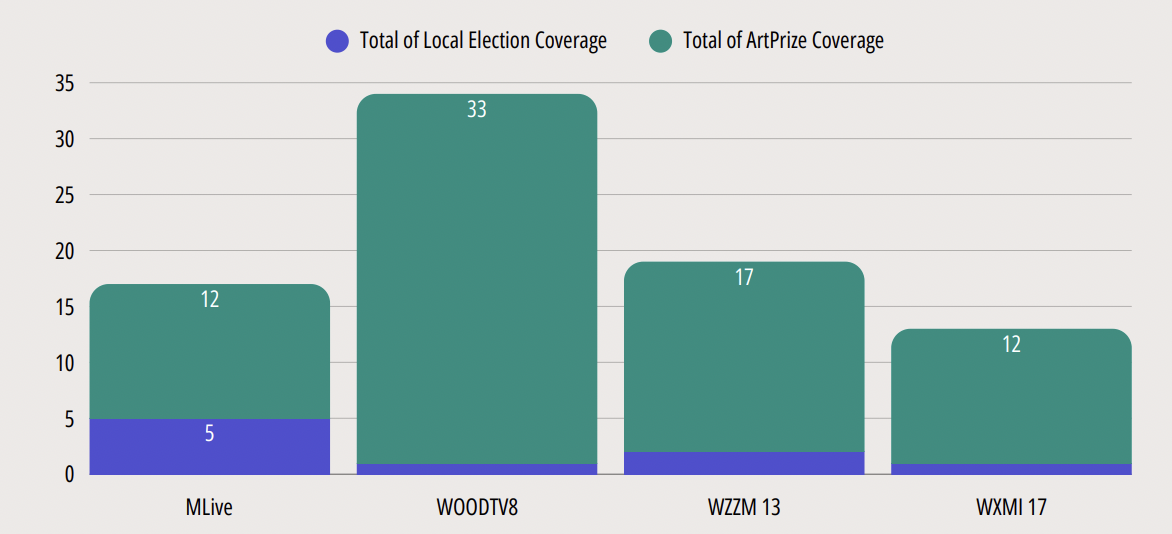
From my 2024 study, I also did a comparative study between local news coverage of local elections and contrasted that to the amount of stories on the annual event known as ArtPrize. I looked at the coverage from MLive, WOODTV8, WZZM13, and WXMI 17 between September 8 and September 29. During that 3-week period, I found the following. There were a total of nine stories done about local elections (by local elections, I mean elections happening for seats within Kent County). This graphic below shows the disparity in election coverage compared to stories about ArtPrize.
Therefore, it is unlikely that a major shift in local TV coverage with WOODTV8 and WZZM 13 will differ, it’s just that they will now share more resources and consolidate staffing in order to capture more of the market in West Michigan.
Here is a wonderful animated piece created for Saturday Night Live in the 1990s, which lays out the ways in which media consolidation is bad for the public.
 Grand Rapids Institute for Information Democracy
Comments are closed.