Community Historians Workshop addresses issues around public education, both politically and economically for GRPS in the 1990s and 2000s
The workshop began with a brief summary of the previous three sessions that took place in the Fall of 2025. I wrote about the one in September and November of last year. These workshops were initiated by Professor Kang who has been conducting interviews with people who were students or staff at the Grand Rapids Public Schools since the 1960s, interviews you can find here.
What follows is information that was presented at the beginning of the workshop, all of which provided participants with context before the conversation began. To see all the slides, go here.
The Introduction of School Choice in Michigan, known as Public Act 362 (1993), created Michigan’s charter school law. Then there was Proposal A (1994), asSchool funding law, which provided the financial mechanism to operate charter schools. Under this system, funding follows the student and since parents were now starting to send their kinds to non-public schools and non-neighborhood schools, school districts began to see their budgets reduce.
Next was presented a quote from the Mackinac Center for Public Policy.
“When the Michigan legislature enacted Public Act 362 of 1993, the law which sets up the guidelines for new “public school academies” or “charter schools”- it sent a powerful message to both the education establishment and parents desperate for new options. No longer would public schools be shielded from competition, insulated from accountability, and immunized against the choices of their customers.”
The Mackinac Center for Public Policy is the oldest right wing think tank in Michigan, which has received millions in funding over the decades from the DeVos family. The Mackinac Center crafts policies and influences state politicians to adopt them. This organization is also part of the larger far right policy group called the State Policy Network.
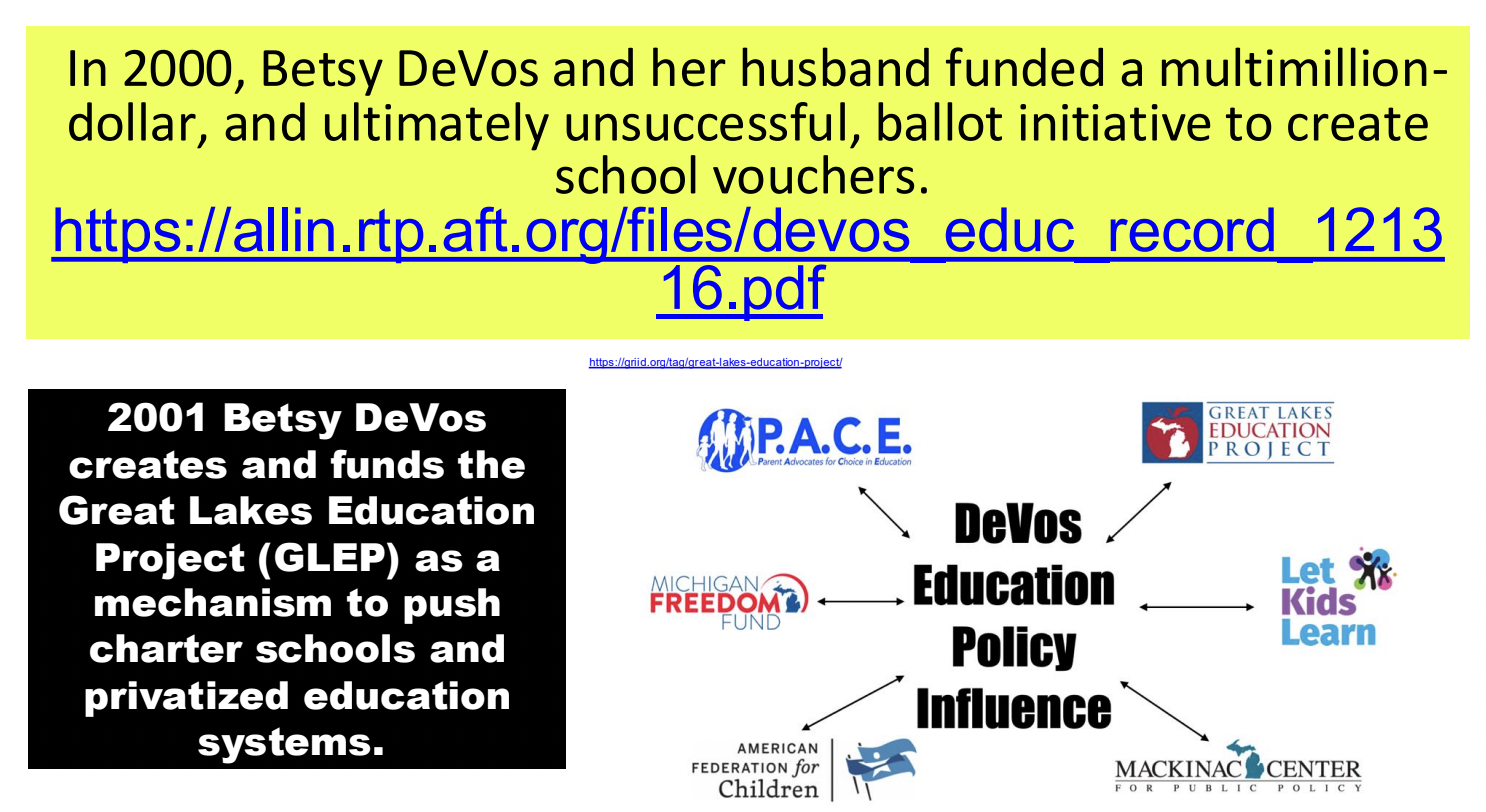
In 2000, Betsy DeVos and her husband funded a multimillion-dollar, and ultimately unsuccessful, ballot initiative to create school vouchers. DeVos had been pushing charter schools and the privatization of public education nationally, and thought she could get a voucher system passed in Michigan. It was roundly defeated. In response to this defeat, in 2001 Betsy DeVos created and funded the Great Lakes Education Project (GLEP) as a mechanism to push charter schools and to privatized education systems.
Here is a video of Dick DeVos speaking at the Heritage Foundation in 2002 about the importance of undermining public education. Pay attention to the language and the strategies he references in this brief clip.
All of this context is what led the Grand Rapids Public Schools to have to deal with less funds, to begin closing schools and restructuring the school system in Grand Rapids, which began under GRPS Superintendent Bert Bleke.
At this point the discussion began and many people shared their own experiences and observations about how the Charter School, reduced budgets and how GRPS restructuring impacted their life or the lives of their children.
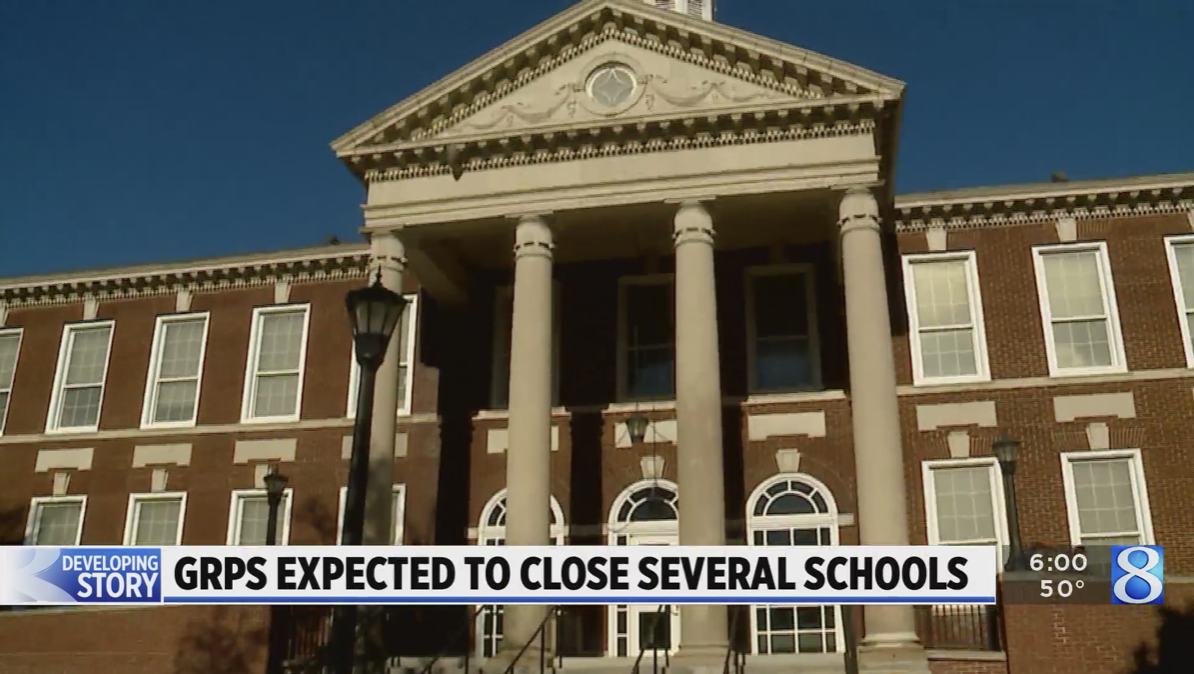
The GRPS had created several alternative schools or specialized schools, which made sense in some ways, but the restructuring has perpetuated racial and class segregation within GRPS schools. One example that was raised was the closing of the Native American School program at Lexington School.
Someone also raised the issue of white flight beginning in the 1960s and its longterm consequences. Another person noted that white families began moving back to Grand Rapids in the 1990s, resulting in some neighborhoods being gentrified and white parents pushing for more options within the GRPS, especially at the Middle & High School level.
One person talked about the pushback from parents who had their children at Hall Street School, which was later changed to Cesar Chavez School. This pushback came primarily from Latine/Latinx parents.
Several people who teach within the GRPS system talked about how principals that have turned schools around were then moved to another school, often against what they wanted. People talked about how frustrating it was to lose this kind of good leadership and how these principals have developed a healthy culture within the schools they were leading.
Towards the end every participant shared their own K-12 experience, even of they did not go to a Grand Rapids Public Schools. It was interesting to hear everyone’s education experience, which allowed people to compare and contrast how the Grand Rapids Public Schools dealt with critical issues compared to school districts around the state or around the country.
 Grand Rapids Institute for Information Democracy
Comments are closed.