GRIID Class on US Foreign Policy since WWII – Week #6: Global Economic Policies
In week #1 I provided some foundational documents and a framework for how to look at no what country the US is engaged in. I also used the framework document to assess the history of Iraq, particularly the US relationship with that country. For week #2 we focused on US government efforts, primarily through the CIA to undermine the elections in Italy 1947-48, and to orchestrate coups in Iran in 1953 and Guatemala in 1954.
For week #3 we continued to used William Blum’s book, Killing Hope: US Military and CIA Interventions since WWII. The three countries we focused on were the Congo, Indonesia, and Chile during the 1960s. In week#4 we discussed how the US undermined Angola, Libya and Nicaragua in the 1970s and 80s. For week #5 we looked at Bulgaria 1990/Albania 1991, Afghanistan 1979 – 1992, and Haiti 1986 – 1994.
The class shifted gears for week #6, since we were no longer looking at specific countries, instead we looked at economic policies and institutions that the US uses to further global dominance.
We began with watching an except from the documentary The Corporation. The clip we watched begins at 18 minutes in, which features a look at sweatshops and the work of the National Labor Committee. I then talked about H.H. Cutler, the children’s manufacturing company that used to be based in Grand Rapids but move operations outside of the US in countries like Haiti in the early 1990s.
We then discussed organizations like the World Trade Organization (WTO), the World Bank and the International Monetary Fund (IMF). The reading on the WTO was from the group Public Citizen, which provides great analysis and reports on globalization issues. The article we read was entitled, Whose Trade Organization, which provides excellent talking points on how the WTO expands US global hegemony.
Next we discussed what are called Structural Adjustment Programs (SAPs), which are implemented through the World Bank and the IMF. The document that everyone read was from a group called Foreign Policy in Focus. Here is the main theme of this article:
Throughout the 1980s and 1990s the U.S. has been a principal force in imposing Structural Adjustment Programs (SAPs) on most countries of the Global South. Formulated as loan conditions by Northern governments and the International Financial Institutions (IFIs), SAPs mandate macroeconomic policy changes that obligate recipient nations to liberalize their trade and investment policies.
In addition, there was extra reading, with more details, on how Structural Adjustment Policies impacted countries in the Global South, an essay from the Bretton Woods Project.
We then shifted discussion to the North American Free Trade Agreement (NAFTA). We looked at two fact sheets, one entitled, NAFTA’s Legacy: Failed Trade Policy That Drove Millions From Their Homes, along with a second fact sheet, NAFTA’s Legacy for Mexico: Economic Displacement. NAFTA also devastated US workers, where Michigan lost over 168,403 jobs because companies had relocated to Mexico seeking cheap labor.
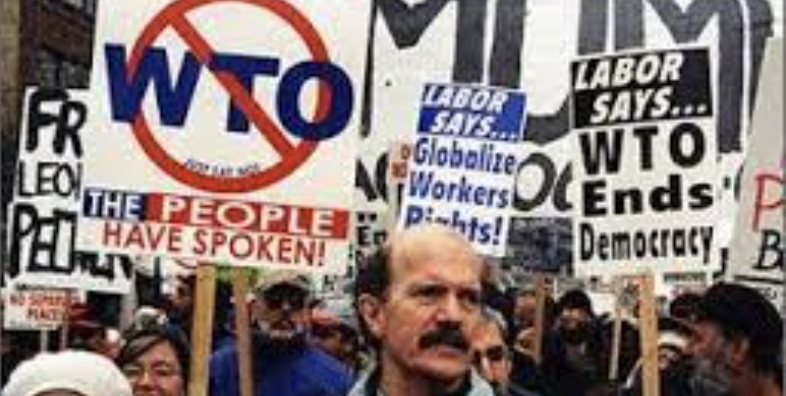
We then talked about how people were responding to these kind of trade policies and discussed what happened during the massive anti-WTO protest in Seattle in 1999, the 2001 protest in Quebec City against plans to implement a NAFTA-like trade policy for all the Americas, and an action in Grand Rapids called the NAFTA Scavenger Hunt and the NAFTA Bunny. Media Mouse produced a video about the NAFTA Bunny.
 Grand Rapids Institute for Information Democracy
Trackbacks
Comments are closed.