Grand Rapids Chamber of Commerce endorses data centers, regardless of the growing public opposition
Last week I posted an article about the growing opposition to data centers across the US, in Michigan and locally.
I cited a recent report from Data Center Watch there has been $64 billion of data center projects that have been blocked because communities have become organized.

However, despite massive public opposition, the Grand Rapids Chamber of Commerce is in favor of data centers. The Chamber’s Vice President of Government Affairs, Christine Simon wrote an article entitled, BUILDING NEXGEN INFRASTRUCTURE: DATA CENTERS IN WEST MICHIGAN, which was posted on February 6th. Let’s take a long at how the Grand Rapids Chamber of Commerce is justifying data centers.
Earlier on in the article, the GR Chamber writer states:
At the Grand Rapids Chamber, our goal is straightforward: replace assumptions with facts and offer a practical view of the potential impact of data center development on West Michigan.
 One so-called fact is, “Many jurisdictions (including Michigan) require data centers to pay energy rates that result in general improvement of our energy grid that all customers will benefit from – not putting that cost onto other ratepayers.” Just because the Michigan Public Service Commission makes a statement, doesn’t mean it is fact.
At a Press Conference I attended last year that addressed energy costs, one of the people who spoke during the press conference share the following facts:
As recently as 2019, close to 14,000 Kent County families living at 50% of the federal poverty level, were spending 33% of their income on energy costs. Spending six percent of household income on energy costs is considered affordable, yet families are spending more than the 30% that they should be spending on housing alone. Since 2019, the Michigan Public Service Commission has approved a total of $274 million in six annual rate hike requests from Consumers Energy.
Those who spoke at this press conference made it clear that Consumers Energy is asking for an additional $325 million in electricity rate hikes.
Another so-called fact from the GR Chamber article states, “Modern data center facilities utilize high‑efficiency cooling mechanisms that dramatically reduce water usage compared to earlier generations of data centers.” The source they include is from an industry publication called Data Center Magazine, which is clearly a pro-data center entity. Conversely, the Environmental and Energy Study Institute makes a significantly different claim:
A medium-sized data center can consume up to roughly 110 million gallons of water per year for cooling purposes, equivalent to the annual water usage of approximately 1,000 households. Larger data centers can each “drink” up to 5 million gallons per day, or about 1.8 billion annually, usage equivalent to a town of 10,000 to 50,000 people. Together, the nation’s 5,426 data centers consume billions of gallons of water annually. One report estimated that U.S. data centers consume 449 million gallons of water per day and 163.7 billion gallons annually (as of 2021). A 2016 report found that fewer than one-third of data center operators track water consumption. Water consumption is expected to continue increasing as data centers grow in number, size, and complexity.
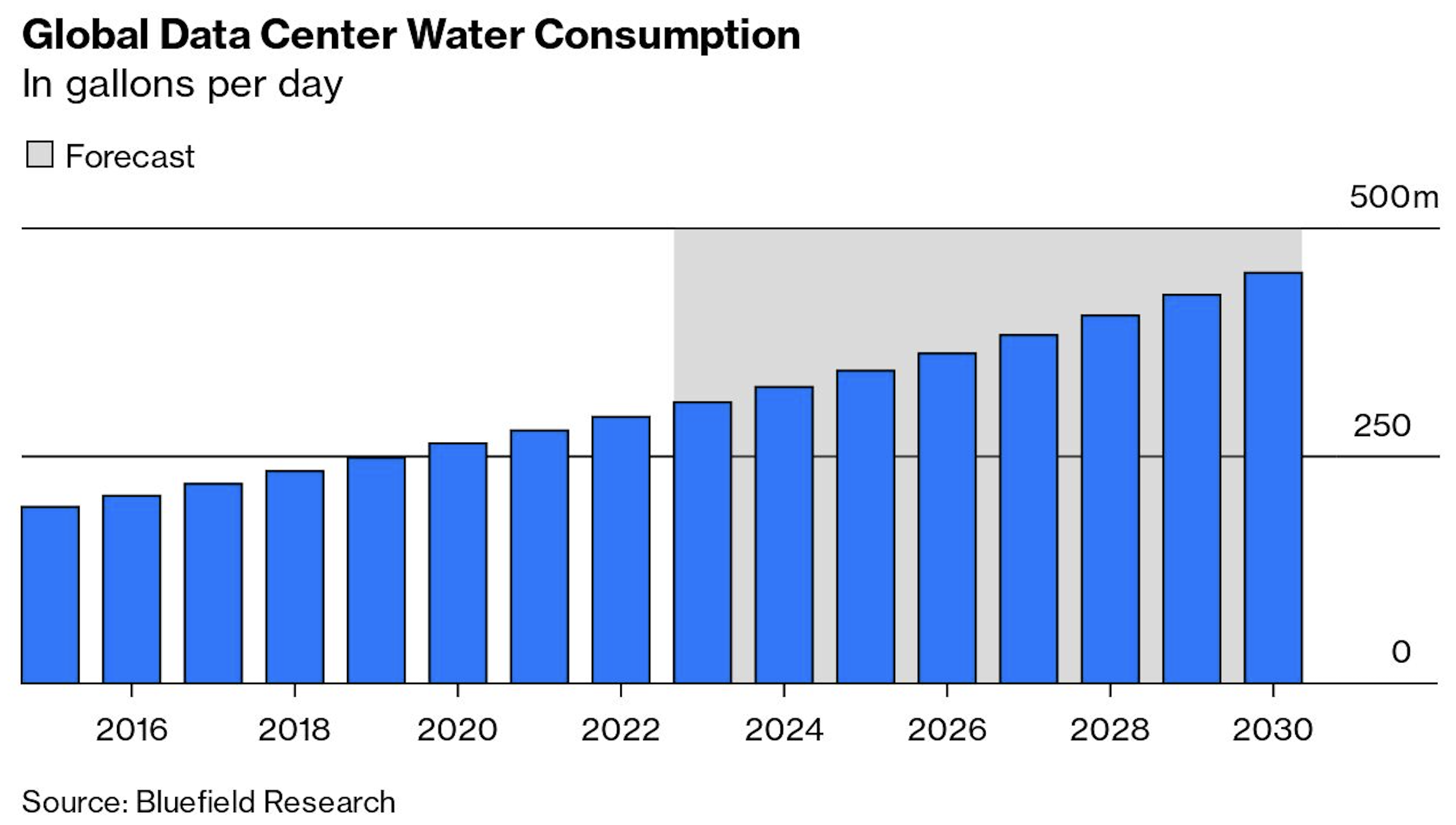
The third so-called fact from the GR Chamber article states, “Data centers typically involve large, long‑term capital investments that can enhance local government tax revenue.” The source used here is from the Tax Foundation, which is connected to the Koch family created American Legislative Exchange Council (ALEC), which defends corporate interests not public interests. In addition, the argument that data centers can increase local government tax revenue is not a strong selling point. The City of Grand Rapids is notorious for spending massive amounts on cops and developments, but not on meeting the needs of residents.
None of what the Grand Rapids Chamber of Commerce is saying about data centers should be surprising to those who are paying attention. At the end of the GR Chamber article it says:
“Approaching decisions around potential development intentionally, rather than reactively, helps ensure that today’s choices support our community’s future vibrancy.”
The Grand Rapids Chamber of Commerce always claims that they want the entire community to thrive, yet ever since they were founded in 1887, large numbers of Grand Rapids residents have struggled to survive, while some families have seen their wealth expand to become billionaires and millionaires. Those are the people that the Grand Rapids Chamber of Commerce primarily supports and their defense of data centers will continue that same trend.
 Grand Rapids Institute for Information Democracy
Trackbacks
Comments are closed.