Doug DeVos and revisionist history of Grand Rapids since 1976: How the Capitalist Class always tries to control the narrative
“History is important. If you don’t know history it is as if you were born yesterday. And if you were born yesterday, anybody up there in a position of power can tell you anything, and you have no way of checking up on it.” Howard Zinn
We should all be deeply skeptical when billionaires like Doug DeVos want to control the narrative around the history of Grand Rapids. In a December 2025 Wall Street Journal op-ed, DeVos wrote a piece entitled, The Grand Rapids Revival and an American Comeback.
Doug DeVos also re-printed the Wall Street Journal op-ed in his recently created pro-Capitalist online journal called Believe!. Believe is a homage to his father Rich DeVos’ book by the same title. I am not going to reprint the entire op-ed piece, but provide a summary, along with a counter narrative about the history that DeVos wants us all to accept.
DeVos begins by making the claim that in 1976 Grand Rapids “had struggled with crime and poverty over the previous decade,” and the Secret Service didn’t want to bring President Ford downtown for a parade because their were too many boarded up buildings downtown.
Like most people with economic or political power, DeVos provides no verification of the claim that Grand Rapids had struggled with crime and poverty over the previous decade. The previous decade would cover from 1965 – 1975, a period in the city’s history where the wealth gap had been growing and where Black residents were disproportionately the ones living in poverty.
In my book, A People’s History of Grand Rapids, and Todd Robinson’s book, A City Within a City, both acknowledge that institutionalized racism permeated most of the institutions throughout the City. The 1967 riot was in part because of police brutality directed at Black youth, but it was predominantly a response to decades of exploitation and systemic racism.
White flight and disinvestment in Black neighborhoods contributed to the deterioration of the city, especially when it came to housing. However, the City of Grand Rapids continued to increase the amount of money they were spending on policing and the financial drain on communities because the federal government had spent billions on the Vietnam War, which Ford had voted for while in Congress and when he was in the White House.
Paul I Phillips noted that median income for black families in 1974 was $7,802 and for white families, $13,830, nearly double. Phillips refers to the policy of the 1970’s as policies of “benign neglect,” with the depression of 1974-75, “effectively undermining the economic gains made by Blacks in the 1960’s.” To survive, “an increasing number of Black families are doubling up and pooling meager resources.”
DeVos goes on to say that his father and other business leaders made a commitment to revive downtown Grand Rapids, a commitment that continues through today primarily through the efforts of Grand Action 2.0, which the DeVos family has been leading since the 1990s when it was founded. Here DeVos writes, “A half-century later, Grand Rapids is a city transformed, regularly ranked among the best places in the U.S. to live, work and raise a family.” Again, no verification of these claims.
Three years ago I deconstructed one of the claims about Grand Rapids, especially to notion of Grad Rapids being an affordable city. The article was entitled, Grand Rapids is the 2nd most beautiful and affordable city: Affordable for whom?
DeVos goes on to write:
When I look back on Grand Rapids transformation, I’m most inspired by how people rallied around a shared vision of the city. My hometown, like America, has never been a place where everyone agrees. But it’s harder to stoke division when you’re working together to tutor struggling students or fund inner-city entrepreneurs.
Of course, DeVos is talking about himself here and the other people who make up the Grand Rapids Power Structure. When DeVos uses phrases like funding inner-city entrepreneurs, he is referring to groups like State Garden, which promotes a false solution that everyone needs to create their own wealth and start their own business. This is simply a lie we are all taught about Capitalism, which disproportionately benefits the super rich and widens the wealth gap.
In 2024, I wrote a piece based on the ALICE report – ALICE stands for Asset Limited, Income Constrained, Employed. In that report it stated that 41% of Michigan households live paycheck to paycheck. I go on to write:
As the MLive headline said, 41% of Michigan households live paycheck to paycheck, but that number goes up to 47% for Grand Rapids households. This means that nearly half of the households in Grand Rapids are living paycheck to paycheck! You wouldn’t know this, since the local news doesn’t really talk about it much, nor do the politicians, hell even faith leaders to make economic justice a priority when they preach.
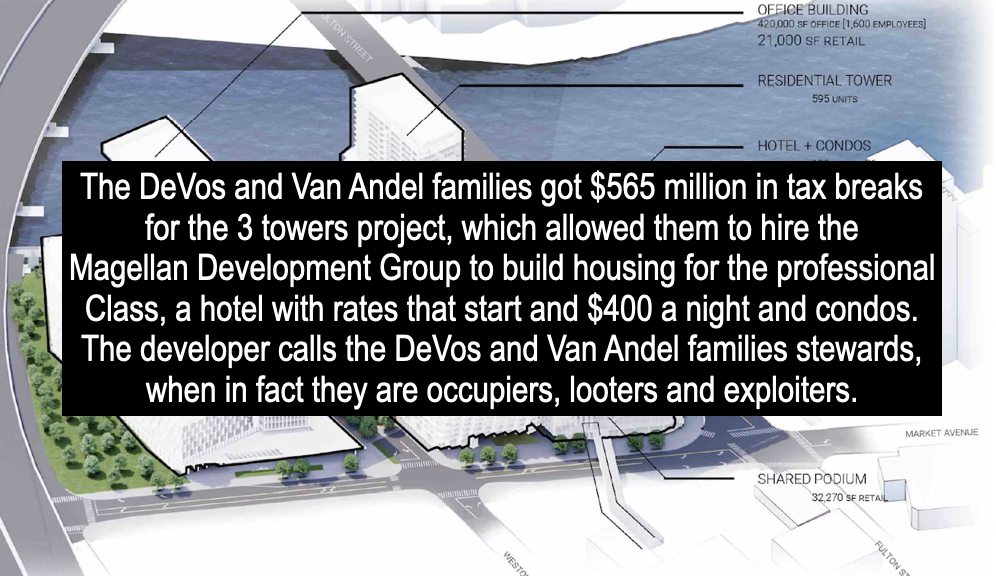
Doug DeVos can try to control the narrative around recent history, but we all know that he and his family are the primary beneficiaries of the Grand Action 2.0 projects. Just within the past few years, the DeVos family has been the primary driving force behind the Amphitheater, the Soccer Stadium and even convinced City officials to provide $565 million is subsidies for their Three Towers project, which will provide housing to people who are well off. Below is a list of GRIID articles on the Three Towers project.
It is a given that people like Doug DeVos want to control the narrative about local history. If people were provided a counter narrative about Grand Rapids history, it would put their wealth and their social status at risk. It is imperative that we tell a different story and gather as many stories as possible, especially from communities that are either omitted from history or are a mere footnote in the dominant narrative.
 Grand Rapids Institute for Information Democracy
Comments are closed.