GRIID Class on US Foreign Policy since WWII – Week #5
In week #1 I provided some foundational documents and a framework for how to look at no what country the US is engaged in. I also used the framework document to assess the history of Iraq, particularly the US relationship with that country. For week #2 we focused on US government efforts, primarily through the CIA to undermine the elections in Italy 1947-48, and to orchestrate coups in Iran in 1953 and Guatemala in 1954.
 For week #3 we continued to used William Blum’s book, Killing Hope: US Military and CIA Interventions since WWII. The three countries we focused on were the Congo, Indonesia, and Chile during the 1960s. In week#4 we discussed how the US undermined Angola, Libya and Nicaragua in the 1970s and 80s. Today, we are looking at Bulgaria 1990/Albania 1991, Afghanistan 1979 – 1992, and Haiti 1986 – 1994.
Bulgaria 1990/Albania 1991
This section of Blum’s book is essentially what was happening right at the time that the Soviet Union was collapsing, thus at the end of the Cold War. Regarding Bulgaria, the US intervention involved the CIA at a lower level, since the US was interested in preventing Socialists from winning the upcoming election.
The US turned to the, as Blum notes:
The National Endowment for Democracy, Washington’s specially created stand-in for the CIA, with funding in this case primarily from the Agency for International Development, was pouring some $2 million into Bulgaria to influence the outcome of the election, a process the NED calls promoting democracy.
The student movements were amongst the recipients of National Endowment for Democracy grants, to the tune of $100,000 “to provide infrastructure support to the Federation of Independent Student Associations of Bulgaria to improve its outreach capacity in preparation for the national elections”. The students received “faxes, video and copying equipment, loudspeakers, printing equipment and low-cost printing techniques”, as well as the help of various Polish advisers, American legal advisers, and other experts – the best that NED money could buy.
But for Washington policy makers, the important thing, the ideological bottom line, was that the Bulgarian Socialist Party could not, and would not, be given the chance to prove that a democratic, socialist-oriented mixed economy could succeed in Eastern Europe while the capitalist model was failing all around it.
Nor, apparently, would it be allowed in nearby Albania. On 31 March 1991, a Communist government won overwhelming endorsement in elections there. This was followed immediately by two months of widespread unrest, including street demonstrations and a general strike lasting three weeks, which finally led to the collapse of the new regime by June. The National Endowment for Democracy had been there also, providing $80,000 to the labor movement and $23,000 “to support party training and civic education programs”
Afghanistan 1979 – 1992
Consider Zbigniew Brzezinski, national security advisor to Jimmy Carter. In a 1998 interview he admitted that the official story that the US gave military aid to the Afghanistan opposition only after the Soviet invasion in 1979 was a lie. The truth was, he said, that the US began aiding the Islamic fundamentalist moujahedeen six months before the Russians made their move, even though he believed – and told this to Carter, who acted on it – that “this aid was going to induce a Soviet military intervention”.
Brzezinski was asked whether he regretted this decision.
Regret what? That secret operation was an excellent idea. It had the effect of drawing the Russians into the Afghan trap and you want me to regret it? The day that the Soviets officially crossed the border, I wrote to President Carter: We now have the opportunity of giving to the USSR its Vietnam war. Indeed, for almost 10 years, Moscow had to carry on a war unsupportable by the government, a conflict that brought about the demoralization and finally the breakup of the Soviet empire.
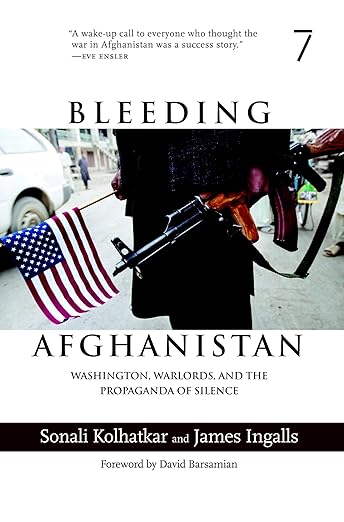 We ow know that the US provided billions to the moujahedeen for training and weapons to fight the Soviets in Afghanistan, even though many of these people later took action against the US, like Osama bib Laden, who was part of the moujahedeen. Blum then tells us:
Like many other CIA clients, the rebels were financed as well through drug trafficking, and the Agency was apparently as little concerned about it as ever as long as it kept their boys happy Moujahedeen commanders inside Afghanistan personally controlled huge fields of opium poppies, the raw material from which heroin is refined. CIA-supplied trucks and mules, which had carried arms into Afghanistan, were used to transport some of the opium to the numerous laboratories along the Afghan-Pakistan border, whence many tons of heroin were processed with the cooperation of the Pakistani military. The output provided an estimated one-third to one-half of the heroin used annually in the United States and three-quarters of that used in Western Europe. US officials admitted in 1990 that they had failed to investigate or take action against the drug operation because of a desire not to offend their Pakistani and Afghan allies. In 1993, an official of the US Drug Enforcement Administration called Afghanistan the new Colombia of the drug world
The moujahedeen regularly committed human rights abuses, against both Russia soldiers and Afghani civilians, using torture and murder, particularly with women. Once the Soviet military left Afghanistan, the US abandoned that country, allowing the Taliban to come to power.
Haiti 1986 – 1994
The US has had an obsession with Haiti every since the Haitian revolution at the beginning of the 19th Century, when they gained their independence from France. In many ways the US punished Haiti because they did not approve of a Black-led revolution.
The US military occupied Haiti from 1914 – 1934, then eventually installed the Duvalier family dictatorship, first with Papa Doc, followed by his son Baby Doc. The Duvalier dictatorship used their own death squads, known as the Tonton Macoute, which suppressed any opposition. In addition, the Duvalier family plundered the national treasury all the way up til they fled the country during a popular uprising in 1990 that led to the election of a Catholic Priest named Jean-Bertrand Aristide,

Version 1.0.0
The US State Department and the CIA immediately worked to overthrown Aristide. Here Blum states:
Jean-Bertrand Aristide served less than eight months as Haiti’s president before being deposed, on 29 September 1991, by a military coup in which many hundreds of his supporters were massacred, and thousands more fled to the Dominican Republic or by sea.
The Clinton administration was as hypocritical on the Haiti question as were its predecessors, exemplified by its choice for Secretary of Commerce – Ron Brown had been a well-paid and highly-active lobbyist for Baby-Doc Duvalier. Cédras’s spit-in-the-face deceit on the Governors Island accord appeared to bother Washington officials much less than the fact that Aristide would not agree to form a government with the military. By February 1994, it was an open secret that Washington would as soon be rid of the Haitian priest as it would the Haitian strongmen. The Los Angeles Times reported: “Officially it [the US] supports the restoration of Aristide. In private, however, many officials say that Aristide … is so politically radical that the military and the island’s affluent elite will never allow him to return to power.”
The US continued to intervene, supporting another coup against Aristide, followed by supporting numerous oppressive governments that kept Haiti unstable and one of the most impoverished countries in the world. As was stated earlier, the US has been punishing Haiti for more than 2 centuries, because it dared to fight for independence from colonial powers and not follow US plans for the region.
 Grand Rapids Institute for Information Democracy
Trackbacks
Comments are closed.