As the Trump Administration enacts brutal policies at home and abroad, it’s time that we learn from the radical Dr. Martin Luther King Jr.
Just to be clear, it has always been my contention that we should have been embracing the radical Dr. King, the real Dr. King all along, regardless of who sits in the White House. I say this because every administration engages in imperialism abroad, along with perpetuating state violence across the country. But now the curtain is pulled back even more, with the Trump administration being very candid about their use of state violence.
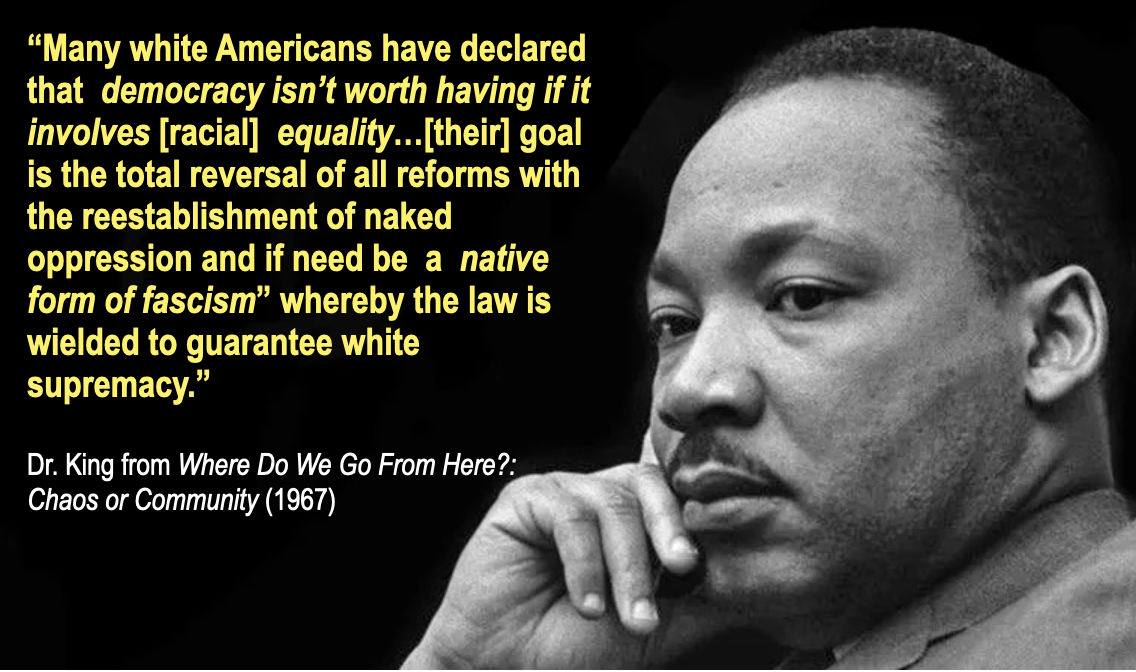
In his final book, Where Do We Go From Here?: Chaos or Community (1967), King offered a sobering take on the white legal backlash to the racial progress achieved by the struggle for Black equality. Many white Americans, King wrote, “have declared that democracy isn’t worth having if it involves [racial] equality…[their] goal is the total reversal of all reforms with the reestablishment of naked oppression and if need be a native form of fascism” whereby the law is wielded to guarantee white supremacy.
Black people were experiencing fascism in the US in 1967 as they had been every year prior to that. Read Bill Mullen’s book, We Charge Genocide!: American Fascism and the Rule of Law, for details of that reality.
We have to begin to see a Dr. King as someone who evolved during his short lifetime of being in the struggle. Dr. King always promoted and practiced direct action as part of the Black Freedom Struggle, from risking arrest in order to expose the structural racism and structural violence that was inherent in the US.
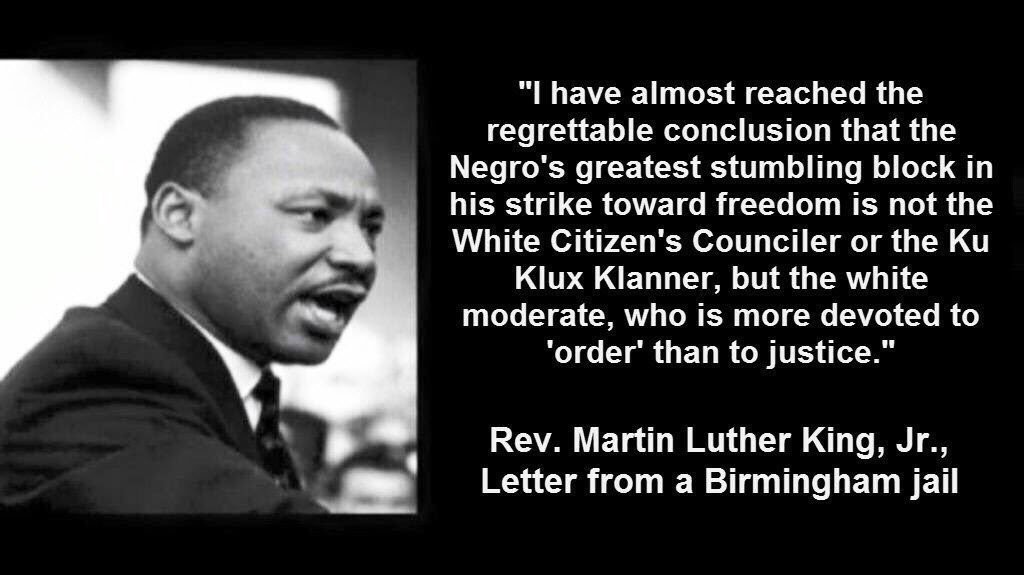
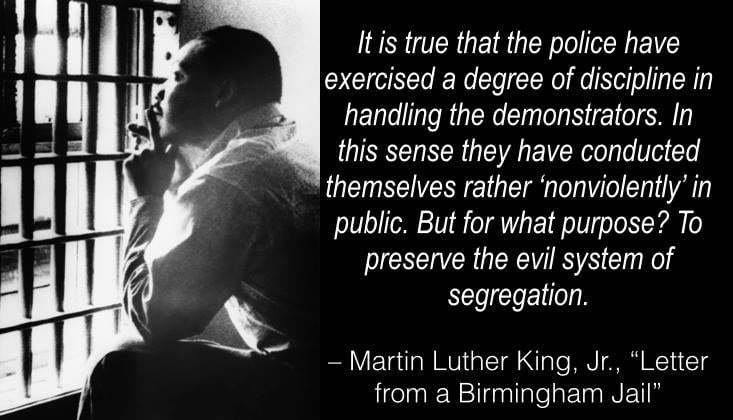
We have to embrace the Dr. King who in 1963 (“Letter From a Birmingham Jail”) wrote that the primary obstacle to overcoming American racial oppression wasn’t the open racism of segregation’s brutal enforcers but the tepid incrementalism of white moderates who counseled excessive patience and discouraged the mass direct action required to overthrow the Jim Crow regime.
We especially need to read what Dr. King was saying and doing after he moved his operations from the south and brought his family to live in Chicago where he experience a more overt forms of white supremacy. Read the book, King of the North: Martin Luther King Jr.’s Life of Struggle Outside the South, by Jeanne Theoharis and watch the documentary King in the Wilderness: The Last Years of MLK Jr.’s Life.
Dr. King organized people to challenge housing policies in Chicago, segregation and mobilized thousands to engage in direct action, such as taking over abandoned housing and turning it into housing for people, or the time that he led a march that shut down a major highway in Chicago, a disruptive tactic to pressure the City to adopt housing policies that would meet people’s needs.
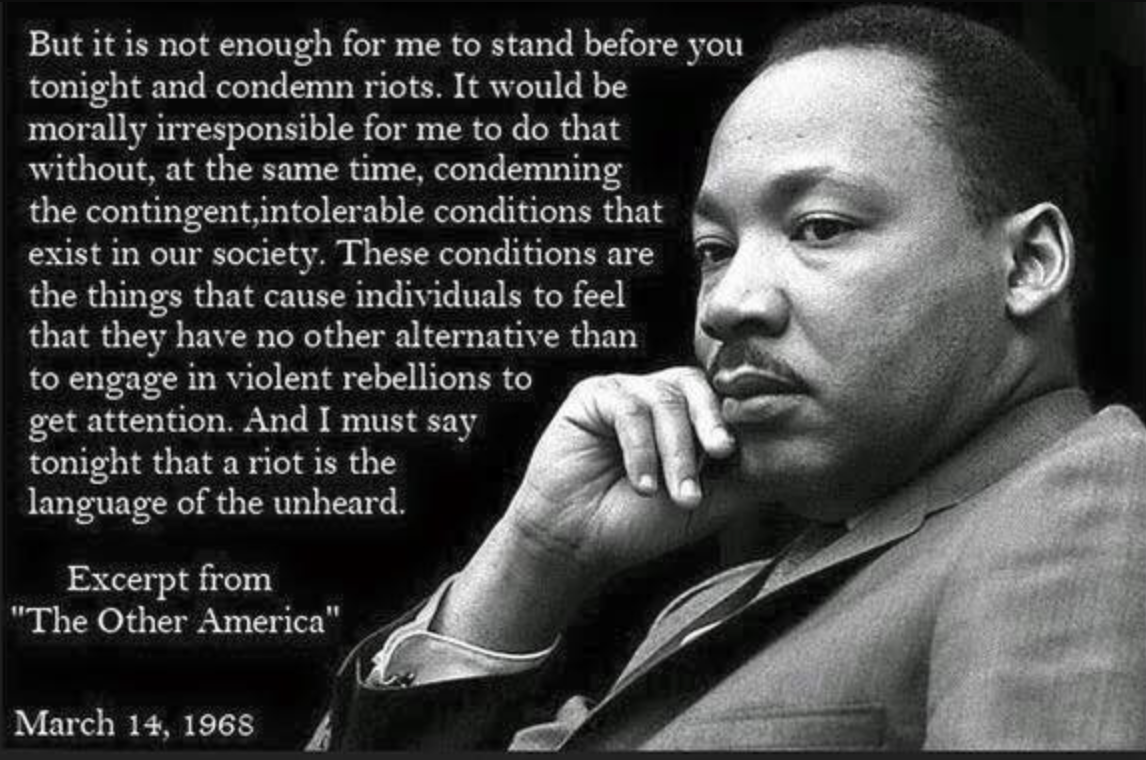
We have to embrace the Dr. King who placed the primary blame for the US race riots of 1965-67 on a “white power structure…seeking to keep the walls of segregation and inequality intact” and a “white society, unprepared and unwilling to accept radical structural change,” that told Black people “they must expect to remain permanently unequal and permanently poor.”
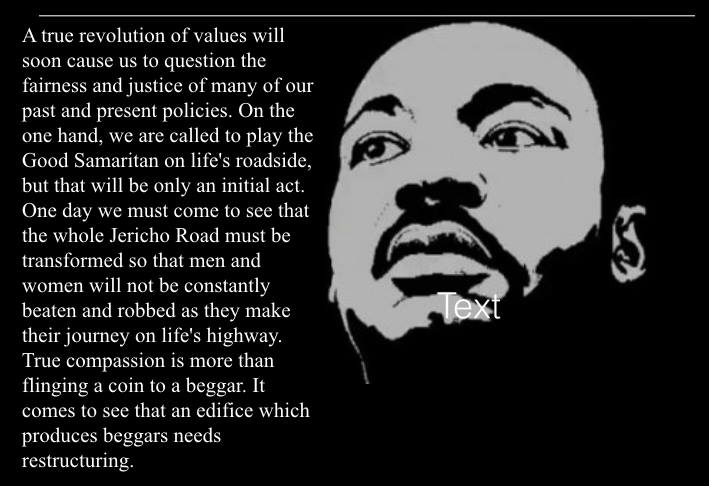
We have to understand the King who denounced what he called “the interrelated triple evils” of racism, economic injustice/poverty (capitalism) and war (militarism and imperialism, and who said that the “real issue to be faced” beyond “superficial” matters was “the radical reconstruction of society itself” – the King who argued that “only by structural change can current evils be eliminated, because the roots are in the system rather in man or faulty operations. For years I labored with the idea of reforming the existing institutions of the South, a little change here, a little change there. Now I feel quite differently. I think you’ve got to have a reconstruction of the entire society, a revolution of values.”
We have to embrace a Dr. King who spoke out against American imperialism, most particularly against the US War on Vietnam, and who said on April 4, 1967, in his famous speech Beyond Vietnam — A Time to Break Silence. King stated “that a society that spent more money on military empire than on programs of social uplift was approaching spiritual death.”
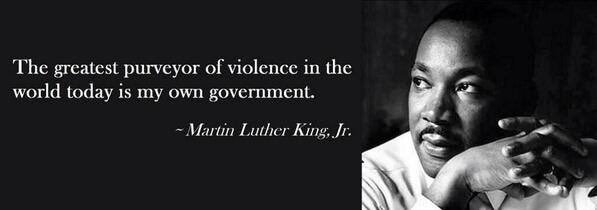
In that same speech, Dr. King said, I knew that I could never again raise my voice against the violence of the oppressed in the ghettos without having first spoken clearly to the greatest purveyor of violence in the world today – my own government.
During Dr. King’s 1963 I Have a Dream speech, he stated “We can never be satisfied as long as the Negro is the victim of the unspeakable horrors of police brutality.” Here is another quote on what the function of policing is in the US.
Dr. King was being monitored by the FBI for years and then FBI director J. Edgar Hoover said that Dr. King was “the most notorious liar in the country.”
Dr. King was received death threats for years and in the last few years of his short life he even recruited some members of the Deacons for Defense to act as body guards. See Charles Cobb’s book, This Nonviolent Stuff’ll Get You Killed: How Guns Made the Civil Rights Movement Possible.
Months before Dr. King was assassinated he began to organize the Poor People’s Campaign, which involved people impacted by poverty across the country. The plan was to occupy DC with thousands of people and not leave until their demands were met.
In the midst of the Poor People’s Campaign Dr. King went to Memphis to support the garbage workers who were striking for better working conditions and better wages. Dr. King had been working with labor unions for years, which is well documented in Michael Honey’s book, All Labor Has Dignity.
On April 4th, 1968, Dr. King was assassinated in Memphis. However, despite the claim that King was killed by a lone assassin, the local police and the FBI were either complicit in Dr. King’s assassination or conspired to kill him, according to the book, An Act of State: The Execution of Martin Luther King.
All of is to say that if we really want to honor the legacy of Dr. King, we need to know how radical he was and that he was seen by the power structure as a threat. If we want to honor the real Dr. King then we need to practice direct action in service of collective liberation and stop making nice with those in power.
 Grand Rapids Institute for Information Democracy
Comments are closed.