GRIID Class on US Foreign Policy since WWII – Week #1: Developing a framework for understanding
I am sharing the content of what all the participants read and what was discussed during each of the eight week sessions in the GRIID class on the history of US foreign policy since WWII.
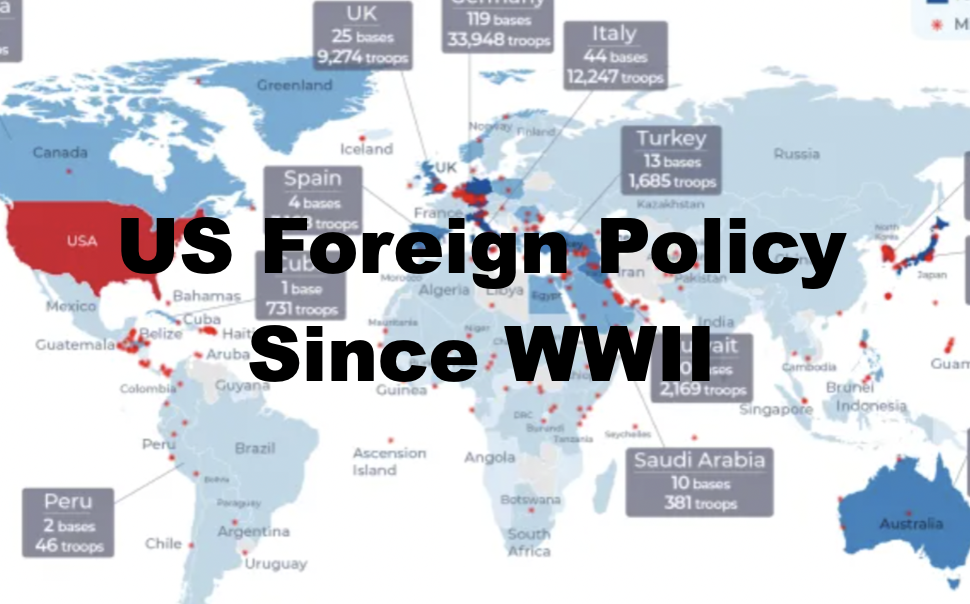
Participants were asked to look over some of the following online resources before week #1.
Military Industry influence peddling
I also shared several documents for them to look at which provide more context and a framework for how we can look at US involvement around the world no matter what country it involves. Another document is a sample of US Military interventions since WWII under each US President/Administration.
Then we also looked at and discussed to quotes from US government and military insiders that are important in terms of thinking about what the function of US foreign policy is. This first quote is from former Major General Smedley Butler, who is the highest ranking US military person in US history. In his book War is a Racket, Butler 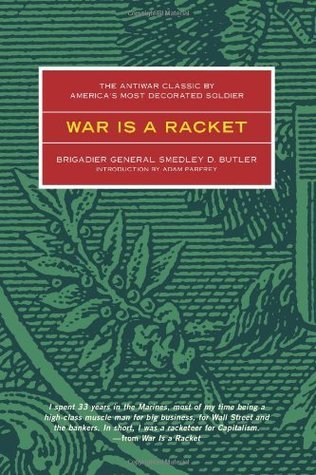 wrote:
War is just a racket. A racket is best described, I believe, as something that is not what it seems to the majority of people. Only a small inside group knows what it is about. It is conducted for the benefit of the very few at the expense of the masses.
I believe in adequate defense at the coastline and nothing else. If a nation comes over here to fight, then we’ll fight. The trouble with America is that when the dollar only earns 6 percent over here, then it gets restless and goes overseas to get 100 percent. Then the flag follows the dollar and the soldiers follow the flag.
I wouldn’t go to war again as I have done to protect some lousy investment of the bankers. There are only two things we should fight for. One is the defense of our homes and the other is the Bill of Rights. War for any other reason is simply a racket.
There isn’t a trick in the racketeering bag that the military gang is blind to. It has its “finger men” to point out enemies, its “muscle men” to destroy enemies, its “brain men” to plan war preparations, and a “Big Boss” Super-Nationalistic-Capitalism.
It may seem odd for me, a military man to adopt such a comparison. Truthfulness compels me to. I spent thirty- three years and four months in active military service as a member of this country’s most agile military force, the Marine Corps. I served in all commissioned ranks from Second Lieutenant to Major-General. And during that period, I spent most of my time being a high class muscle- man for Big Business, for Wall Street and for the Bankers. In short, I was a racketeer, a gangster for capitalism.
I suspected I was just part of a racket at the time. Now I am sure of it. Like all the members of the military profession, I never had a thought of my own until I left the service. My mental faculties remained in suspended animation while I obeyed the orders of higher-ups. This is typical with everyone in the military service.
I helped make Mexico, especially Tampico, safe for American oil interests in 1914. I helped make Haiti and Cuba a decent place for the National City Bank boys to collect revenues in. I helped in the raping of half a dozen Central American republics for the benefits of Wall Street. The record of racketeering is long. I helped purify Nicaragua for the international banking house of Brown Brothers in 1909-1912 (where have I heard that name before?). I brought light to the Dominican Republic for American sugar interests in 1916. In China I helped to see to it that Standard Oil went its way unmolested.
During those years, I had, as the boys in the back room would say, a swell racket. Looking back on it, I feel that I could have given Al Capone a few hints. The best he could do was to operate his racket in three districts. I operated on three continents.
The second quote comes from George Kennan who was Director of Policy Planning of the U.S. Dept. of State in 1948. Kennan stated:
“We have 50 percent of the world’s wealth, but only 6.3 percent of its population. . . In this situation we cannot fail to be the object of envy and resentment. Our real task in the coming period is to devise a pattern of relationships, which will allow us to maintain this position of disparity. We should cease to talk about the raising of the living standards, human rights, and democratization. The day is not far off when we are going to have to deal in straight power concepts. The less we are then hampered by idealistic slogans, the better.”
After looking at these larger US foreign policy frameworks, we then applied it to the example of Iraq, with the following timeline and narrative:
Historical Context – WWI demonstrated to the British that oil was an essential strategic resource to power the war machines and the Middle East was rich in oil.
1916 Sykes-Picot agreement, between Russia, the UK and France divided up most of what is now the Middle East, which the UK controlling Iraq.
1919 there was an Arab independence movement and the British responded by convening the League of Nations to ratify their colonial control.
1920 – Arab nationalists then fought the British, but the British military was far superior and brutally crushed the uprising. T.E. Lawrence and Winston Churchill both argued in favor of using poison gas. Churchill stated at the time, “I do not understand this squeamishness about the use of gas. IU am strongly in favor of using poison gas against uncivilized tribes.”
1921 – Iraq was created by the British government behind closed doors. Iraqis were not fit to govern themselves. King Faisal was chosen by the British government to rule Iraq.
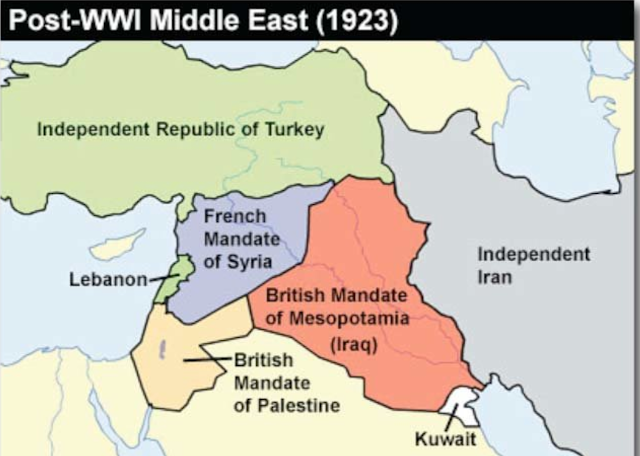
1925 – King Faisal was forced by the British government to sign a 75-year concession granting the foreign owned Iraq Petroleum Company all rights to Iraq’s oil.
After WWII there were 3 major things that happened: The US became the leading world power; oil became central to global power; and the US shifted from domestic oil production to global oil production.
In 1950 Persian Gulf Oil cost about 5 to 15 cents a barrel to produce, but sold for $2.25 a barrel.
1952 – massive demonstrations began against the British and the monarchy. It was violently repressed.
1958 – a military led uprising began, with the King and his son shot dead.Coup was led by Gen. Abdul Qasim. Iraq now wanted part of the control of Iraqi oil. The UK/US alliance would not budge, so in 1960 Iraq invited Saudi Arabia, Iran Kuwait and Venezuela to create what is now called OPEC – Organization of Petroleum Exporting Countries.
By the late 1950s, the US began a covert campaign to destabilize Iraq, primarily led by the CIA. Part of this effort was to develop relationships with leadership in the Ba’ath Party.
There were attempts by members of the Ba’ath Party to assassinate Qasim, including a young Saddam Hussein.
1968 – Ba’ath Party takes control of Iraq through a military coup. At the time Saddam was head of the Revolutionary Command Council (RCC) and by the mid-70s he was the most powerful figure in Iraqi politics.
In the 1970s, the US attempted to undermine the Ba’ath Party, since it was becoming to independent of the US. They attempted to use the Kurds against the Ba’athists.
1980 – 1990 the Iraq/Iran war took place, with the US arming both sides.
1990 – Build up to the Persian Gulf War
January 16, 1991 the US begins bombing campaign against Iraq. Less than 2 months later the war ended, without the removal of Saddam Hussein.
Beginning in 1991 the most brutal economic sanctions were imposed on Iraq, sanctions that lasted until months after the 2003 US invasion of Iraq began. 500,000 Iraqi children died as a result of the sanctions in combination with the devastation from the 1991 US bombing. Asked on TV, then US Secretary of State, Madaline Albright was asked if it was worth it for so many Iraqi children had died. She said, “It was worth it.”
2003 – US invasion of Iraq began
2009 – Soft US troop withdrawal began
Iraq in a constant state of instability – factions, ISIS, oil.
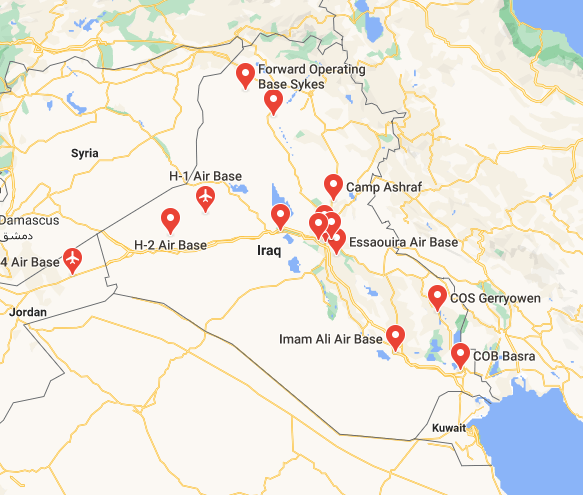
(Map above shows US military bases in Iraq.)
Geo-Politics
Arab Nationalism and anti-Colonialism was a major source of US geopolitical concern beginning in the 1950s.
1953 CIA coup in Iran, which ousted Mossadegh and put in power the Shah, who ruled until he was overthrown in 1979, by an Islamist movement, which the US had support decades earlier.
Turkey began a relationship with the US after WWII, military aid, etc because of their strong anti-Communist stance and the repression of an independent Kurdish state. US has had military bases since 1955.
US Saudi Arabia relations began prior to WWII, but increased after the war, allowing US troops to deploy, joint military training and deep relationship between the US and the Saudi monarchy.
Syria – US has had a difficult relationship with. Numerous CIA coups were attempted and it has always been contentious.
Jordan – has been an ally since WWII
Lebanon – has been an ally since WWII
1956 – Nasser comes to power in Egypt. There were tension between the US and Egypt, but when Sadat became president that changed, along with the Arab/Israeli war. Egypt became one of the top recipients of US military aid and a player against Arab nationalism.
Israel – the US has had a special relationship since its founding in 1948, but especially after the 1973 war with Egypt. Israel has been the number one recipient of US military aid since 1975 and acts essentially as the police of the region.
Economic Interest – oil, re-writing Iraqi Constitution and applying US Shock Doctrine to Iraq’s economy.
Human Rights/Human Cost – Iraq lost 200,000 during Iran/Iraq War
10 – 12,000 Iraqis died during the Gulf War.
Sanctions from 1991 – 2003 killed half a million children and 40,000 adults.
1 million Iraqis died during the US invasion/occupation of Iraq from 2003 – 2008.
US Troop loses during Gulf War – Gulf War syndrome, use of depleted uranium. 150 during invasion, undetermined from Gulf War Syndrome
US troop loses during 2003 – 2008 invasion/occupation 4,500, with 32,000 wounded.
US Military Complex – What US taxpayers spent on the war since 2003, includes US military Aid, US military bases, use of private military contractors, Defense Contractor profits.
US Media Coverage
Gulf War – First Cable News War/24 Hour War
2003 invasion/occupation
GRIID Study of 2003 US invasion
US Domestic response – 1991 Gulf War demonstrations, Teach-Ins, civil disobedience. Grand Rapids History.
2003 Invasion/Occupation – demonstrations before it started, Teach-Ins, civil disobedience, counter-recruitment organizing, targeting war profiteers, Iraq war veterans resistance. 10 part series on GR People’s History Project.
 Grand Rapids Institute for Information Democracy
Trackbacks
Comments are closed.