Accompanying an immigrant to court: Fear and loathing in West MI
Editor’s Note: I am a volunteer organizer with GR Rapid Response to ICE and have been doing accompaniment work for several decades.
Earlier this year I facilitated a class called Understanding the Prison Industrial Complex in Kent County.. We used as a primary resource the book, Beyond Courts, which was a project involving the Community Justice Exchange, Interrupting Criminalization and Critical Resistance.
Beyond Courts is an excellent resource, primarily we tend to focus most of our energy on cops and prisons, but not so much on the role of the courts. In chapter 5 of the book the authors write:
“For example, in 2022, there were almost 13 million misdemeanor charges that forced thousands of people into the criminal justice system each year. More than a quarter of all cases filed in criminal courts are motor vehicle, drug and broken windows offenses, so called “low-level” crimes that police and prosecutors pursued aggressively in cities particularly in the 1990s.”
The authors argue that these 13 million misdemeanor charges more often than not landed people in jail, primarily because they could not afford bail. These statistics expose the absurdity of the of the Prison Industrial Complex across the US, since for primarily non-violent offenses, people are separated from their families, lose their jobs and are subjected to a cruel form of punishment.
Accompanying an immigrant to court
On Wednesday morning I picked up a young man who had a court appointment in the Grand Rapids area. I drive, because undocumented immigrants are not allowed to have a drivers license in Michigan.
When I picked up the young man I could tell that he was nervous, then he told me that he did not sleep well, so he asked if we could get some coffee on the way.
The air was frigid this morning and when we got to the court house we stayed in the car to keep war, drink our coffee and reduce the amount of time he would be subjected to cops, lawyers and judges.
When we finally decided to go in the first thing you have to do is go through a metal detector and then possibly be subjected to cops searching your body, backpacks or other items that people carry in their person. Those doing the monitoring at the metal detector and searching through your property and body are cops, which always have side arms and other less deadly weapons that can do harm to you.
Once you get through the metal detector you generally need to wait. The court system tells people to show up at 8am in the morning, but that doesn’t mean you will be going before a judge at that time. Each judge has a docket, where they might hear several dozen cases in a day. This means that when people go to court they have to sit and wait. On Wednesday morning we sat and waited for about an hour.
Eventually the court clerk came out and told us to come in as the judge was getting ready to hear the case of the person I was accompanying. However, there was another delay, since the lawyer that the person I was accompanying was not present. Not only was the lawyer not present, they did not submit a request for translation, since the person I was accompanying had limited English skills.
I was doing my best to communicate what was going on without talking loudly as judges do not take kindly to any disruption in the courtroom. When the judge asked the person I was accompany regarding the whereabouts of his lawyer, he did not understand what was being said. I spoke up and said that he did speak much English and that I could translate for him if need be. The judge asked me if I was a state certified court translator and I said no. The judge then said they could not use me as a translator.
After the judge, the prosecutor and the court clerk spoke to each other, the judge decided to postpone the case until the lawyer showed up. We then went back out to the area just outside the courtroom so I could communicate with this young man what had just happened. Imagine people talking about your life and you are completely unaware of what they are saying.
We waited a few more minutes when the lawyer finally showed up, but instead of speak with the young man I was accompanying, they went directly to the courtroom. We were then called back into the courtroom, where the judge laid into the lawyer about being late and not submitting a request for a translator.
The judge then called an entity that provides translation services online. This means the person who was translating was listening and talking through microphones. Finally the young man I was accompanying knew what was going on.
However, the lawyer then told the judge that they no longer wanted to represent this young man, so the judge then said that the lawyer had to submit a request to withdraw from the case, which would then allow the young man the option of using a court appointed lawyer.
When we left the courtroom the young man said to me that he didn’t understand how lawyers can treat people like this, expect to be paid and then not do a damn thing. Unfortunately, while working with GR Rapid Response to ICE I have see repeated instances where lawyers demand several thousand dollars upfront in order to take cases, and many of them do the absolute minimum when it comes to representing undocumented immigrants who are facing potential detention and deportation.
After dropping the young man off, all I could think about on the way home is how demeaning and dehumanizing this was for him. Cops, lawyers and judges were determining his fate, and none of them seemed to show an ounce of compassion or care towards someone scared of them, plus the potential for ICE to apprehend him during the two and a half hours that we were in the court building.
We are told in school that the courts are part of our justice system. I did not witness any justice on this day.
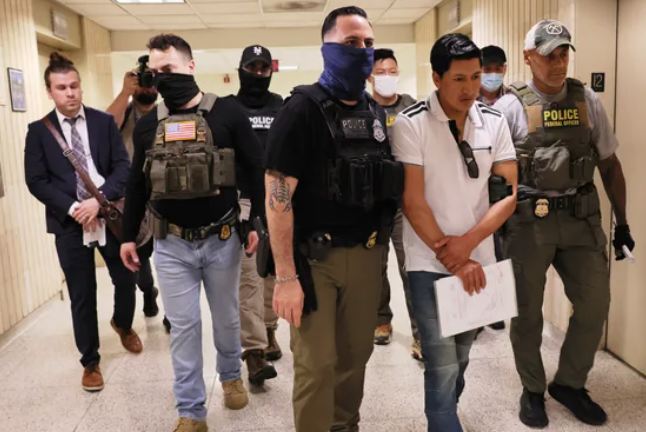
Note: the photo used in this article was used as a reflection of the possibility that ICE can apprehend immigrants when they go to court for case that are unrelated to their immigration status.
 Grand Rapids Institute for Information Democracy
Trackbacks
Comments are closed.