What ICE terrorism looks like in Grand Rapids and how we can respond to it
Editor’s note: For transparency sake I am a member of the core team for GR Rapid Response to ICE.
Most people are aware of all of the awful ways in which ICE is terrorizing immigrants throughout the country, especially in cities like Chicago, which the Trump Administration has targeted for immigration enforcement. There is no shortage of videos and article detailing the harm that ICE is doing, along with how communities are responding.
 What people in West Michigan might not know is that the same kind of harm commitment by ICE is happening right here in Grand Rapids. As someone who has been directly involved with GR Rapid Response to ICE I wanted to share a concrete example of how ICE harms people in this community, along with how the community has responded.
In early September, GR Rapid Response to ICE received a call from a Guatemalan mother of five, who’s husband had just been picked up by ICE. The family from the southern part of Guatemala had been in Grand Rapids for the last 4 years, living in the Burton Heights area.
Clara, who had recently given birth to their fifth child told a person who answered the GR Rapid Response to ICE hotline that her husband had just been picked up while on his way to work. Picking up people after they leave their house and are in a vehicle seems to be the preferred way for ICE to apprehend immigrants who are on their list. Clara told GR Rapid Response to ICE volunteer that her husband had already been taken to an ICE detention facility, specifically the GEO Group ICE Detention Center, also know as the North Lake Prison in Baldwin, Michigan.
Clara was now forced to raise her five children all by herself, at least for the immediate future. GR Rapid Response to ICE found out that she was not employed, did not know how to drive, didn’t have a driver’s license and didn’t know how she was going to be able to support her family. In the majority of ICE arrests they take the primary income earners, leaving families is a deep economic bind.
GR Rapid Response to ICE put out a Mutual Aid request as soon as they received the information about Clara’s husband and shared it on social media. Three days later I delivered the money to Clara, enough to pay for rent, plus groceries, utilities and doing laundry at a nearby laundromat.
The family was renting a small apartment on the second floor just off of Burton St. When I went to see Clara she invited me into the apartment, where I met all five of her children, with the oldest two being in elementary school. As is customary for indigenous people from Guatemala, Clara was a gracious host who seemed to be doing as well as can be expected from someone who had their husband kidnapped by ICE. The children were also friendly and curious about who I was. Indigenous Guatemalans are small and Clara stood at 4 ft 6 inches, weighing less than 100 pounds. After taking a seat, one of the older children said to me, “do you know where my daddy is?”
Too often we don’t think about the level of trauma that families endure when I takes someone, especially how children are impacted by trauma. Family separation for children will often have a lifelong impact, even if the consequences don’t manifest immediately.
While talking with Clara I learned what part of Guatemala she and her husband were from, which was a part of the country that I had been do, but had not spent a lot of time there. She smiled when I told her I had been to that part of her country, which seemed to make her more relaxed by my presence. In addition to bringing her money GR Rapid Response to ICE had raised I asked her if there were other needs. She promptly told me that one of her children had a dentist appointment the following week, so I wrote down the details and was able to find one of the many volunteers with GR Rapid Response to ICE who was able to transport her and her children to that appointment.
Over the next few weeks, Cosecha and GR Rapid Response to ICE were able to deliver diapers on several occasions, more money to cover the next months rents and transportation for another dentist appointment. When I brought more funds a second time Clara told me that her husband was being deported back to Guatemala. After a brief moment of silence, she then told me she had no reason to stay in Grand Rapids and wanted to go back home to be with her husband.
Over the next few weeks Cosecha helped her get the necessary documents she needs to fly back to Guatemala. Clara sold her husband’s truck, which was enough to cover the costs of plane tickets, but she asked if we could cover the cost of sending back several boxes of her children’s clothing so they would not return home with just the clothes on their backs. GR Rapid Response to ICE put out another Mutual Aid request and within two days we were able to cover the shipping costs.
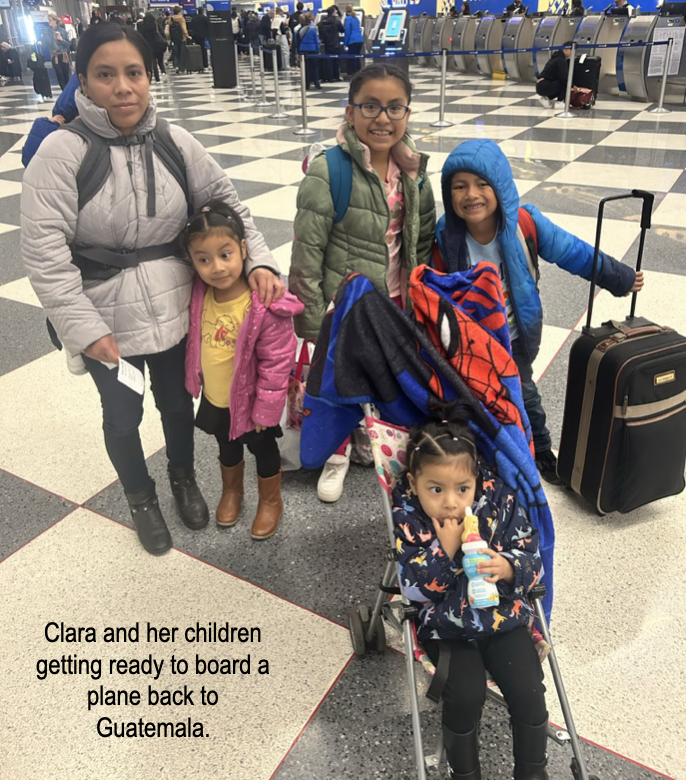
Once we knew the date for her flight that was leaving from Chicago, GR Rapid Response to ICE was able to find volunteers who could provide safe transportation to Chicago and make sure she and her five children got on the plane safely, especially since ICE activity in Chicago was cause for concern.
On Saturday morning, Clara and her five children flew back to Guatemala where they would be reunited with their father and Clara’s husband. Cosecha and GR Rapid Rapid Response to ICE made this happen, because that is what these groups do, they support members of the affected community who are harmed by ICE.
As a member of GR Rapid Response to ICE I want to acknowledge everyone who contributed money, shared the Mutual Aid request on social media, those who donated diaper, those who provided transportation and those who made sure that the family got to the airport safely. We often say, “This is what community looks like.”
At the same time, no family should have to experience this kind of trauma and violence at the hands of ICE agents and an oppressive detention system. This is why we need to resist ICE, so we don’t have to continue to request community support for immigrant families who have been harmed by ICE. Take a future GR Rapid Response to ICE training, get involved in the resistance, contribute to Mutual Aid requests and support the work of Movimiento Cosecha with your time, your solidarity, and your money. La Lucha Sigue!
 Grand Rapids Institute for Information Democracy
Trackbacks
Comments are closed.