What are the Sanctuary policies that Cosecha and GR Rapid Response to ICE are demanding from Grand Rapids and Kent County: Part IV
This is the fourth in a series that will further examine the various sanctuary policies that Movimiento Cosecha and GR Rapid Response to ICE are demanding that the City of Grand Rapids and the Kent County Commission adopt.
In Part I, I looked at the policy that allows officers to provide assistance to federal immigration authorities when there is an emergency that poses an immediate danger to public safety or federal agents. In Part II, I looked at policies that would prevent local governments from entering into a contract with the federal government to hold immigrants in detention. Kent County used to have a contract with ICE that began in 2012, a contract you can read here. In Part III, I looked at policies that could prevent immigration detention centers from being established in Grand Rapids or Kent County.
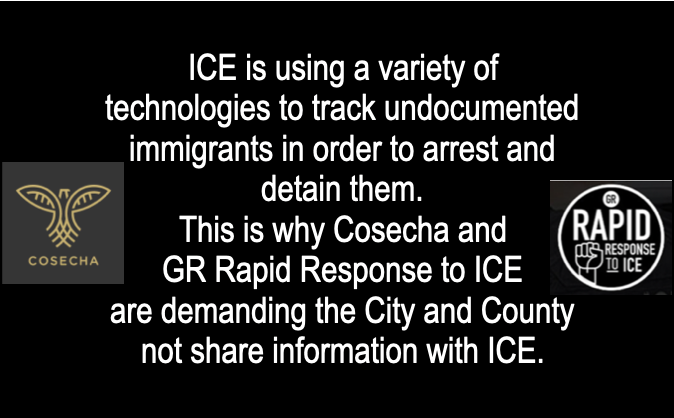
Today I want to look at two policies that are connected, since they both have to do with local government bodies sharing information with ICE. The first is a policy restricting the police or other city/county workers from asking about immigration status. The second is a policy that will not allow the GRPD or the Kent County Sheriff’s office to share Flock camera images or any other information gathered by the city of Grand Rapids with ICE or any other law enforcement agency seeking to arrest, detain and deport immigrants.
Demanding that the City of Grand Rapids and Kent County staff not ask people about their immigration status seems like an easy demand. Why would they ever have a reason to ask people what their immigration status is? Both the City and the County have repeatedly said that immigration matters are left to the federal government and federal agents. If this is the case, then agreeing to the demand that they not ask people their immigration should be a no brainer and yet, both the City and the County have ignored this demand.
The other demand has to do with the Flock cameras that are located in Kent County, with the majority of them within the City of Grand Rapids. I reported on the exact locations of the Flock cameras within the City and the County, which you can find in this article.
To be clear, Flock cameras are being used throughout parts of the US to provide license plate information to Immigration and Customs Enforcement (ICE) officials/agents. Now that we know the Flock camera location in the GR area, people who are vulnerable to ICE might consider alternate routes and destinations.
Automated License Plate Readers (ALPRs) are a threat to your privacy and civil liberties. They’re regularly used to track everyone’s movements without a warrant, probable cause, or reasonable suspicion. Law enforcement agencies use them for various purposes, no matter how unethical, including ICE raids and tracking abortion seekers across state lines.
The Kent County Sheriff’s Office first began using the Flock camera technology in the Spring of 2022. According to a recent article on 404 Media, Immigration and Customs Enforcement (ICE) is now using what are called Flock cameras to obtain license plate numbers to track down undocumented immigrants.
Using the Flock technology provides an additional tool to be used by the Kent County Sheriff’s Department, the GRPD and other local law enforcement agencies to assist ICE in hunting down those who are undocumented and those that the administration are targeting, regardless of immigration status.
It is well know that ICE is constantly using numerous types of technology to track undocumented immigrants, such as:
- ICE uses systems like FALCON, Investigative Case Management (ICM), and the forthcoming AI-powered ImmigrationOS platform developed by the company Palantir to aggregate data from various sources. These platforms pull information from government databases, including passport records, Social Security files, IRS tax data, and driver’s license data, to identify patterns and flag individuals for potential enforcement action.
- ICE agents use mobile apps like “Mobile Fortify” that allow them to photograph individuals in the field and check their images against federal databases in real time. ICE has also purchased software from companies like Clearview AI and uses iris scanning technology.
- ICE is expanding its efforts to monitor social media platforms like Facebook, TikTok, and Instagram, using AI-powered tools and contractors to generate leads for investigations and deportation raids.
- ICE has contracts for spyware like “Graphite” from Paragon Solutions, which can remotely access data, location, and encrypted messages from smartphones without the user’s knowledge or consent.
What Movimiento Cosecha and GR Rapid Response to ICE are demanding is that the City and the Kent County not share Flock camera images with ICE agents to track undocumented immigrants and to not allow City or County staff to ask people about their immigration status. These demands might seem insignificant, but for members of the affected community it is vitally important that they know that local governments are not sharing information with ICE about immigration status for those who live and work in the area, along with not sharing the Flock camera images with ICE under any circumstances.
 Grand Rapids Institute for Information Democracy
Comments are closed.