Senator Slotkin prefers to use cops as a tool of state carceral violence as opposed to the US military in US cities
Last week Michigan Senator Elissa Slotkin introduced a bill called the No Troops in Our Streets Act of 2025, SB 3167. Slotkin announced the bill in a speech at the Brookings Institution and used it as an occasion to blame Trump for soling making the decision to use US troops in cities across the country.
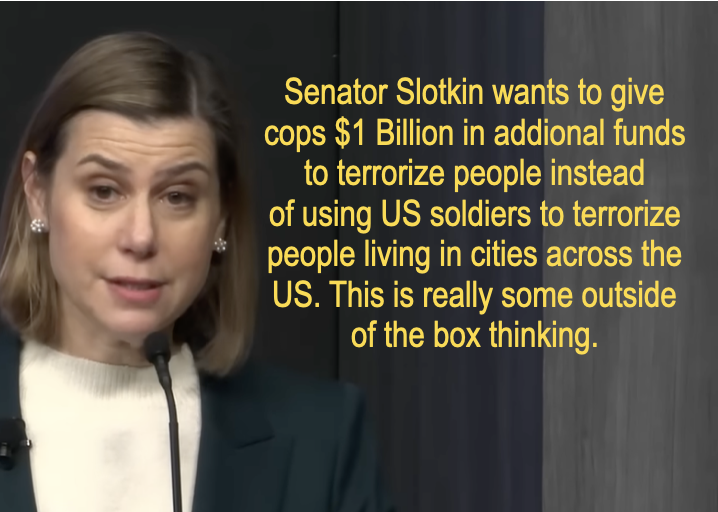
This proposed legislation from Senator Slotkin states in part that with a majority vote members Congress can prohibit US military personnel (including the National Guard) from being deployed domestically.
Seems like reasonable idea, but one question I have is, why now? The US Congress has supported the use of US Military personnel, especially the National Guard, to be used throughout US history, particularly to suppress popular struggles within the US. Some examples have been to suppress labor strikes, such as the Ludlow Massacre, along with National Guard troops being deployed against Black-led uprisings in numerous US cities in the 1960s (see Elizabeth Hinton’s book, America on Fire: The Untold History of Police Violence and Black Rebellion Since the 1960s) all the way up to 2020 during the George Floyd protests, even right here in Grand Rapids, Michigan. Thus, deploying US Military personnel in US cities has a long and bipartisan history.
However, the more important aspect of Senator Slotkin is proposing in her No Troops in Our Streets Act of 2025, is that the Michigan Senator wants the federal government to provided additional funding to local police departments across the country to. “fight crime in American communities,” according to Press Release from Slotkin on November 13th.
Senator Slotkin not only wants to provide additional funding to cops around the US, she is proposing $1 Billion in funding for police departments. Here is the breakdown of funding in Senator Slotkin’s proposed bill:
(1) $600,000,000, to remain available until expended, for the Edward Byrne Memorial Justice Assistance Grant program as authorized by subpart 1 of part E of title I of the Omnibus Crime Control and Safe Streets Act of 1968 (34 U.S.C. 10151 et seq.) (except that section 1001(c), and the special rules for Puerto Rico under section 505(g), of title I of that Act shall not apply for purposes of this Act);
(2) $150,000,000, to remain available until expended, for a community violence intervention and prevention initiative; and
(3) $50,000,000, to remain available until expended, for emergency law enforcement assistance, as authorized by section 609M of the Justice Assistance Act of 1984 (34 U.S.C. 50101), to support any of the purposes specified in section 501 of the Omnibus Crime Control and Safe Streets Act of 1968 (34 U.S.C. 10152), of which the President may direct not greater than $10,000,000 per law enforcement emergency, as defined in section 609N of the Justice Assistance Act of 1984 (34 U.S.C. 50102), with the approval of the chief executive of the State and locality, to support State and local law enforcement.
(b) Community-Oriented policing hiring.—In addition to amounts otherwise appropriated, out of any money in the Treasury not otherwise appropriated, for fiscal year 2026, there is appropriated $100,000,000, to remain available until expended, for grants for the hiring and rehiring of additional career law enforcement officers under section 1701 of the Omnibus Crime Control and Safe Streets Act of 1968 (34 U.S.C. 10381).
It is instructive to see that Senator Slotkin’s response to the Trump Administration’s deployment to cities like Los Angeles, D.C., Chicago and now to North Carolina, is to just increase the funding for police departments, which essentially act as occupying forces in urban communities. It’s also worth noting that Senator Slotkin has not denounced ICE in Chicago or other cities for kidnapping people and acting as an additional police force targeting immigrants.
Senator Slotkin states that the $1 Billion in funding for cops is to fight crime, even though there is no evidence of increased crime in the US, especially violent crime. In fact, the last FBI report released in August of this year states that violent crime has decreased by 4.5% from the previous year.
Lastly, why isn’t Senator Slotkin proposing massive funding to meet people’s basic needs instead of funding the cops? Slotkin’s proposed legislation is not only deeply problematic, she demonstrates that liberals are equally committed to state carceral violence as the Republicans are.
 Grand Rapids Institute for Information Democracy
Comments are closed.