More propaganda from the West Michigan Policy Forum about the Invest in MI Kids ballot initiative
Members of the Grand Rapids Power Structure are once again spreading propaganda about a ballot initiative that would mildly raise taxes for the wealthiest people in Michigan.
Here is the language for the Invest in MI Kids ballot initiative:
Constitutional amendment to: add, beginning in 2027, an additional 5% tax on annual taxable income over $1 million for joint filers and over $500,000 for single filers. This tax is in addition to existing state income taxes, and is to be deposited into the State School Aid Fund and required to be used exclusively on local school district classrooms, career and technical education, reducing class sizes, and recruiting and retaining teachers; and subject funds to annual audits.
There are currently 12 billionaire families living in Michigan, with 2 right here in the Grand Rapids area, the Meijer and DeVos families. According to one source, there are 73,364 households in Michigan with $500,000 or more in income, which makes up only 1.8% of the population. Therefore, if the ballot initiative is passed, then 1.8% of the population – the wealthiest members of Michigan – will pay increased taxes that will generate billions for public schools.
What Propaganda looks like
In July, I wrote about groups that were against the Invest in MI Kids ballot initiative, specifically in this area, like the Grand Rapids Chamber of Commerce and the West Michigan Policy Forum. I have identified both of these groups as members of the Grand Rapids Power Structure for years.
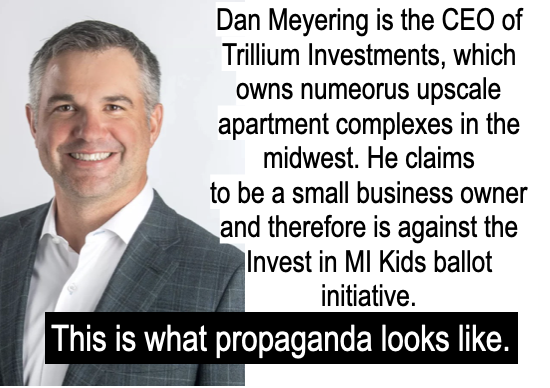
The latest attack against the Invest in MI Kids ballot initiative was posted in Crain’s Grand Rapids Business, with the headline, Michigan can’t afford a tax hike wrapped in education promises. This commentary piece was written by Dan Meyering, who is the CEO of Trillium Investments and a board member of the West Michigan Policy Forum.
Meyering makes numerous claims in this article, but never sources any of his claims. In addition Meyering uses the standard Capitalist Class argument for raising taxes for the wealthiest members of society. Here Meyering argues:
If adopted, this income tax increase would fall hardest on Michigan’s small businesses, not its largest corporations. In fact, over 75% of those who would pay more under this plan are small business owners. That’s because many small businesses are “pass-through” entities, meaning owners pay taxes on business earnings and even money reinvested into growth, hiring, or equipment. The simple truth is these entrepreneurs aren’t forced to pay additional taxes on household income of $500,000 for single filers; they’re taxed on their business’ income.
First of all, if passed, the Invest in MI Kids ballot initiative would not increase taxes for corporations, yet Meyering includes corporations in his deceptive argument. Second, Meyering makes the claim that whatever profits small businesses make gets reinvested in new hiring or equipment, but again does not provide evidence or data to support such a claim.
Later in the article, Meyering uses the standard anti-public education talking points, where he states:
We should focus on three clear changes to help kids learn:
- Make sure third-grade reading works by supporting teachers with proven science-of-reading instruction and literacy-based advancement.
- Give parents transparency to make school performance data clear, comparable and accessible.
- Expand options for families. Every child learns differently, and every family deserves access to the education model that works best for them.
It is worth noting that Meyering refers to himself as a small business owner. Now, when I think of a small business owner I think of someone who owns a neighborhood restaurant or a bookstore. Meyering is the CEO of Trillium Investments, which owns a growing number of multifamily apartments across the midwest. These apartments are not affordable to most people, thus Meyering’s company owns apartment complexes that cater to members of the professional class. Thus, owning apartment complexes in Michigan and Minnesota hardly makes one a small business owner.
Meyering has a history of using his wealth and position of influence to impact public policy that benefits the wealthy and punishes working class people. For example, Meyering sits on the board of the Michigan Strategic Fund, which uses public dollars to support private projects, like the one he voted on to give $252.3 million of incentives for Amphitheater in downtown Grand Rapids. Meyering was also a signatory to the GR Chamber’s push for the City of Grand Rapids to adopt ordinances that would criminalize the unhoused.
Lastly, Meyering contributes to political campaigns locally, where he uses his wealthy to influence the outcome of elections. Meyering contributed $1000 or more in the following local elections since 2022:
$1000 to Andrew Robbins who ran for Grand Rapids 1st Ward Commissioner in 2022
$1000 to Kenneth Hoskins who ran for Grand Rapids 3rd Ward Commissioner in 2022
$1225 to Dean Pacific who ran for Grand Rapids 1st Ward Commissioner in 2024
$1225 to John Krajewski who ran for Grand Rapids 3rd Ward Commissioner in 2024
If Meyering can spend that kind of money to influence local elections and sit on state boards that approve millions of public dollars for private projects, he can surely pay a modest increase in income taxes to benefit public education. This is what propaganda looks like and why we need to call it out.
 Grand Rapids Institute for Information Democracy
Trackbacks
Comments are closed.