The threat to cut SNAP benefits and why we need to radically imagine a different approach to make sure everyone has enough to eat for the rest of their lives
There is deep concern about the threat against people not receiving SNAP benefits in the coming days, and rightfully so. According to a recent KConnect message, “SNAP benefits are a lifeline for nearly 76,000 individuals in Kent County alone, including almost 32,000 children.”

Rep. Hillary Scholten posted on her Facebook page recently these comments related to SNAP:
We’re mere days away from folks losing the benefits they need to put food on their table. I led Michigan Dems in Congress to call on c. Rollins and the U.S. Department of Agriculture to use their contingency fund, which is set aside for scenarios exactly like the one we’re in now. We can’t leave American families to starve.
This is a nice sentiment from Rep. Scholten but sentiments don’t put food on the table for the thousands of families in Kent County that will suffer once SNAP benefits get cut.
It is never a question of lack of money, but a matter of priorities
If Rep. Scholten was really serious about making sure that people who live in her district would not go hungry, there are several things that she could do to demonstrate her commitment to food justice and economic justice simultaneously.
- Rep. Scholten could stop voting for the massive annual US military budgets, which are just shy of $1 Trillion annually. The US military budget is larger than the next 9 largest country military budgets combined. Having a vastly smaller US military budget would guarantee that there would be funds to make sure the millions of food insecure people living in the US would have enough food, health care, etc. From the 3rd Congressional District alone, taxpayers are paying $1.82 billion to the US military budget on an annual basis, according to the National Priorities Project. Imagine what kind of community care work could be done for people on an annual basis with $1.82 billion?
- Rep. Scholten could choose to redirect the millions she raises every 2 years for her re-election efforts and spent that money on food for the people in her district that would lose SNAP benefits. Lets face it, most of the campaign contributions go towards awful and deceptive campaign ads. Rep. raised over $5 million for her 2024 election campaign, according to Open Secrets. In addition, using campaign funds to meet the daily needs of people living in the 3rd Congressional District would likely get her more votes than campaign ads that few people actually pay attention to.
- Rep. Scholten and her fellow Democratic Party colleagues in Congress could engage in a creative act of Civil Disobedience and get arrested in Washington, DC to demonstrate their commitment to the people living in their district demanding that cutting SNAP benefits is unjust. Making statements on social media is performative, but taking direct action stands a greater chance of forcing the Trump Administration to not punish people who are food insecure.
What happens when we take care of each other
I have no illusion that Rep. Scholten or other politicians and governments at any level will actually do the kinds of things I suggested above, which is why I believe that we ultimately shouldn’t rely on government programs like SNAP.
I believe that communities can take care of themselves. Now I am not talking about charity or just doing local food drives. Those types of things might be necessary in the short run, but I am saying is that we need to re-orient our communities to be more interdependent and not rely on the crumbs that governments provide to the people. Governments and politicians have not and do not serve the interests of the majority of the public, so we better come to terms with that fact.
There are groups in Kent County right now that are not waiting for people to go hungry, but are actively engaged in ways to provide some Mutual Aid to those who will lose SNAP benefits. The Grand Rapids Area Mutual Aid Network has been doing this kind of work since March of 2020 just days after the US government finally acknowledged the pandemic. There is also work being done to provide more food equity from the group Unite & Resist, which is included in the graphic here above. And of course people can contribute to local food pantries or get involved in other food emergency efforts, but these are all short term solutions, also hereontheright.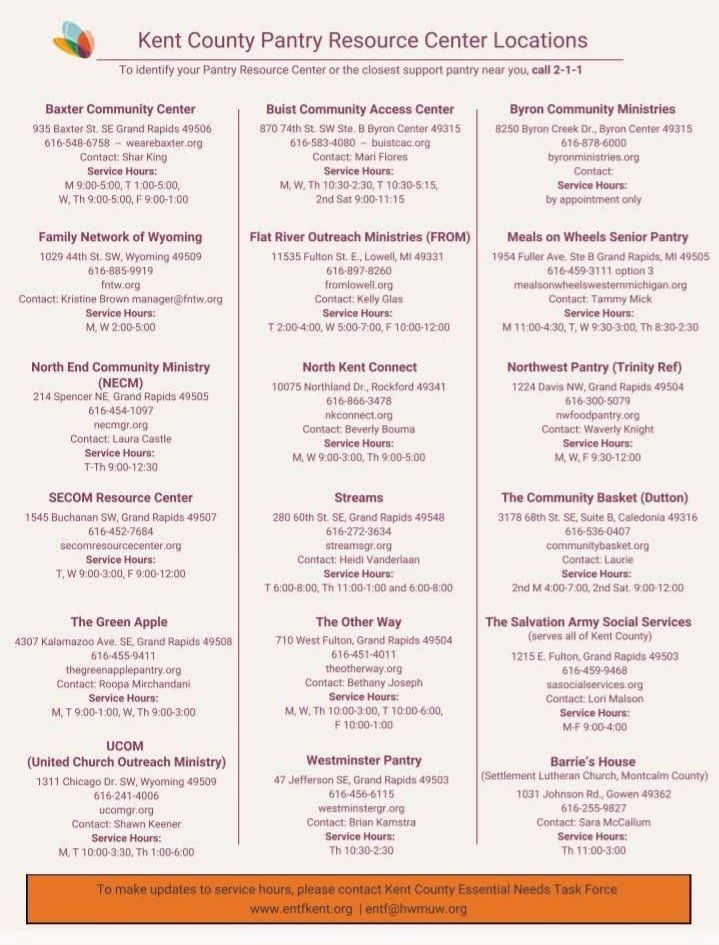
During the height of the COVID pandemic I wrote a series of articles entitled, Why we can’t go back to the way things were in Grand Rapids. Part II in that series was Re-imagining a new food system.
So what might a radically re-imagined food system look like in the Grand Rapids area? Here, we offer 10 ideas about how to move in that direction.
- We do need more people to question the existing food system and learn food growing and food preserving skills. More people growing and preserving food is an important step, but it is only a first step and not the end goal.
- We need large, fully functional farmers markets in a sectors of the Grand Rapids area, which will make it easier for more people to access fresh food that is in their neighborhood.
- We need to guarantee that people have access to land to grow food, particularly to grow food collectively. I support people turning their lawns into spaces of food production, but this is often a privileged response, since many people do not have lawns. Vacant lots, church property, green space that exists at commercial facilities, all need to be made available for people to collectively grow food.
- Right now, a great deal of food that is grown in West Michigan, does not stay in West Michigan. Many of the area farms grow mono-crops, like corn and apples, which are either used for animal feed (in the case of corn) or the food is sent abroad to be used in the creation of highly processed foods. Current, the food system is not bio-regional and this also means that the average food item grown will travel 1,000 miles before it is consumed. This is not sustainable, nor should it be desirable. More farmers would use a CSA model (Community Supported Agriculture), but this requires that thousands more need to join a CSA.
- Food waste is built in to the current food system. Food that goes bad before it gets to consumers is expected and used as a write-off in the current food system. Then there is the amount of food that grocery stores throw away because it has expired and all the food that is thrown away by restaurants and other institutions that prepare thousands of pounds of food every day. So much food ends up in a landfill, food that could be used to meet the nutritional needs of so many people.
- We need to rethink how we access food and move beyond supporting the large grocery chains, moving to other food distribution models. We need more food coops, food buying clubs, more CSAs and more neighborhood-based farmers markets. 75% of the food sold in Grocery store chains is highly processed foods that we don’t need, and if fact, the highly processed foods is what has led to a major health crisis, especially for those experiencing poverty.

- The Slaughterhouse industry has also now being exposed to its brutal and dysfunctional nature. For years we have know that a meat-centric diet in the current food system is a major contributor to climate change. Moving forward we need to come to terms with the fact we need to significantly reduce animal consumption to truly have a just and sustainable food system.
- Right now it is apparent that agricultural workers/migrant workers are “essential workers.” However, agricultural workers/migrant workers have always been essential to the current food system, despite the fact that they are exploited on a massive scale. Food worker demands should be met, which includes a livable wage, safe working conditions, just housing conditions and the elimination of the threat of ICE arrest, detention and deportation, since many workers in the food system are undocumented. Farmworker unions should be a priority.
- Farmworker labor improvements are a good first step, but it would still not do much to challenge the existing food system. We need massive land reform, which includes a longstanding tradition, particularly in the Global South, where those who work the land should own the land.
- We also need to challenge the massive subsidization of the current food system, also known as the Farm Bill. Billions of dollars of taxpayer money is used to support a dysfunctional, exploitative and unjust food system.
- Instead of ending the Farm Bill, maybe we need to radically re-imagine a new Farm Bill that would redistribute the billions going to support the agribusiness sector and redistribute that money to fund all of the other ideas listed above.

These ideas are just the beginning of what a radically re-imagined food system might look like, but it is just that, a beginning. We have to radically re-image our economy, our housing system, transportation, health care, community safety and so much more if we want to begin to practice real solidarity and work towards collective liberation. Politicians won’t save us nor the existing systems that have been designed to maintain power and privilege. Another World is Possible!
 Grand Rapids Institute for Information Democracy
Comments are closed.