I was invited to submit some entires for the Zinn Education Project’s social media popular education platform known as This Day in History
Last week someone with the Zinn Education Project sent me a message asking if I would like to submit some pieces for their online popular education tool known as This Day in History.

I was delighted and honored to be invited to submit some options and the three that I cam up with are: the 1911 Grand Rapids Furniture Workers Strike, November 4, 1985 Calvin students take action on getting the school to divest from South African Apartheid, and June 28, 2018 – Beginning of the End the Contract with ICE Campaign.
I wanted to submit several clear examples over the past century, all of which demonstrate people power. Minutes after I submitted them, all three were approved by the Zinn Education Project and will be included on their social media platforms.
1911 Grand Rapids Furniture Workers Strike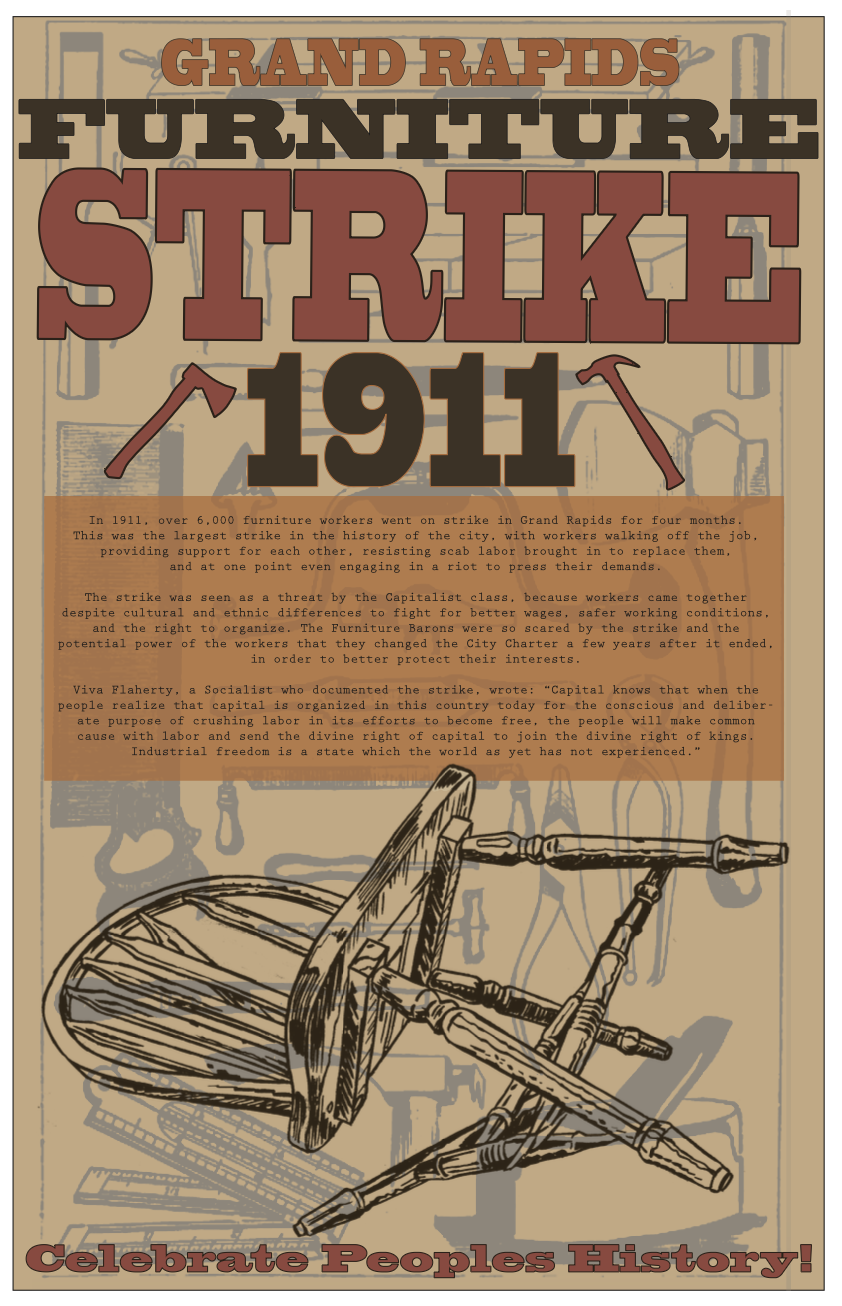
The 1911 strike was founded on longstanding worker grievances. As early as 1909, the workers discovered that the price of the furniture they produced had increased by 10%, and they demanded that their wages be increased. Some of the workers who called for the increase were fired shortly thereafter for being agitators.
The furniture workers strike began in the Spring of 1911, with estimates of between 4,000 – 6,000 workers going on strike, and with thousands more in support of the strikers. Just prior to the beginning of the strike, the Grand Rapids Employers Association sent Francis Campau to deliver a message to the press, in order to influence public opinion, that workers were being treated fairly. Francis Campau was the grandson of the brother of Louie Campau, the so-called founder of Grand Rapids.
Furniture workers, on the other hand, had a very different view of life working in those factories. One important source that reflected the worker’s perspective was a booklet called, History of the Grand Rapids Furniture Strike: With Facts Hitherto Unpublished. This documented was created by Viva Flaherty, a secretary at Fountain Street Church and a known Socialist. Flaherty documented the 1911 strike because she believed that the “people of Grand Rapids are awakened and enlightened and they can be trusted with the whole truth.”
Flaherty makes it clear in her version of the story that the strike was able to endure because of the seven unions that were involved, with membership of over 4,000 workers in thirty-five shops in Grand Rapids. She also documented that the Christian Reformed Church would not grant their members the right to be part of the union, since labor rights and organizing were not “founded on divine right.”
Flaherty documents the kind of wages earned by those in the furniture industry, stating that of the eight thousand furniture workers employed in Grand Rapids, most made less than $2 a day.
The Catholic leader, Bishop Schrembs, came out in support of the strike, stating, “I consider the present labor situation in our city as a most deplorable one from every point of view.” Bishop Schrembs was later banished to the Diocese of Toledo for his solidarity with furniture workers.
The strike ended in August of 1911 and the workers did not win the demands they had hoped. However, they did win lots of public support. During the 1911 Labor Day parade, there were an estimated 10,000 people walking in the parade. The Grand Rapids Furniture Barons, were not happy with worker demands and how much support there was from the city government. In 1916, the Furniture Barons put forward a ballot initiative that changed the City Charter from a 12 ward system to a 3 ward system, in order to consolidate their power. The current ward system we have in Grand Rapids today, is a direct result of those in power punishing workers and their families.
For additional information, see the book, “A People’s History of Grand Rapids”, by Jeff Smith
November 4, 1985 Calvin students take action on getting the school to divest from South African Apartheid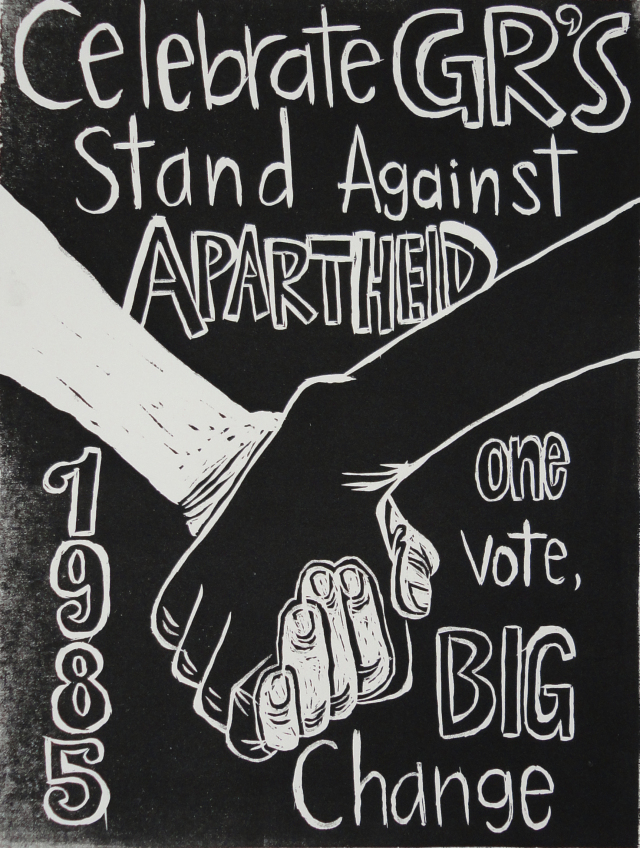
The South African Anti-Apartheid movement was a global movement that took decades to dismantle the legal system of apartheid in South Africa.
In Grand Rapids, there were several anti-Apartheid campaigns that were successful, including the Grand Rapids Public Schools and the City of Grand Rapids. Both of those entities adopted resolutions and put in place practices to divest from companies profiting off of the racist system of Apartheid in South Africa.
A third campaign was led by students from what was then called Calvin College. The students would then recruit Calvin faculty to be part of the campaign, which was eventually successful. What follows is a letter from one of the student organizers to Calvin administrators, a letter that was dated November 4, 1985.
Dear Priorities Committee Member,
The following is a copy of a motion passed unanimously by Student Senate at its October 28 meeting. Part of the request was that the faculty join the Student Senate in making this resolution. This resolution now comes before the Priorities Committee for our discussion regarding its presentation to the entire faculty.
In the summer of 1984, the Synod of the Christian Reformed Church condemned the Biblical defense of apartheid as heresy. The the autumn of 1985 apartheid remains the official policy of the South African government. Under this system of racial segregation, the injustice of minority oppression continues. Therefore, in keeping with the spirit of the Synod’s decision, we the Student Senate of Calvin College, resolve to commit ourselves to take the following action as a manifestation of our strong disapproval of the policy of apartheid and as an expression of our sincerest desire to see the system of apartheid dismantled and replaced by a system that recognizes the equality and oneness of all people before God their Creator: The Student Senate strongly urges Calvin College to divest itself of all holdings in corporations currently doing business in South Africa or transacting business with the government of South Africa.
Student Senate also mandates the Student Senate Executive Committee to draft letters to the companies from which we are recommending the divestment of Calvin College’s holdings expressing Student Senate’s concern regarding involvement in South Africa and explaining the reasons for our action.
Student Senate urges the Faculty to join us in making this resolution.
Very Truly yours,
Craig Knot
Student Body President
For more information on the Grand Rapids anti-Apartheid Movement, especially source material, go to this link and read Chapter 6 of A People’s History of Grand Rapids by Jeff Smith.
June 28, 2018 – Beginning of the End the Contract with ICE Campaign
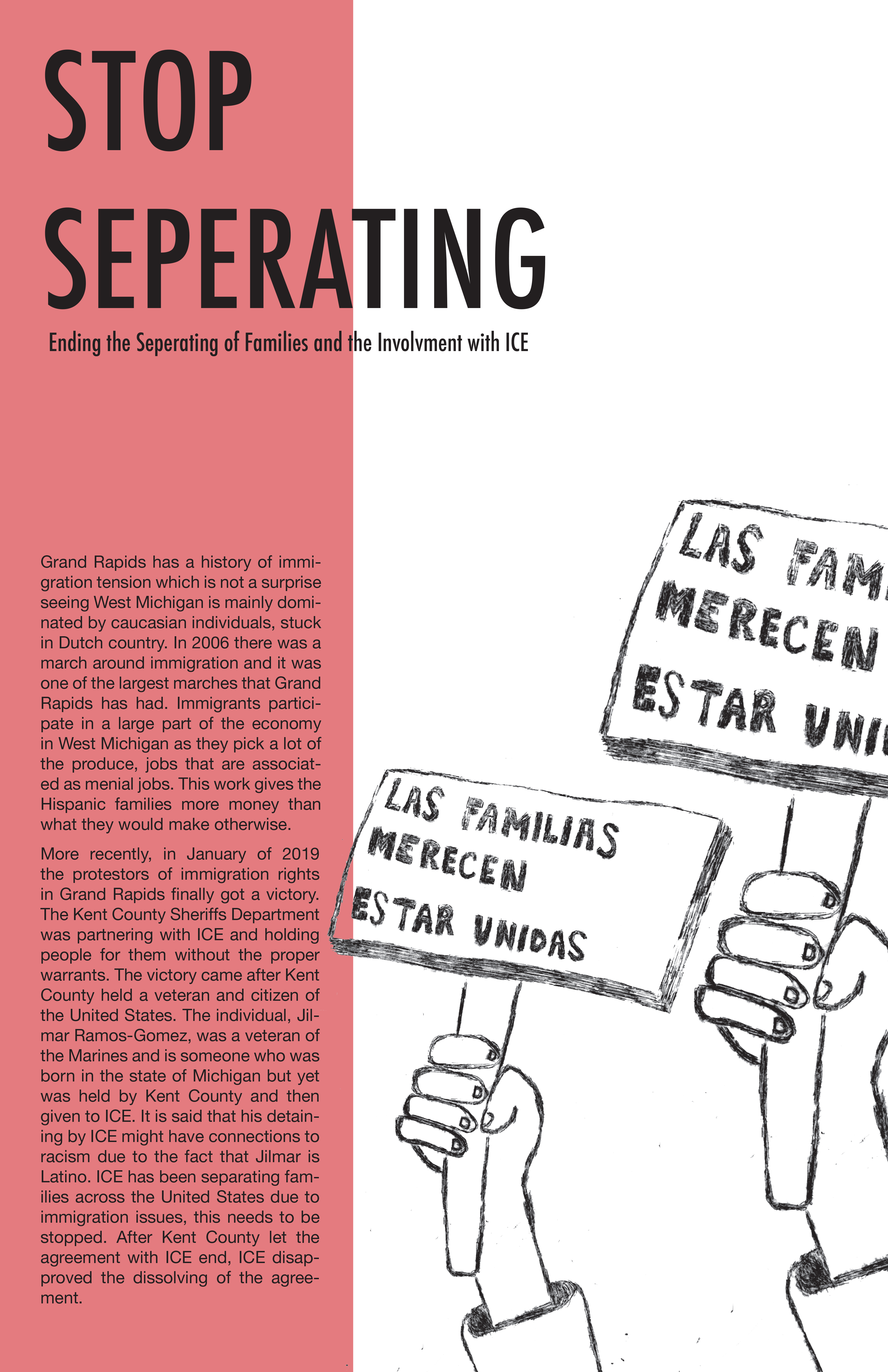 On Thursday, June 28th, 2018, roughly 250 people showed up to the Kent County Commission meeting, a turnout that is rarely seen at such meetings. People with Movimiento Cosecha and GR Rapid Response to ICE had been planning for months to attend the commission meeting and demand that they end the contract between ICE and the Kent County Sheriff’s Department.
Organizers waited until the Public Comment period of the commission meeting and after a few people spoke, a few dozen people occupied the space in the commission chambers, where the Kent County Commissioners sat during the meetings. Some people unfurled a large banner that said, Kent County Separates Families, End the Contract!
Most of the Kent County Commissioners got up and left the meeting, with a just a few of them remaining. The End the Contract campaign organizers asked people to come to the podium and have a People’s Hearing, where dozens of people, primarily those impacted by ICE violence, spoke about the fear they experienced, fear of arrest, fear of detention and fear of deportation. For more than an house the People’s Hearing was conducted, essentially taking over the Kent County Commission meeting.
This was the first action taken in the End the Contract Campaign, which lasted until the following year, when Immigration and Customs Enforcement decided to end their contract with the Kent County Sheriff’s Department, primarily because of all the negative and national press generated from the protests and the abusive actions of ICE and Cops in Grand Rapids.
It should be noted that the Kent County Commission, nor the Sheriff’s Department, called for an end to the ICE contract. In fact, Immigration and Customs Enforcement (ICE), is the entity that ended the contract with Kent County, primarily because of how much media attention the End of Contract campaign was getting. The amount of attention was two fold. First, the 14 month efforts of Movimiento Cosecha GR and GR Rapid Response to ICE engaged in numerous Direct Actions that not only confronted Kent County officials, it engaged the public and generated a tremendous amount of media attention. Second, when an off-duty GRPD Captain contacted ICE about a former US Marine, whom the cop thought was an undocumented immigrant, the national media began to pay attention to the absurdity and immorality of the racist profiling of immigrants. Thus, ICE ended their contract with Kent County in September of 2019.
For additional information, see Chapter 9 from A People’s History of Grand Rapids.
 Grand Rapids Institute for Information Democracy
Comments are closed.