We need to come to terms with the history of US government repression and stop saying “this is not the US” when the most recent incident happens
Last week, ICE agents stormed an apartment complex in Chicago where witnesses say they broke down residents’ doors, smashed furniture and belongings, and dragged dozens of them, including children, placed in U-Haul vans.
In the days that followed this action by ICE there were lots of articles with headlines like, ‘Surreal Moment for America’: ICE Agents in Chicago Drag Children Out of Their Homes, Ransack Building. There were also social media posts that read – Putting an apartment building under siege and rappelling from Black Hawk helicopters into the apartment building is NOT the United States.
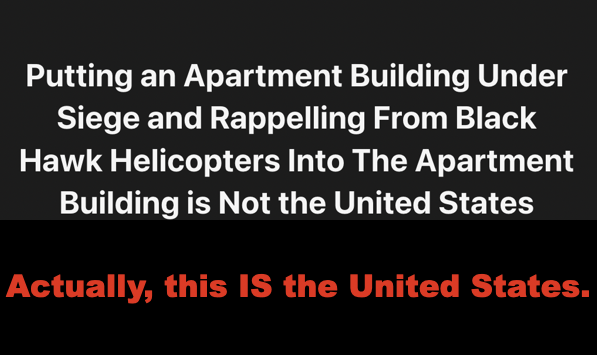
I certainly understand the sentiment, the outrage and the visceral reaction to such brutal repression by a US government agency. However, such actions are part of the very fabric of what the US government has been doing since it was founded. In fact, the US was founded on the genocide of Indigenous people and the enslavement of African people.
Now, I know that good, white liberals know this, but if they know this, then why do they respond to the recent ICE action in Chicago by saying this is NOT the US? I’m not sure of this a lack of awareness, a lack of education about US history, or the possibility that people are in denial about this history. I think it is a combination of these three elements, but being in denial might be the most powerful.
If people believe the narrative created by those in powerful, that the US is the greatest country on the planet or that the US is a shining example of democracy, then to be confronted with the reality that this is simply not true would radically alter how people move forward, particularly in terms of how we view one administration from another. In other words, if political repression was a constant, which it has been, then we have to come to terms with the fact that government repression is a bi-partisan practice.
I’m not sure why we don’t own up to the fact that the US was founded on genocide and slavery, but maybe that is because those are somewhat vague concepts. What follows are some concrete examples of US government repression that makes what ICE did in Chicago last week seem rather tepid.
1838 Trail of Tear – The US Military forcibly removed Indigenous people from 5 different Indigenous nations in order to provide more land to white settlers in the state of Georgia. The forced removal resulted in the deaths of thousands of indigenous people, including children and the elderly.
1864 Sand Creek Massacre – US troops killed 230 people, most of which were women, children, and elders of the Cheyenne and Arapaho nations at sunrise on November 29, 1864 at Big Sandy Creek in southeastern Colorado.
As a result of the Chinese Exclusion Act (1882) – in 1885 and 1886, at least 168 communities carried out Chinese expulsion and self-deportation campaigns. These campaigns resulted in the destruction of Chinese businesses, homes and several massacres.
1919/1920 Palmer Raids – The US Attorney General oversaw the arrest of thousands of people who were speaking out against the US participation in WWI, but mostly because of the labor organizing being done by people who identified as anarchists, socialists and communists. 6,000 people were arrested across 36 cities. with 556 foreign citizens being deported, including a number of prominent leftist leaders.
Japanese internment was the forced incarceration of over 120,000 people of Japanese descent, most of whom were American citizens, during World War II, following the attack on Pearl Harbor. Fueled by prejudice and wartime hysteria, Executive Order 9066 authorized the forced removal of Japanese Americans from the West Coast into government-run “relocation centers” or internment camps.
Forced sterilization has been systematically used against Black, Indigenous, and Latina women in the United States since the early 20th century, rooted in racist eugenics policies that disproportionately targeted poor women of color. These practices were driven by the racist belief that these women were “unfit” to be mothers and that controlling their reproduction would solve social problems and reduce welfare costs.
On May 13, 1985, the streets of Philadelphia shook with such force that some thought a gas main had blown. The quake, as it turned out, was the result of the Philadelphia Police Department dropping a bomb on the headquarters of MOVE, a Black liberation and environmentalist organization located in West Philadelphia. The bomb killed 11 people, including five children, and the resulting fire destroyed an entire city block.
These are only 7 examples of how the US government has engaged in repression against mostly communities of color, but it is important to note that this has been a constant throughout US history.
We need to stop romanticizing the US around the issue of government repression and start coming to terms with the fact that this has been an ongoing shit show. Where we can take some comfort or even inspiration, is from the incredible courage, efforts and sacrifices that hundreds of thousands of people have made throughout US history to combat government repression. This is the lesson we can learn from Chicago, to see that people are fighting back in the face of government repression, instead of being shocked by what the US government has been doing since it was founded. Power to the People!
Sources used:
An Indigenous Peoples’ History of the United States, by Roxanne Dunbar-Ortiz
America for Americans: A History of Xenophobia in the United States, by Erika Lee American Intolerance: Our Dark History of Demonizing Immigrants, by Robert Bartholomew & Anja Reumschussel
A Little Matter of Genocide: Holocaust and Denial in the Americas 1492 to the Present, by Ward Churchill
An Afro-Indigenous History of the United States, by Kyle Mays
American Eugenics: Race, Queer Anatomy, and the Science of Nationalism, by Nancy Ordover
From #BlackLivesMatter to Black Liberation, by Keeanga-Yamahtta Taylor
From the Palmer Raids to the Patriot Act: A History of the Fight for Free Speech in America, by Christopher Finan
 Grand Rapids Institute for Information Democracy
Comments are closed.