GRIID Interview with Leanne Kang on the upcoming Community Historians workshops and the Grand Rapids Public Schools
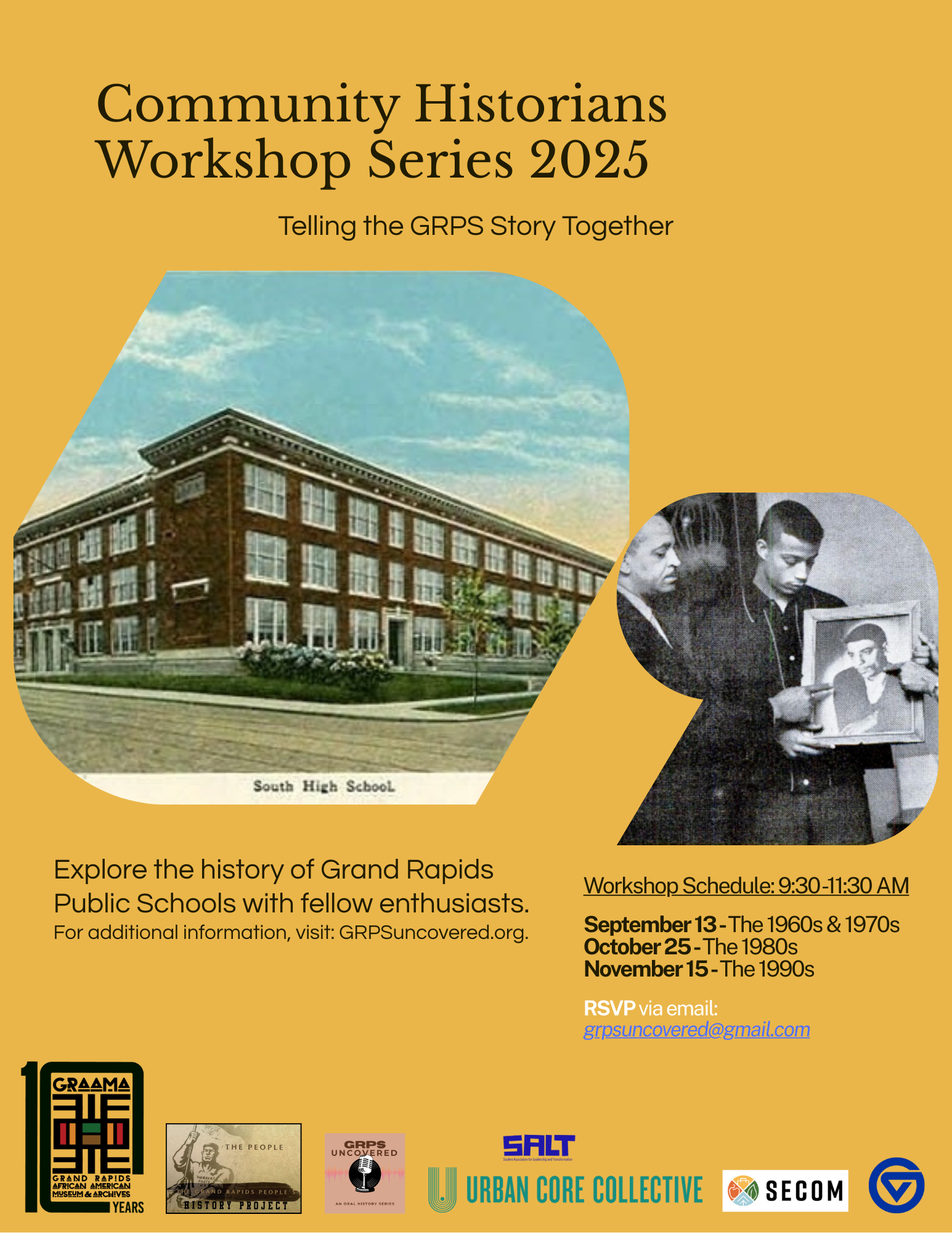 I recently sat down with GVSU professor Leanne Kang to talk about the upcoming Community Historians workshops and the work that she has been doing with oral histories of people who either attended or worked for the Grand Rapids Public Schools.
GRIID – You wrote the book, Dismantled: The Breakup of an Urban School System: Detroit, 1980–2016, what were some of the main takeaways from that book?
Leanne – One of the main takeaways from Dismantled is: Beginning in the 1990s, there was a succession of educational policies that on the surface appeared to be different in nature, but all of them were designed to weaken Detroit’s local power and decision-making around schools. Basically, over time, these policies – Proposal A, mayoral control, the Education Achievement Authority (to name a few) – succeeded in eroding and displacing Detroit’s education regime with a new regime of outsider decision makers. This new outsider regime, which I refer to in the book as the market governance regime, consists of billionaire philanthropists, such as Betsy DeVos, foundations, educational entrepreneurs (e.g., J.C. Huizenga), and “educational executives” (e.g., former governors John Engler and Rick Snyder).
GRIID – For the past 18 months you have been interviewing people who were students in the Grand Rapids Public Schools. What stories/messages that people have shared stand out to you?
Leanne – Jerry Bentley and Jermar Sterling’s interviews stand out to me in particular because of where their stories pick up in terms of periodization. Jerry’s interview is a recounting of where he was and what he was doing during GRPS’s efforts to integrate in 1968 and when Union High School broke out into a race fight within a few days. Fast forward to Jermar’s story in the 1980s and he’s describing having an incredibly difficult time in school and is essentially telling a story of his experience of what education scholars have decried as the school-to-prison pipeline in U.S. cities.
GRIID – Have you noticed some similarities between Detroit Public Schools and the GRPS?
Leanne – DPS and GRPS are similar in that they both share the history of northern residential segregation and its effects on urban schooling. As Black migrants fled to northern cities from the Jim Crow South in the mid-twentieth century, Whites refused to live with Blacks. White northerners responded with real estate practices such as racially restrictive covenants and redlining that ensured Blacks lived in separate areas in the city. Meanwhile, suburban expansion created opportunities for Whites to leave the city and build equity, as Blacks were denied home mortgage loans.
By the 1960s, Black residents in both Detroit and Grand Rapids were calling out this issue and sought to better the schooling of their children. Both cities experimented with integration, attempts to create more racial balance by busing Black and White children to schools outside of their neighborhood.
More than 50 years later, however, the economic and color line continues to exist in both cities, and their school districts continue to struggle with funding and providing their students with a quality of education akin to their suburban counterparts.
With this being said, I do think there are major differences between the two urban school districts, which is why in part I’m interested in studying GRPS’s history. For one, Detroit is a majority Black city and Grand Rapids is a majority White city. Historically, the two cities have influenced state and national politics in radically different ways. Consider how the former Secretary of Education Betsy DeVos is from Grand Rapids…
GRIID – You and several community partners are hosting a series of discussions around the history of the Grand Rapids Public Schools, beginning in the 1960s. What is the goal or hoped for outcome of these community workshops?
Leanne – Our hope is that the community can join us in investigating GRPS’s history. What happened after integration efforts in the 1960s and 1970s? How did the school district evolve over the decades? Why are things the way they are today?
Another outcome we hope for is to create opportunities for community gathering and storytelling. We hope to create a space where community members can make sense of their collective past. We also hope that the workshops will be intergenerational as younger and older generations listen to stories and contemplate the relationship between past and present, as well as future.
GRIID – Why do you think it is important for people and for the community to understand the history of the GRPS, especially a history that is partially based on the lived experiences of those who attended the GRPS?
Leanne – There are so many ways to respond to this question, but I’ll focus on this one idea that’s been important to me both personally and as a researcher. So much of what we think is “normal” or “the way things just are” is socially constructed, including the ways we understand and tell history. Thus, to tell history as a community and to emphasize particularly the lived experiences of those who were affected by unequal schooling is to think and do things differently from the “norm.” With things being the way they are more than 50 years later, the “norm” is but the status quo – education researchers and policymakers, and the public, who have relied on quantitative analyses and certain ways of viewing and thinking about the world, have been ignorant of the voices and sense making of the community. We need to see things differently if we’re going to move towards a better future for all people. We need to listen to each other to have clarity about our own existence and experience to decide where we want to go next.
GRIID – Are their correlations between the direction of public schools and larger social, political and economic policies that are happening in society?
Leanne – Yes! I’ve always thought about public education in the U.S. as a stage or theater upon which our national politics plays out. This is why I have thought about the history of education policy in the U.S. around regimes or coalitions, different interest groups vying for political power and particular governing arrangements to control how we educate our children. And these different regimes all have different sets of values, world views (i.e., ideologies), priorities, and agendas.
What happens in urban public education is even more pronounced as it is a stage upon which specifically our racial politics plays out. What these regimes believe about the purpose or function of public education, the role of teachers, parents, and other stakeholders in the city, tells us about their ideas about race, the country’s history, and the purpose of government, business, capitalism, etc. For me, the history of DPS at the turn of the twenty-first century shows that the very rich, business-oriented leaders and advocates of small government and an unbridled free-market have controlled the narrative and steered public schooling away from issues of civil rights. My hunch is that we will see some of these correlations in the GRPS story as well…
GRIID – Who are these workshop sessions open to and how can they sign up?
Leanne – The workshop series is open to anyone in the community, and they can sign up at GRPSUncovered.org.
 Grand Rapids Institute for Information Democracy
Trackbacks
Comments are closed.