After 6 months of opposing Trump Administration policies where are we now in terms of resistance work?
It has been an intense six months since the Trump Administration began with the Executive Order promoting mass deportation on January 20th. Further attacks on public education, medicaid, DEI policies, environmental regulations, trans students, people with disabilities, and people publicly opposing the Israeli genocide happening in Gaza. I say “further attacks”, since under the Obama and Biden Administrations, some of these same attacks were already happening, although to a lesser degree or a lesser known degree.

People have shown up to numerous large rallies throughout the country and in Grand Rapids, whether it was International Women’s Day, the Hands Off rally or the No Kings rally. In Grand Rapids there have been several thousand at each rally. There have also been several other smaller protests, usually weekly at the Tesla dealership on 28th St., at the Social Security office, the Veteran’s facility and various bridge protests, located at overpasses throughout Grand Rapids.
Then there have been several protest actions at the offices of politicians, during Town Hall meetings and when it is know that elected officials will be in public spaces. There are weekly campaigns to call elected officials to either pressure them or thank them for certain votes, plus there is already efforts to work on getting candidates elected in the 2026 mid-terms.
Lots of awareness has been happening around what policies the Trump Administration has implemented over the past 6 months. However, little of what has happened has reduced or slowed down the onslaught of what we have all been experiencing since January 20th. Congress continues to adopt repressive policies, often with Bi-partisan support, which includes massive wealth and cost transfers, such as large tax breaks for billionaires, while Medicaid is cut, plus $170 billion that will no go towards immigration enforcement and deportations.
The Democratic Party has been either silent on some of the harm being implemented by the Trump Administration or has made statements condemning the policies that has increased hardship for millions. Statements do not equal resistance. There have also been some new proposed legislation from Democrats, like the legislation to make ICE agents have ID and not cover their faces, but such proposals do not alter the immigrant family separation and trauma caused by ICE, which the Democrats do not oppose. In addition, since the Democrats do not control Congress, they will propose all sorts of progressive-appearing policies because they know they won’t get passed, but it makes them look like they are listening to the public outrage. This has been a standard practice of the Democrats for decades, but we need to not be fooled by their fake legislative proposals.
So, over the past 6 months, a great deal of energy has been spent on rallies, marches, sign holding, online petitions, calling politicians, scolding politicians and talking about candidates for the 2026 election. These are the tactics that are the default tactics that people employ, either because it is all they know, because they ideologically think that working within the current political system is the most effective, or because they are unwilling to take risks and engage in more resistance work and Direct Action.

Resistance that matters
To be clear, I am not saying that people shouldn’t hold rallies, marchers, or hold signs in public, but those things by themselves will never work if we really want to resist systems of power and oppression.
We really need to develop strategies and tactics that will challenge, confront and potentially dismantle what we are fighting against. However, we can’t just be about resistance work, without developing ways of living in the world that are outside of these systems of power and oppression. For years I have been encouraging people to read Stephen D’Arcy’s essay, Environmentalism as if Winning Mattered: A Self-Organization Strategy. D’Arcy talks about a resistance phase – how we fight against systems of power and oppression, and a transition phase – how we build autonomous communities outside of Capitalism, Colonialism, Fascism and all other isms that brutalize us.
For those of us who live in this society and carry certain privileges – class, gender, racial, legal status, religious affiliation, etc., we really need to think about the communities of people who are most impacted by the current systems of power and oppression, build relationships with them and engage in resistance work together. The reality is that BIPOC, immigrant, queer, trans, those with disabilities, those subjected to poverty, etc. are being brutalized no matter which political party has power in this country or this state. If you aren’t aware of that reality, then you aren’t paying attention.
In any sort of social movement or radical politics, we need to participate in disruptive actions, actions that are disruptive to systems of power and oppression. Instead of just holding signs outside of Social Security offices, why not go inside and disrupt their ability to do what they do? Instead of holding signs on highway overpasses, why not occupy the offices of members of Congress….all members of Congress?
Disrupting systems of power and oppression often means attacking either their ability to make profits, conduct business as usual and perpetuate harm. Capitalism is an insidious economic system that is based on profits and constant growth, but it is also rooted in exploitation and destruction, both of the exploitation of humans and ecosystems. This is why the South African Anti-Apartheid campaign had as one of its strategies a boycott, divestment and sanctions campaign to not support businesses that were profiting off of racial apartheid, robust boycott campaign targeting some of the largest perpetrators of racial apartheid, divesting funds from banks, pension funds, etc, and to call for governments to impose sanctions. This campaign involved a great deal of resistance, and lots of civil disobedience. The current Palestinian BDS campaign is built around the exact same model.
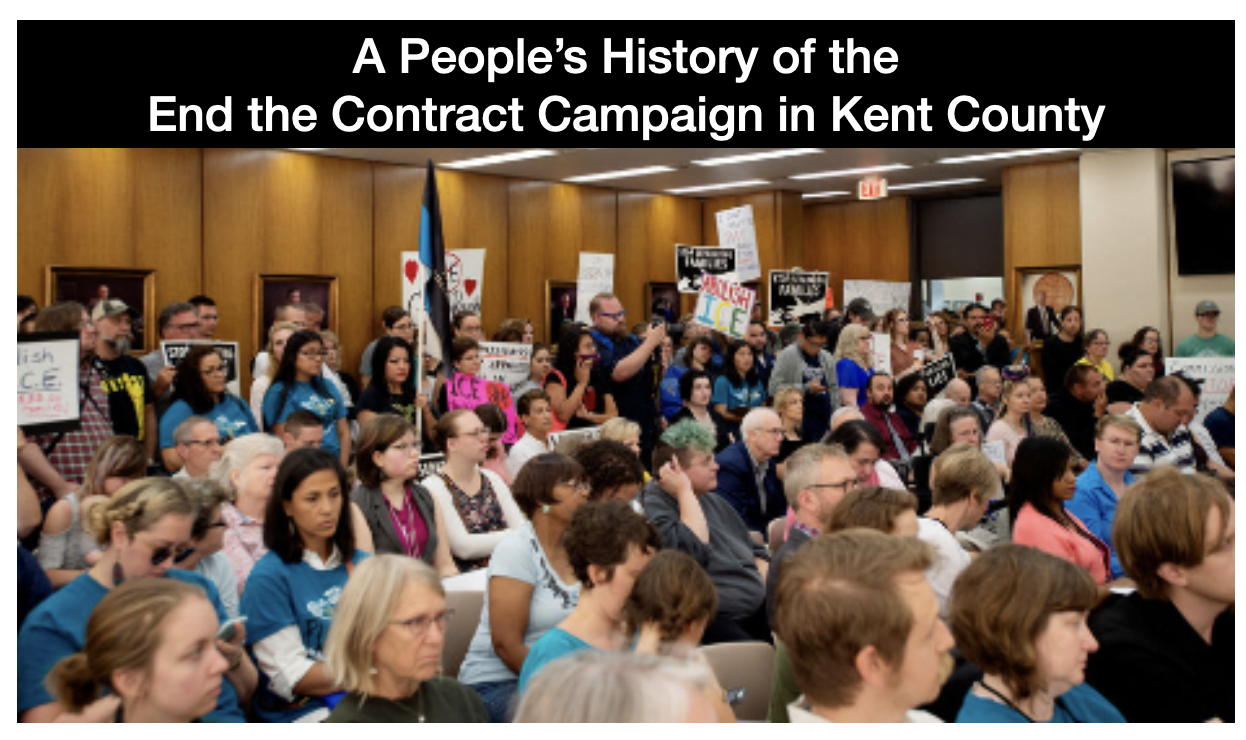
Another form of disruption is when we throw a monkey wrench into systems of power and oppression to conduct business as usual. During the End the Contract campaign that happened in Kent County in 2018-2019, the campaign that sought to get Kent County to end their contract with ICE, those involved in the campaign engaged in all kinds of disruptions. In fact, the kickoff to the campaign in late June of 2018, began with some 200 people showing up to the Kent County Commission meeting and shutting it down. The campaign disrupted numerous county meetings over the next several of months, but it also involved in taking up space in the 4th of July parade, going in to the Kent County Jail and making so much noise that those working the phones had a difficult time hearing callers. After the GRPD called ICE on Jilmar Raos Gomez, the campaign shut down several Grand Rapids City Commission meetings, and on numerous occasions it disrupted traffic. You can read about this campaign here. The County never ended their contact, but ICE did in September of 2019, primarily because of all the bad press and bad PR the campaign had generated!
Lastly, disruptions can mean engaging in actions that reduce harm that is being perpetrated by systems of power and oppression. This can look like what animal liberation groups have done by liberating animals from cages to destroying the machinery of those systems of cruelty. Harm reduction disruptions can also look like Indigenous people blockading fossil fuel corporations from continuing to build oil pipelines. According to a report put out by the Indigenous Environmental Network in 2021, Indigenous-led resistance campaigns against pipelines in the US and Canada have reduced greenhouse gas pollution by at least 25% annually since these campaigns began.
Resistance work in Grand Rapids
Look at the grassroots work of groups like Movimiento Cosecha and GR Rapid Response to ICE. The work of these two groups – which work collaboratively – has been with undocumented immigrants to provide training on what to do if ICE shows up, along with broader solidarity work and political campaigns to get the City of Grand Rapids and Kent County to adopt Sanctuary policies. In addition, Movimiento Cosecha and GR Rapid Response to ICE have been doing direct intervention work to reduce ICE attempts of family separation, using the hotline (616)-238-0081, by providing accompaniment for immigrants and by doing patrols in the Grand Rapids area to monitor ICE activity and directly intervene when possible.
These groups are being strategic and using tactics that not only reduced the possibility that ICE will separate families, they also provide the necessary community care and Mutual Aid that moves us to relying more on each other than on systems of power and oppression.
We take care of each other
The immigrant-led group Movimiento Cosecha GR often says, “what we need is already right here in our community.” What Cosecha organizers mean by this statement is not just material needs, but ideas, vision and radical imagination. Radical Imagination – imagining that another world is possible, that we don’t have to settle for what systems of power and oppression give us. As the great Puerto Rican poet, Martin Espada once said, “No change for the good ever happens without it being imagined first, even if that change seems hopeless or impossible in the present.”
Mutual Aid has been a practice in many communities and culture for a very long time. Mutual Aid project are essentially a form of political participation in which people take responsibility for caring for one another and not just through symbolic acts or putting pressure on representative, but by actually building social relationships that are more survivable. Check out this video, which provides a wonderful popular education framework for what Mutual Aid is.
I would also recommend that people read the book, Mutual Aid: Building Solidarity During this crisis (and the next), by Dean Spade. Spade, who is a long time activist/organizer, proposes four criteria for evaluating the success of a mutual aid effort:
- Does it provide material relief?
- Does it leave out an especially marginalized part of the affected group (i.e., people with criminal records, people without immigration status?)
- Does it legitimize or expand a system resistant left movements are trying to dismantle?
- Does it mobilize people, especially those most directly impacted, for ongoing struggle?
There are several groups that have been involved in Mutual Aid work in Grand Rapids over the years. The Bloom Collective hosted several of the first Really, Really Free Market events around 2007-2008. Really Really Free Markets are where people bring items they no longer need and then people take what they need, which means no one is buying or selling.
In 2017, GR Rapid Response to ICE started practicing Mutual Aid, by providing material support to immigrants that were impacted by Immigration and Customs Enforcement (ICE) violence. GR Rapid Response to ICE continues to practice Mutual Aid in the present. There are other groups, like the the West Michigan Care Collective and Grand Rapids Pullover Prevention. The Grand Rapids Area Mutual Aid Network, which was create at the beginning of COVID in March or 2020, also does amazing work in this community and has provided lots of material aid, including raising several hundred thousand in dollars of Mutual Aid for primarily BIPOC, queer, trans, those with disabilities and immigrant neighbors in the greater Grand Rapids area.
There have also been amazing Mutual Aid Projects that have been created to respond to a particular crisis over the last decade or so. Some inspiring examples are how quickly grassroots mutual aid groups responded to Hurricane Sandy and those that formed with the fires in Los Angeles last year.
Throughout history there have also been fabulous examples of communities practicing Mutual Aid. One of the most overlooked is the Black Panther Party for Self-Defense (BPP). The BPP is inaccurately represented by systems of power and oppression as simply being gun-wielding thugs, but nothing could be farther from the truth. The BPP was part of the lager Black Freedom Struggle and began in 1966 with their Ten-Point Program, which provided a framework for what they wanted. It is true that the BPP engaged in armed self-defense, but they saw that as only one of their Survival Programs. The BPP’s Survival Programs were Mutual Aid Projects and they developed over 60 of them during their short history. People are somewhat familiar with the Children’s Breakfast Program, but most people don’t know that they had their own ambulance service, free commissary for prisoners program, free clinics, their own newspaper and Liberation Schools. Click here to see the entire list.
These kinds of autonomous Mutual Aid Projects need to be explored and practiced if we want to develop real people power. The history of social service programs that make up the larger US government safety net, particularly the programs that began after the Great Depression did not come out of no where. In fact, there were two primary factors that determined much of what we often call the New Deal programs. First, the New Deal programs that provided material support to families deeply impacted by the Great Depression were modeled after the people-created projects that came directly out of those most impacted. (See Dana Franks book, What Can We Learn from the Great Depression?: Stories of Ordinary People & Collective Action in Hard Times)
Second, the New Deal policies that the FDR Administration put in place was a direct response to the massive public pressure from working class people and organized labor. In the early 1930s there were over 1,000 labor strikes happening on an annual basis across the US (See Jeremy Brecher’s book, Strike!). The US government was forced to create New Deal programs because of the massive resistance to economic conditions that were brought about by the Capitalist Class. If the FDR Administration not passed New Deal policies, the public would have been in open rebellion against the government. And just to be clear, the New Deal policies did not benefit everyone, especially the poorest, Black communities, Mexicans and other groups that were hit the hardest from the Great Depression.
What I have been attempting to communicate in this article is that if we just want to get rid of Trump then we will continue to perpetuate systems of power and oppression. We have to come to terms with the fact that the current political system, the Neoliberal economic system, which is also driven by US imperialism abroad, a system which is bi-partisan, is the very system that produced the likes of Donald Trump.
I don’t want to go back to normal. Normal in the US leaves us with mass incarceration, the climate crisis, a housing system that is rooted in profits, police brutalizing Black, Latinx, immigrant and trans people, plus a political system that is antithetical to anything resembling real democracy. The system ain’t working for most of us, so instead of just hoping for mild reforms and lesser of evil politics, why don’t we practice solidarity, mutual aid and fight like hell for collective liberation.

 Grand Rapids Institute for Information Democracy
Trackbacks
Comments are closed.