Adaptive Reuse for housing is nothing more than code for developers to get more public funding to make larger profits from housing
The GR& Riverfront website, which was created late last year, is a platform for the members of the Grand Rapids Power Structure to showcase updates and information on all of the new commercial developments in downtown Grand Rapids.
In a recent post entitled, Making Room: The Rise of Adaptive Reuse in Grand Rapids Housing, the GR& Riverfront wants us all to think that just because developers are using old buildings, that we should praise them for utilizing these spaces, spaces which have either sat empty or under their current iteration are not generating enough profits.
Adaptive Reuse is fundamentally a label that commercial developers are using to market yet another profit making housing scheme, which often includes re-directing millions in public dollars to the spaces they are re-purposing. The only thing that commercial developers are re-purposing is public money, public money which will expand their wealth.
The GR& Riverfront post provides several examples of “Adaptive Reuse” buildings:
- The former Radisson Hotel Grand Rapids Riverfront on Ann St. NW
- The Fifth Third Bank Building on Lyon Street
- The Factory Yards building on Godfrey Avenue
Former Radisson Hotel on Ann St
The GR& Riverfront article writes:
Developer Jack Hoedeman, who is leading the project, summed up the vision with a simple but powerful statement: “Everybody should be able to live on the river.” That vision aligns with the city’s broader goal of bringing more life, equity, and vibrancy to its riverfront corridor.
How sweet, Hoedeman wants to promote equity. Actually, Jack Hoedeman is the former owner of Compass Insurance Agency, which he sold in 2024 for $12 million and is now a partner with Compass Property Development. There are no details about how much public funding the former Radisson Hotel building owners will seek from the state and the City of Grand Rapids, but Compass Property Development has a history of already benefiting from a so-called Public Private partnership. Developers use public money to make more profits, while the public has no say in these matters, along with the fact that thousands of people who make up the public are housing insecure in Grand Rapids.
Former Fifth Third Bank Building
The GR& Riverfront post states:
In the heart of downtown, another major transformation is underway: the redevelopment of One Eleven Lyon, formerly known as the Fifth Third Bank Building. Originally built in 1967 as the Old Kent Bank headquarters, this 10-story high-rise is undergoing a partial conversion, turning seven upper floors of office space into 140 rental apartments.
According to an article on MLive in late April, CWD Real Estate Investment, which owns the former Fifth Third Bank building, “is requesting a $15.2 million public subsidy for its plan to convert the top seven floors of the structure into 140 apartments.”
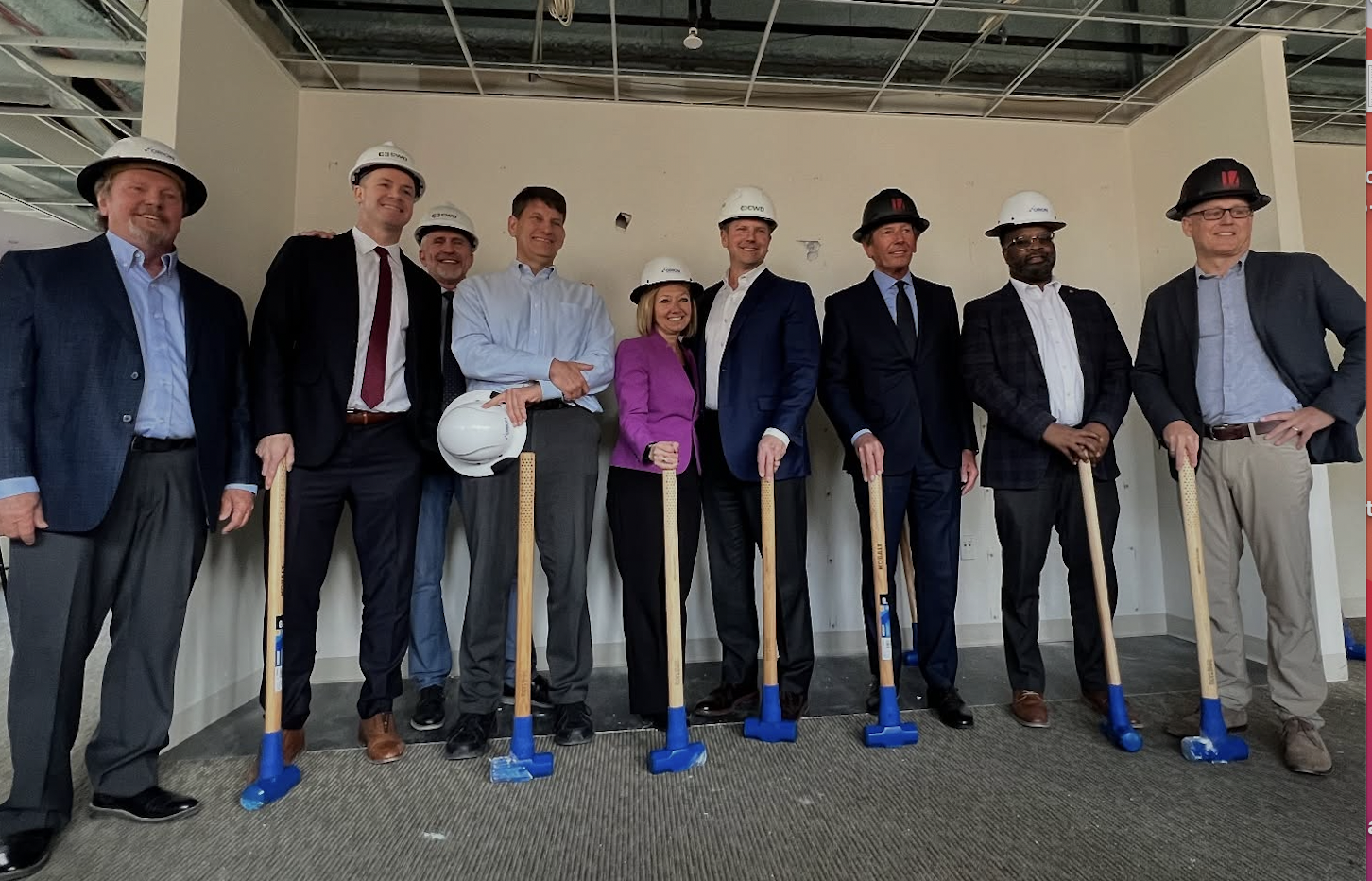
In addition, CWD Real Estate Investment is talking with the Michigan State Housing Development Authority (MSHDA), which usually means they will be seeking state funds as well.
In the above picture, you can see current Mayor David LaGrand (4th from the left), former Mayor Rosalynn Bliss (5th from the left), Sam Cummings (CWD – 3rd from the left), Dan DeVos (CWD- 3rd from the right) and Grand Rapids City Manager Mark Washington (2nd from the right). I reference this picture, because at a Grand Rapids Chamber of Commerce event this past Spring, Sam Cummings talked about a state law that was adopted in 2023, which amended the Brownfield Redevelopment Financing Act. This amendment made housing development projects, like the One Eleven Lyon project eligible for brownfield capture. Cummings made these remarks at the Spring conference held by the GR Chamber of Commerce, which contributed to LaGrand’s campaign for Mayor and subsequence campaigns for State Representative, which is nothing more than influence peddling by people like Cummings, who has a long history of using public funds to expand his wealth.
Factory Yards development project
The GR& Riverfront post states:
The $150 million development is backed by over $100 million in incentives through Michigan’s Transformational Brownfield Plan, the first Grand Rapids project to qualify when it was announced in October 2023. In addition to the apartments, the development is expected to generate hundreds of jobs and bring long-overdue revitalization to a historically overlooked part of the city.
This acknowledges that public money (incentives) is providing two thirds the cost of the project. The Factory Yards development project will include 467 apartments, with 100 of those apartments being “income-restricted housing units.” Whether or not those 100 units will be truly affordable remains to be seen, but like the other two projects millions in public money will go to private developers who will profit handsomely with these “Adaptive Reuse” buildings. The Factory Yards project is owned by Heritage Development Partners.
The City of Grand Rapids is supporting the project with an Obsolete Property Rehabilitation Act (“OPRA”) tax abatement valued at $10,155,093 over 12 years, as well as the local portion of the property tax capture component of the Brownfield TIF valued at $15,974,912.
 Grand Rapids Institute for Information Democracy
Trackbacks
Comments are closed.