Some thoughts about the Trump Administration’s decision to send the National Guard to LA and how it relates to Grand Rapids
Over the past week the intensity of ICE raids and ICE activity has increased, whether we are talking about what is happening in Los Angeles, Chicago, Seattle, in US/Mexican border states, and even right here in Grand Rapids.
I have written about how ICE had taken people last Wednesday, people who were showing up to their appointments at the ISAP office on Michigan Street in Grand Rapids. The ICE violence resulted in people showing up to defend those most affected by ICE violence. This same tactics is being used across the country, resulting in an increase in fear for immigrants.
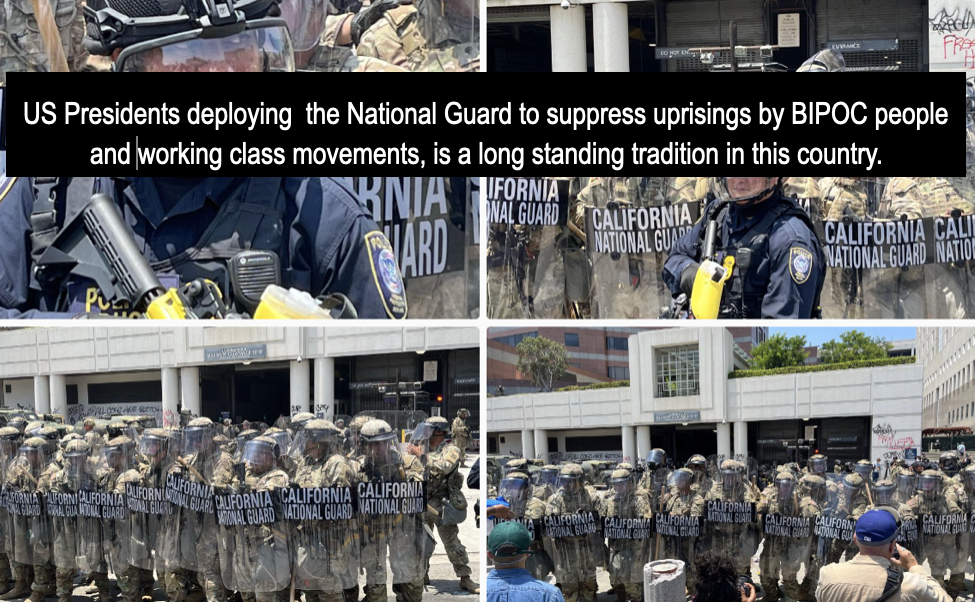
There has been lots social media chatter condemning Trump’s decision to send the National Guard to suppress those actually defending the community, and rightfully so. However, some of the commentary suggests that this is the first time this happened and other make the point about why the National Guard was not called out on January 6th, 2021.
The National Guard has been deployed all over the country, primarily to suppress popular movements, particularly movements that we led by BIPOC communities. Some examples of the National Guard being deployed domestically to suppress popular movements are:
1914 – the Colorado National Guard was sent in to suppress coal miners who were making demands, which led to a massacre with 21 people killed, mostly wives and children of the miners. Wilson was President.
1921 – Tulsa Race massacre, where Oklahoma National Guard to impose Martial Law, but only after white people terrorized and killed Black people and Black businesses in Tulsa. Harding was President.
1943 – Detroit race riot, where President FDR invoked the Insurrection Act of 1807 and ordered in federal troops. About 6,000 troops imposed a curfew, restored peace and occupied the streets of Detroit.
1965 – Watts, where 14,000 members of the California Army National Guard helped suppress the disturbance, which resulted in 34 deaths. Johnson was President.
1967 – there were an estimated 159 riots in the US, in cities such as Boston Louisville, Atlanta, Detroit, Kansas City and Grand Rapids. See my 3 part series on the 1967 GR riot at this link. For an excellent source on the 1960s riots, read Elizabeth Hinton’s book, America on Fire: The Untold History of Police Violence and Black Rebellion Since the 1960s. Johnson was President.
1970 – Kent State, where the Ohio National Guard shot and killed 4 students. Nixon was President.
1992 – Los Angeles riots after Rodney King trial verdict where the California National Guard, United States military, and several federal law enforcement agencies deployed more than 10,000 of their armed responders to assist in ending the unrest. George Bush Sr. was President.
2014 – Ferguson, where Gov. Nixon issued an executive order calling in the National Guard to “help restore peace and order and to protect the citizens of Ferguson.” Obama was President.
2020 – George Floyd protests all across the country, where the National Guard was deployed to suppress the uprisings, just like in Grand Rapids. Trump was President.
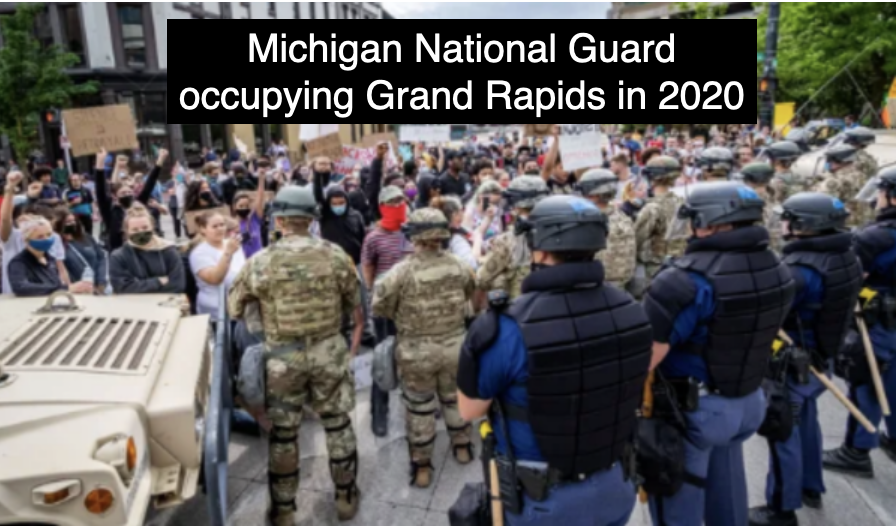
These are only a handful of examples where the National Guard were deployed to put down strikes, uprisings and rebellions. I included the name of the US President in each case and you can easily see that deploying the National Guard to suppress the public is a bi-partisan affair. We should never ignore this history and deny that it has any bearing on what is happening in LA right now.
The term fascism is also being attached to what Trump is doing by sending the National Guard to Los Angeles, which may be true, but if that is the case you would need to apply the same terminology to previous administration that did the same. In fact, it would be more accurate to say that Presidents deploying the National Guard to suppress uprisings by BIPOC people and working class movements, is a long standing tradition in the US.
Peaceful vs Violent uprisings, rebellions, strikes
Then there is the question of whether or not uprisings, rebellions, strikes are “peaceful” or not. Based on the social media posts I have seen most of them have suggested that if it is “peaceful” then it is good. This is an arrogant and privileged position to take, considering with most uprisings, rebellions, strikes are led by BIPOC people and working class people.
In an interview I heard from an Indigenous organizer in Los Angeles, Ron Gochez, he stated:
And so, we understand that the violence that’s being used against us is lethal. We understand the violence is being used against us on a daily basis, whether it’s by the Border Patrol or the police. It’s violence against the community. And so, we have every right to defend ourselves, by any means necessary, because that is our — the livelihood, the well-being of our families is what’s at stake. Children have been gassed here in Los Angeles.
And so, whether it’s the National Guard, whether it’s local police, we have to resist this, because in Los Angeles, we clearly understand what’s happening. The Trump administration is trying to make an example of Los Angeles. Los Angeles is the heart of the Mexican and Central American community here in the United States. And so, they think that if they can break us, they can break anyone in the country. And so, we understand that, and that’s what we know. We cannot afford to fail. The resistance will continue. Whether they keep threatening us or not, we will continue. We will be peaceful every time that we can. But if we face violence, where we have to defend ourselves, we have every human right to do so, as well.
Again, it is an arrogant and elitist stance to take when those of use with lots of privilege demand that marginalized communities remain “peaceful.” Calling a protest peaceful, when protests are anything but peaceful, is a way for the system(s) to dictate the narrative about what is happening. When the police say a protest was peaceful, they mean that those protesting obey their orders, did nothing to disrupt business as usual and often it means that protest organizers cooperate and even collaborate with the police. In fact, one could argue that if this happens, then it is not really a protest, instead it becomes a performance. Such forms of “protests” are almost always organized by white liberals to make other white people feel good about themselves, without having to interrogate systems of power and oppression.
Lastly, it is important that we not demonize those who use force or engage in property destruction to achieve liberation. Too often, those who only engage in non-violence, risk-free protests will demonize people/organizations and movements that utilize disruptive tactics, property destruction or those who engage in armed resistance. Historically, non-violence, property destruction, community self-defense and forms of armed resistance have been successful against tyrants, dictators, totalitarian and fascist governments. Demonizing those who do not always practice non-violence only benefits the state and their ability to engage in repression.
 Grand Rapids Institute for Information Democracy
Comments are closed.