For those who want to be involved in social justice movements, it is critical that we engage in a robust power analysis of Grand Rapids
“This struggle may be a moral one, or it may be a physical one, and it may be both moral and physical, but it must be a struggle. Power concedes nothing without a demand. It never did and it never will. Find out just what any people will quietly submit to and you have found out the exact measure of injustice and wrong which will be imposed upon them, and these will continue till they are resisted with either words or blows, or with both. The limits of tyrants are prescribed by the endurance of those whom they oppress.” Frederick Douglass

If you are concerned about issues like Climate Change, the ridiculous cost of housing, reproductive justice, gentrification, the non-profit industrial complex, public education or the recent mistrial for the ex-cop that shot Patrick Lyoya in the back of the head, then you might consider why a Grand Rapids Power Analysis is important.
If you are involved in social movement work, you will be familiar with the fact that politicians, organizations and institutions will object to what you are doing, push back or put roadblocks in front of any efforts to address injustices, especially systemic injustices.
A local power analysis can help us understand the economic, political and social power that institutions, organizations and members of the capitalist class play in opposing, infiltrating or undermining specific campaigns or the long haul work that social justice movements engage in. What follows is a recent example where social movement work, campaigns and collaborative efforts to demand structural change was defeated by those in the Grand Rapids Power Structure.
Campaign to defeat Grand Rapids ordinances that criminalized the unhoused
The Grand Rapids Power Structure has spent several decades to transform downtown Grand Rapids into a hub for expanding the wealth of the capitalist class and prioritizing the city as a tourist destination rather than meeting the needs of the most vulnerable in the community.
In July of 2022, the Grand Rapids Chamber of Commerce first submitting a letter to the Grand Rapids City Commission, which stated in part: “The Grand Rapids Chamber shares many of the values and priorities set by the City’s Strategic Plan, including goals for economic prosperity and a safe community. Unfortunately, as many of you are hearing, the high rate of shootings, violent crimes, trespassing, harassment and many other unacceptable actions continue to harm businesses and their employees in downtown, neighborhood business districts and other critical commercial corridors.”
In December of 2022, the GR Chamber of Commerce not only submitted an ordinance proposal to criminalize the unhoused, they got over 100 of their business friends to support said ordinance.
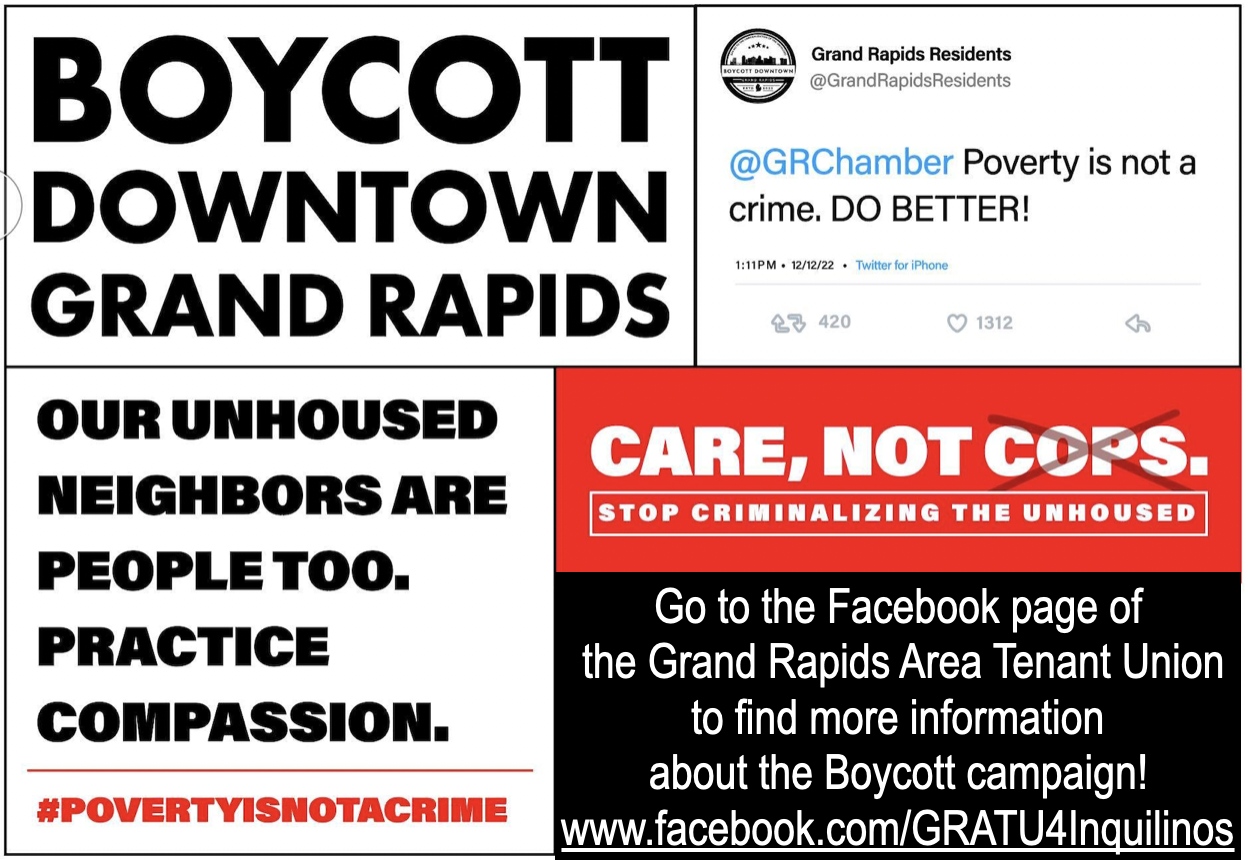
In response to the GR Chamber’s effort to push the city to criminalize the unhoused, the Grand Rapids Area Tenant Union (GRATU) began an information campaign to expose what the local Chamber of Commerce was doing and to initiate a boycott of businesses in downtown Grand Rapids.This campaign began in late December of 2022.
Then, in June of 2023, the City of Grand Rapids put forth two ordinance proposals that adopted some of the same language as GR Chamber ordinance proposal.
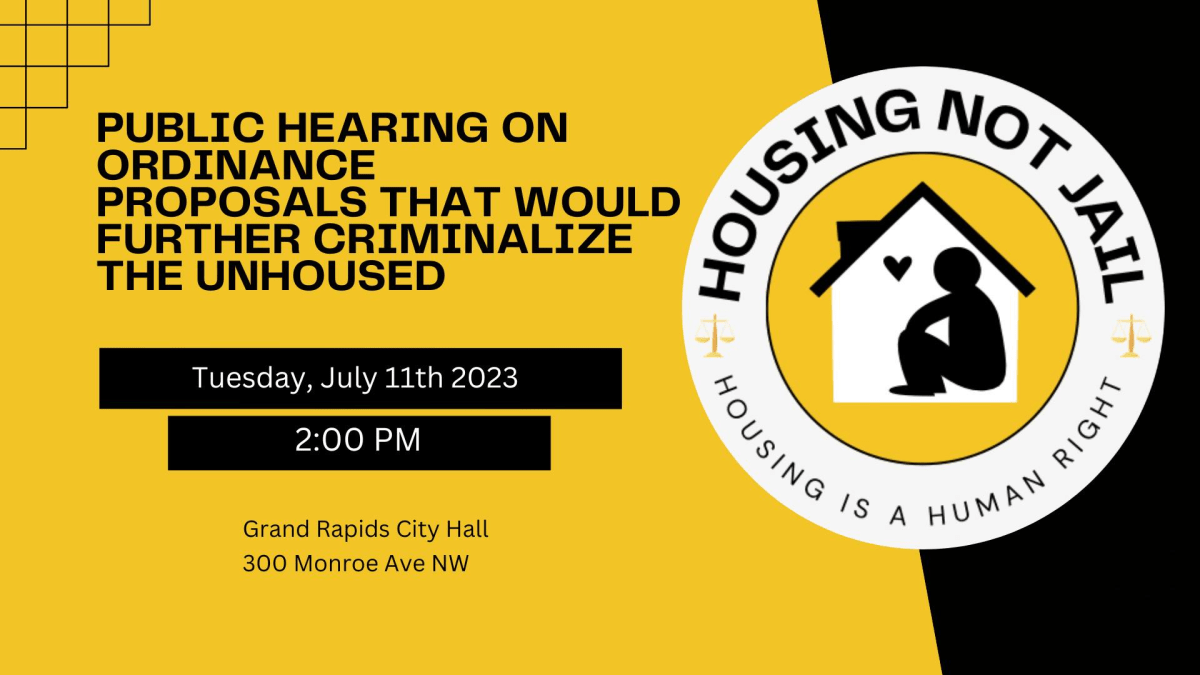
The Grand Rapids Area Tenant Union then organized a campaign to oppose these ordinances, which led to a Housing Not Jail campaign to pressure Grand Rapids City officials to not adopt ordinances that would criminalize the unhoused. This campaign by GRATU generated several thousand letters to the Gand Rapids City Commission. In contrast, the GR Chamber of Commerce got a handful of letters submitted by downtown business owners.
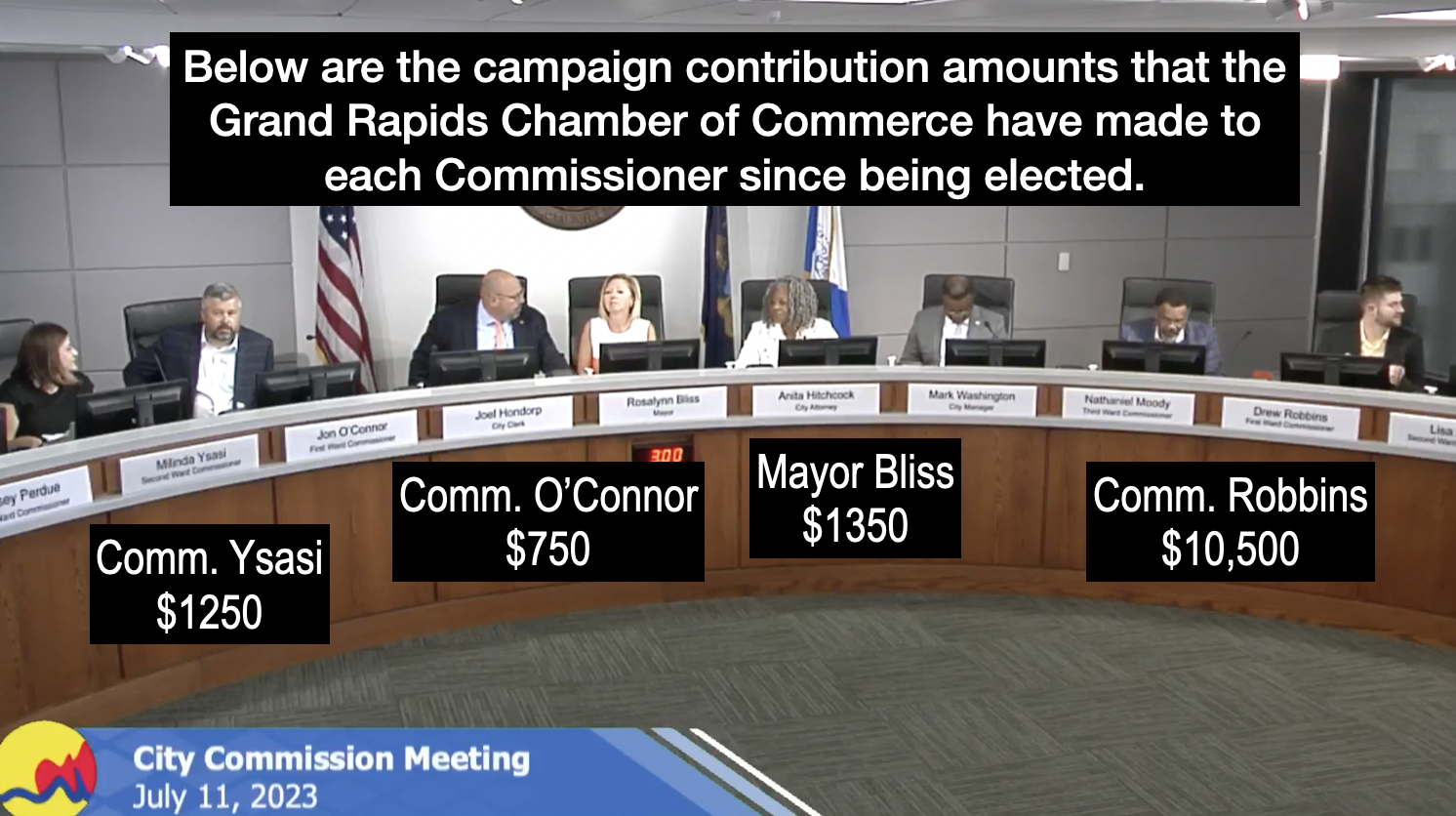
During the July 12th hearing on the proposed ordinances to criminalize the unhoused, the majority of people who spoke during public comment were against it, but the GR Chamber of Commerce made sure that their campaign contributions to members of the City Commission were in place, as you can see from this image here.
In the July, the Grand Rapids City Commission voted to adopt the ordinances that now criminalize the unhoused. This was a clear example of how organized money from members of the GR Power Structure were able to defeat the grassroots organized effort from the community.
It is also important to note that the local news media provided more time to the GR Chamber perspective than they did to those who would be most impacted by these ordinances. In addition, the local non-profit industrial complex, particularly those involved in housing were either silent on this matter or endorsed the ordinance campaign. One such group was Mel Trotter Ministries, which was one of the groups that supported the original GR Chamber ordinance proposal, was then rewarded with $200,000 in public money from the City for a personal storage program. One of the City’s ordinances would fine the unhoused for carrying their belongings with them in sacks, trash bags or shopping carts.
Lastly, the GRPD was then given license to detain and arrest unhoused people who violated either of the two ordinances adopted in July of 2023.
This example demonstrates that members of the capitalist class in Grand Rapids wanted to protect their investments, the GR Chamber of Commerce wanted to influence local policy, the news media normalized the criminalization of the unhoused and the City of Grand Rapids adopted policies to make GR a more appealing tourist destination, and using the GRPD to enforce the ordinances. This is why a local power analysis is so important for movement work.
This Thursday, May 15, beginning 7pm at Fountain Street Church, I will be doing a Grand Rapids Power Analysis.
 Grand Rapids Institute for Information Democracy
Comments are closed.