What are we really celebrating on the 175th Anniversary of Grand Rapids?
 Last week, Grand Rapids celebrated its 175th anniversary as a city. WXMI 17 ran a story about the city’s birthday, the TV station omitted significant aspects of this history and the founding of this city.
The channel 17 post states at one point:
While the area around the Grand River was the home of the Hopewell Indian tribe for thousands of years, the first permanent white settler was Isaac McCoy, a Baptist minister who arrived in 1825.
This sentence suggests that Indigenous were no longer living in this area, and then white settlers just arrived.
Whitewashed history
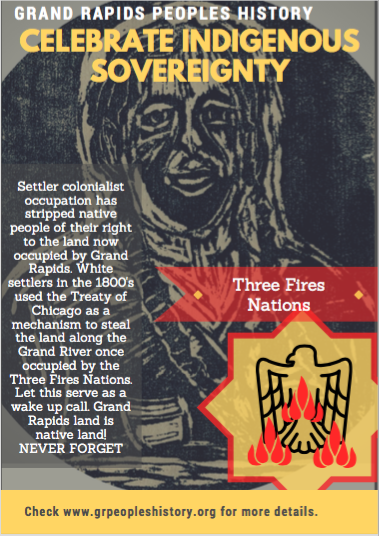
As a foundational framework, it is vital that we come to terms with the fact that Grand Rapids, like virtually all US cities were founded on what Native scholar Roxanne Dunbar Ortiz calls Settler Colonialism. Settler Colonialism in West Michigan is the result of a larger White Supremacist strategy that included legal means (treaties), forced relocation, spiritual violence (role of churches) and cultural imperialism, most radically seen with the policy of putting Native children in boarding schools with the goal of, “Killing the Indian, Saving the Man.”
We know that hundreds of Native children from the Three Fires Nations were taken and put into boarding schools by settler colonialists, many of which were run by Christians. In these instances Native children were denied the right to speak their own languages and practice their own spiritual traditions. Most of the removal of Native children from their communities happened in the later part of the 19th Century and first half of the 20th Century.
However, on the matter of Christian missions attempting to make converts of Native communities in the 1820s and 1830s along the Grand River, it is less clear on whether or not this could be defined as a form of genocide. How much free will did Native people have on choosing another religion? Was the adoption of Christian beliefs a form of assimilation into the dominant culture and was it tied to larger socio-economic issues like food and land?
It should come as no surprise that right after the 1821 Treaty of Chicago was signed, the first christian missions came to what is now West Michigan. The Baptist Church established a mission in 1824, under the leadership of Isaac McCoy, and Catholic missions were begun in 1833 by Fr. Frederic Baraga.
One of the things that lured missionaries to the area after the signing of the Treaty of Chicago, was a provision in the treaty which allowed funds for people to work as teachers of blacksmiths amongst the Native people along the Grand River. The government treaty called this, the “civilization fund,” a phrase that underscores the settler colonial mentality. However, whatever tensions existed, they were most useful in pushing Native people out of the area as more white settlers colonialists came to the area. This increase in settler colonialists, along with greater desire for land and settler colonial expansion, resulted in a new treaty being drawn up, the Treaty of Washington in 1836. This treaty turned over an additional 13,837,207 acres of land to settler colonialism’s expansionist desires.
It seems that all along, the goal with relations of Native people along the Grand River were to take the rest of their land. Whether or not there was direct complicity with the early Christian missions to this land takeover is not relevant, the fact remains that they did nothing to resist such an effort.
What the City of Grand Rapids says about the 175th anniversary
On the 175th anniversary of the founding of Grand Rapids, the City also posted an announcement about a party they are having in June.
The City’s announcement also states:
The celebration kicks off with an opening prayer by members of the Grand River Bands of Ottawa Indians, the original Indigenous peoples of Grand Rapids. and a proclamation by Mayor LaGrand, recognizing the city’s founding on May 2, 1850. Grand Rapids City Commissioners and federal, state, and local elected officials will be on hand to hand out cupcakes as part of a festive “We Serve You” moment of gratitude.
 Wow. So, the city is using Indigenous people for their event, the very same people that the City founders stole the land from. Is this just some weak attempt to omit the brutal history I mentioned earlier? Does the city really think that by using Indigenous people in this way is a form of guilt washing for white people?
To make matters worse, they are inviting politicians to come and hand out cupcakes? What the hell is that? Do they really think that people are so gullible, that they believe these politicians serve the public. Politicians serve those with the real power, the wealthy individuals, businesses and institutions that dictate what happens in this city.
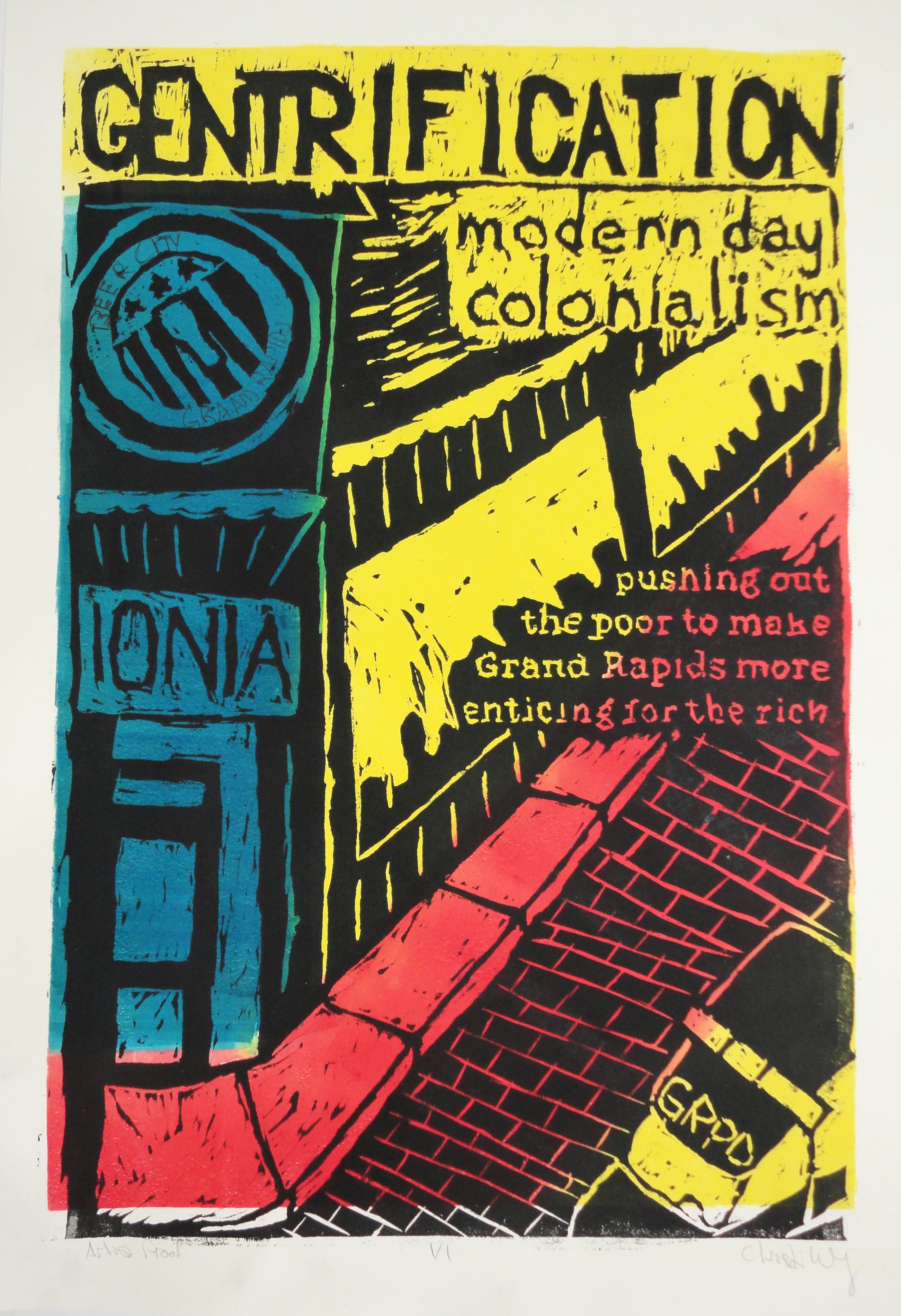
Grand Rapids is nothing more than a playground for the rich and powerful, which get whatever they want. Grand Rapids is a deeply racist city, which practices gentrification, housing injustice, and gives the GRPD carte blanc to suppress and repress any effort to demand justice. Grand Rapids is more committed to expanding capitalism and maintaining business as usual, than it is to centering the most marginalized and practicing justice. This is the legacy of not coming to terms with Settler Colonialism.
 Grand Rapids Institute for Information Democracy
Trackbacks
Comments are closed.