From La Matanza to El Salvador’s prison: A century-long US commitment to El Salvador’s dictatorships
The US government’s decision to deport Kilmar Abrego Garcia to El Salvador has received a fait amount of attention. The attention around the case of Kilmar Abrego Garcia is mostly due to the fact that the US Supreme Court unanimously ruled that the Trump Administration should bring Garcia back, since he was wrongfully deported.
According to a recent article from Jacobin:
On March 16, 2025, El Salvador received a US deportation flight of 238 Venezuelans along with Salvadorans of various documentation statuses. They were incarcerated in El Salvador’s megaprison, the Center for Terrorism Confinement (CECOT), placing them in legal limbo. The conditions of those incarcerated in El Salvador are notorious and likely violate a number of human rights under international law. The United States is paying El Salvador a fee of $6 million per year to house some three hundred deported people.
After the US Supreme Court decision, some national news agencies asked President Trump, while he was entertaining El Salvador’s President Nayib Bukele if he would be bringing Kilmar Abrego Garcia back from El Salvador. The exchange is rather instructive and is included in a recent Democracy Now! show from April 15.
Jeffrey St. Clair, co-editor of CounterPunch, wrote in a recent column:
 Trump’s ICEtapo has sent 238 people to El Salvador. A Bloomberg analysis shows that more than 90% of them had no criminal record. And of those with criminal records, only five had been convicted of felonies. This hardly matters. To be sent to El Salvador means you are guilty. You are a terrorist in the eyes of the state that deported you, even if the state’s highest courts have intervened on your behalf. There will be no return. Even two self-proclaimed Autocrats say they don’t have the power to make it happen.
Many commentators have speculated that what President Trump is doing by sending supposed criminals to El Salvador is to test the waters in order to see how much public resistance there is to this practice, since this administration might begin to send political dissidents there as well.
It is always difficult to predict future policies, but it is worth looking at the history of US relations with El Salvador, which could give us a better understanding of what the US government will do and what the American public will tolerate.
History of US/Salvadoran relations
El Salvador gained its independence from Spain in the early part of the 19th century, but they became subject to the US Monroe Doctrine. The Monroe Doctrine was an imperialist policy, which essentially said that all of Latin America was under the control of the US.
El Salvador, a country the size of Massachusetts, has been living under an oligarchy for most of the nation’s history. Europeans controlled most of the land in El Salvador, which was the result of Spanish colonialism in the region. The oligarchy began to utilize the best lands for coffee production in the late 1800s, thus making coffee exports the number one economic driver of El Salvador’s economy.
In the 1920s, the price of coffee dropped steeply, threatening the oligarchs’ export business. To make up for their loss of profits, the ruling families took over even more land from peasants and cut their workers’ wages in half. Following elections in 1932, in which the government refused to seat elected members of the Communist Party, Salvadoran peasants organized a popular insurrection to demand better living and working conditions. Most of these peasants were part of the indigenous population. The government responded to the strike by massacring an estimated 30,000 people, or 4% of the population, in one week.
This event became known as “La Matanza,” or “The Massacre.” The military government established following La Matanza went on to ban every vestige of indigenous culture, including language, traditional clothing, and music. To avoid further persecution and murder by government troops, the indigenous people began to hide all outward signs of their identity. During La Matanza, the US had warships off the coast of El Salvador in order to support the very government that massacred 30,000 Salvadorans.
La Matanza and the military rule which followed set the political tone of the next several decades in El Salvador, as military dictators followed one another into the 1970s, and all of these dictators had US government support, both militarily and diplomatically. In addition, the US government trained countless Salvadoran soldiers at the famous US Army School of the Americas.
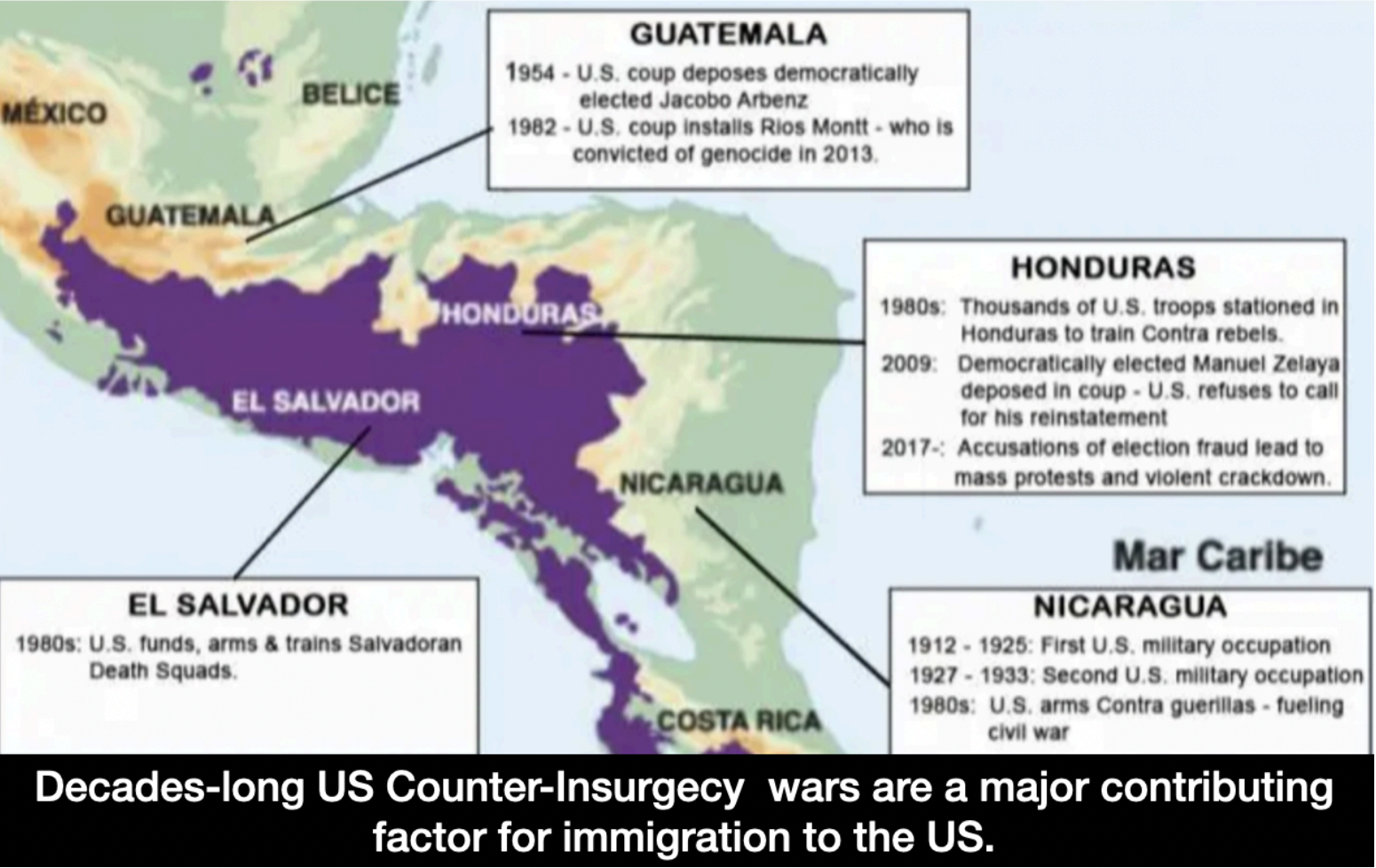
In the late 1970s, an armed insurgent movement known as the FMLN (Farabundo Martí National Liberation Front) grew in popularity and began to control part of the countryside in El Salvador. The US government’s response was to zealously support the Salvadoran dictatorship, which included massive amounts of US military aid, US military advisors, the sale of US military weaponry and US political pressure to prevent the Organization of the American States (OAS) or the United Nations from trying to intervene in what became a massive counter-insurgency war. What follows are some some details of the US/Salvadoran relationship during the counter-insurgency war from 1979 – 1992.
- March 24, 1980 – Archbishop Oscar Romero was assassinated by Salvadoran government death squad members while he was saying mass. Just weeks before his assassination, Romero had sent US President Jimmy Carter a letter demanding he stop sending military aid and send humanitarian relief aid instead.
- December 2, 1980, four US Churchwomen working in El Salvador, were raped and murdered by Salvadoran government death squad members.
- In December of 1981, the Salvadoran Army murdered over 800 people in Morazan Department of El Salvador, which became known as the El Mozote Massacre. The Salvadoran army mostly killed women, children and the elderly in this massacre. The US government defended the massacre.
- During the US financed counter-insurgency war in El Salvador, there were an estimated 8 – 9,000 Salvadoran civilians that were “disappeared.”
- The 1992 UN Truth Commission in El Salvador determined that 75,000 civilians were killed, with the majority of those deaths being committed by the Salvadoran military or extra-judicial paramilitary groups that worked with the Salvadoran military.
- In November of 1989, the Salvadoran military murdered 6 Jesuit priests, their cook and her daughter. Many of the soldiers involved were trained at the US Army School of the Americas.
- Several high ranking Salvadoran military officials that were directly responsible for the deaths of nearly 75,000 Salvadoran civilians fled El Salvador after the 1992 ceasefire agreement and found refuge in the United States. The irony of this is that throughout the years of the US-financed counterinsurgency war in El Salvador, thousands of Salvadorans sought political asylum in the US, but were denied.
- After the US financed counter-insurgency war in El Salvador, the US continued to support the ruling class in that country, even intervened to prevent a left Presidential candidate from winning the election there in 2004, got El Salvador to sign on to the Central America Free Trade Agreement (CAFTA – which created more poverty and exploitation).

This is the historical context to which we find the current Salvadoran President Nayib Bukele. This history between the US and El Salvador should make it clear as to why Bukele is just the most recent iteration of the long-standing dictatorships that have run that country with full US support.
A recent article from the Washington Office on Latin America (WOLA) provides some important insight into why those of us in this country should be concerned about what is happening in El Salvador. The WOLA article provides 4 good reasons for concern:
- Bukele negotiated and offered economic incentives to gang leaders in exchange for reducing homicides.
- The ‘Bukele Security Model’ is based on mass incarceration and human rights violations, but fails to provide any real access to justice or due process.
- The Salvadoran penitentiary system is marred with corruption, where there is no oversight, transparency or accountability.
- There is a generalized environment of fear as civic space is shrinking and human rights defenders and independent journalists are under attack.
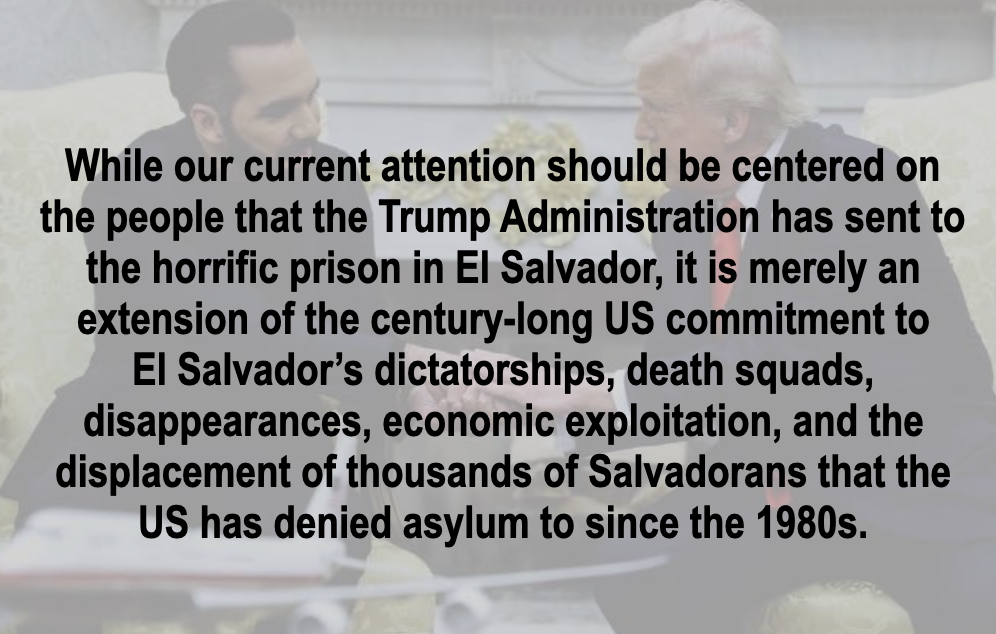
While our current attention should be centered on the people that the Trump Administration has sent to the horrific prison in El Salvador, we should also understand that these brutal human rights violations have always been central to the longstanding US military support of El Salvador’s oligarchy, to the murder and disappearances of tens of thousands of Salvadorans during the US financed counter-insurgency war, the US denial of asylum to thousands of Salvadorans fleeing political violence, the US-provided safe haven status for former Salvadoran military officials, and US economic policies like CAFTA that have forced forced to many Salvadorans to become immigrants. This brutality did not begin with the Trump Administration, it is merely an extension of the century-long US commitment to El Salvador’s dictatorships, which translates as US Imperialism.
 Grand Rapids Institute for Information Democracy
Comments are closed.