Copaganda: Deconstructing the GRPD TV series on HBO/MAX – Episode #2
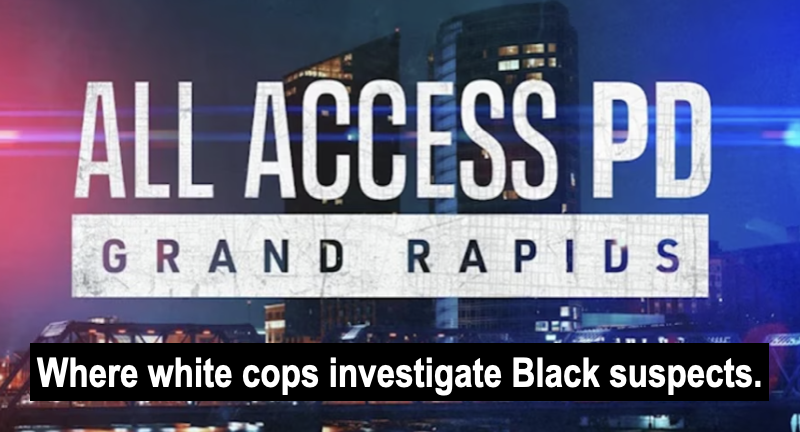
Episode #1 affirmed stereotypes about Black people, thus perpetuating structural racism. The episode also demonstrated that this TV series will be a highly constructed show with the GRPD dictating the narrative about who they are and what they do.
Episode #2 begins with a roll call at the GRPD, where one of the cops says, apparently some of the homeless people were raising hell at US 131 and Ann St. Viewers then see a GRPD cop in their cruiser and we hear this cop say that there is more crime at night, and that “nothing good happens after midnight.” No clarification or verification of the claims are made, since cops always tell the truth.
In the subsequent scene we hear gun shots being fired, a 911 call, with someone saying that gun shots happened in the street. This is followed by mostly bodycam footage, with a cop saying that they couldn’t find anyone who was shot.
We then see the GRPD in the same neighborhood, looking for clues and talking to residents about the shooting. A GRPD cop then goes to the hospital and talks to a Black woman who saw the shooting, since she brought someone to the hospital who had been hit by a bullet. This is also when we hear that the Black woman that the cop was speaking with said that they were on a “party bus”, which is the name of Episode #2.
Back at the scene of the shooting, where the cops find the party bus, they also find a gun and some bullet shell casings. Everyone the GRPD spoke to who were on the party bus, all appear to be BIPOC people.
Viewers are then introduced to a white female-appearing cop who says they were tasked with heading up the homicide investigation. The GRPD is back at the hospital, where the body of a Black man is on a stretcher and is pronounced dead. The GRPD cop “allows” the mother of the victim to pray over his body during a 30 second clip of the episode. Always important for a constructed TV show to demonstrate to viewers that the cops are compassionate.
About 10 minutes into the episode, the episode brings us back to the GRPD headquarters talking about getting the video footage from the party bus. Chief Winstrom then says that he has full confidence in the female officer. The female cop is attempting to speak with a Black person who saw what had happen, but refuses to give information without a lawyer. Chief Winstrom then calls this dynamic “generational mistrust.” Winstrom is followed by another GRPD cop who says that people who don’t come forward with information as a “societal problem.”
“Generational mistrust” and people not giving cops information as a “societal problem?” It is deeply unfortunately that the producers of this show do not unpack or interrogate these terms, terms which are politically and racially charged. A basic question that could be asked at this point is, do Black people have reason to not trust the police? This is a very basic question, but a critical one to think about and talk about. The All Access PD Grand Rapids show only provides the GRPD’s perspective on this matter. What if viewers heard from Angela Davis, Miriame Kaba, Andrea J. Ritchie, Ruth Wilson Gilmore or Marc Lamont Hill?
Back to the episode………
The cops then look at video from porch cameras and talk about the shooters. Chief Winstrom then talks to the camera saying the the Grand Rapids City Commission wants answers to the increase in shootings over the summer (summer of 2023). The next scene is in a City Commission meeting, with Winstrom addressing the commissioners. Winstrom then talks up Commissioner Knight, with the following scene including Lisa Knight and the mother of the shooting victim.
The episode then cuts to another day, where the GRPD get a call about another shooting, with a AR 15 rifle. The cops find the shooter who is in a vehicle and then takes off. The cops purse the vehicle onto Cesar Chavez Way/Grandville Ave, where the shooter is boxed in. A latino male gets out of the car with no apparent weapon, while the GRPD has guns pointed at him and then releases a police dog on the man. The dog bites the man, and then we see the man bloodied and in cuffs. Winstrom then says that the illegal use of guns is a problem.
The episode then pivots back to the party bus shooting, where the GRPD are now looking at the social media profiles of those who were on the party bus. The social media videos they show are primarily of Black people.
The next portion of the episode involves looking at the guns that was found and the bullet casings. The white female cop who was heading up the investigation received a photo of a Black guy in a white hat, the same white hat that was found at the scene of the shooting.

The potential suspect lives outside the city limits, so the Kent County Sheriff’s Department now gets involved, with them and the GRPD heading to the suspects home. Most of the cops arrive on the scene heavily armed and using an armored vehicle. For the next minute they use bodycam footage, in COPS-like fashion. Eventually, someone in the mobile home comes out and the GRPD begins to ask her questions.
A Black male witness comes in to speak with the GRPD. This witness had a gun and shot it into the air, but his brother also had a gun and fit the image of the photo that the GRPD had. The brother then came in (another Black man), but during the questioning the Black man’s face was not blurred, unlike other people in the episode. The female investigator continued the questioning and the man she was questioning stated he didn’t have a gun. The homicide investigator was “shocked” that this Black man denied having a gun.
The episode ends with the mother of the shooting victim coming in to the GRPD headquarters and talking to Winstrom on camera, praising them for all they have done on this case. The mother states, “You give off a vibe that you really care.” The mother then praises the female homicide investigator, with Winstrom and another cop smiling as the episode credits are rolling.
After watching two episodes, one could easily conclude that only Black & Brown people commit violent crimes and that the GRPD does the work to keep the public safe. However, the reality is quite different, where the GRPD is not preventing violence from happening, it traffics in racial stereotyping and celebrates cops as heroes. Anyone with half a brain is not buying this polished PR shit!
 Grand Rapids Institute for Information Democracy
Trackbacks
Comments are closed.