Copaganda: Deconstructing the GRPD TV series on HBO/MAX – Episode #1
In Episode #1 of the TV series featuring the GRPD, called All Access Grand Rapids, we first hear from GRPD Police Chief Eric Winstrom. This makes complete sense, since not only is Winstrom a slick PR person, he always wants to control the narrative about the GRPD.
Winstrom states that when he came to Grand Rapids, “trust in the Grand Rapids Police Department was at an all-time low.” Unfortunately, the TV show doesn’t provide any historical context around why the community, specifically Black and Brown residents did not trust the GRPD.
For the five years before Winstrom came to Grand Rapids, there were numerous instances that contributed to the community’s lack of trust when it came to the GRPD, such as:
- GRPD stoping Black youth and pulling guns on them
- GRPD arresting Honestie Hodges, an 11 year old Black girl, while the cops were out looking for a Black suspect
- 100 Black men coming to the Grand Rapids City Commission meeting to demand the City hold the GRPD accountable for their abuses in Black neighborhoods
- GRPD caught on video beating a Black man in his car, with the man’s child in the car
- GRPD stopping at gunpoint two Latino youth
- GRPD calling ICE on Jilmar Ramos Gomez, a former US Marine
Right after Winstrom provides no context for why the community did not trust the cops, he says, “If there is no trust, that equals a more dangerous and more violent city.” Wow. A more dangerous and violent city for whom?
Once the episode gets passed the GRPD-dictated framing of the narrative, the episode moves into using a clock counter on the screen, footage of the dispatch and using audio from calls regarding a shooting. The footage goes from an arial shot bodycam footage where cops show up to find Amillier Penn lying dead on the ground.
Winstrom then states that the local news was covering this issues, but they failed to report that homicides predominantly happen in Black neighborhoods. Again, there is no verification for such a claim and no commentary from those who might have a robust critique or response to Winstrom’s claim.
The episode then cuts to Winstrom and one of his captains at the GRPD headquarters reviewing bodycam footage and Winstom is clearly playing to the camera, stating, “here he is, a 15 year old full of bullets.”
Next there are two cops who are involved in the investigative aspect of homicides, where they talk about how hard it is to get witnesses coming forward. These two cops then go out into the community to ask neighbors near the shooting of they access Ring camera footage. The episode then continues with some of this Ring camera footage shown, which adds to the drama, along with the music in the background. One of the investigative cops is looking right into the camera say that they couldn’t imagine how the young man might have been feeling in this moment and how the family might be dealing with it. This scene is clearly a constructed scene, since the camera crew is asking questions, which is another way of trying to humanize the cops.
Viewers of the episode then go into the home of Amillier Penn, where his mother is talking and grieving the loss of her son. This only lasts a minute, then it is back to the GRPD headquarters where the cops are looking at what Amillier Penn’s phone messages were just before he died. From there is the episode cuts to footage of a vigil for Amillier.
At 13 minutes into the episode, it shifts and goes to the GRPD killing of Patrick Lyoya, where they use footage of the City’s Press Conference and commentary from Winstrom on the importance of showing the video of what happened in order to “not lose the community’d trust.”
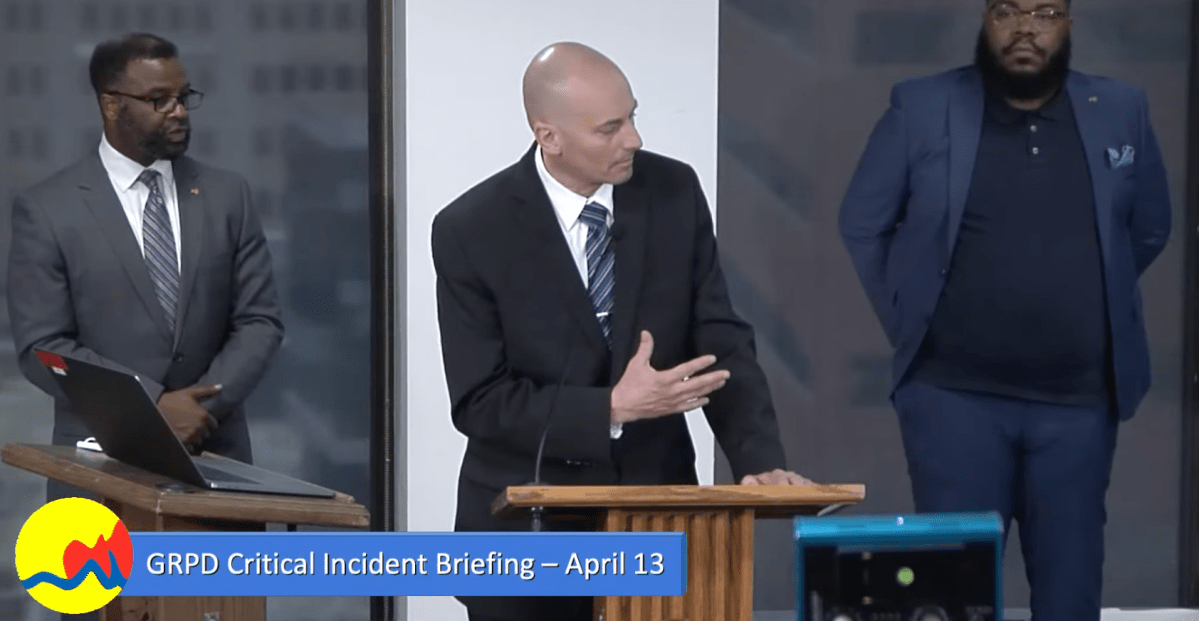
At 14 minutes into the episode, Winstrom then speaks to the camera, essentially blaming the lack of community trust from the Patrick Lyoya murder, thus preventing people coming forward on the death of Amillier Penn. Next, we see Winstrom at the Garage Bar talking with people and telling them that they need to step forward if they know anything.
At the 15 minute mark into the episode, viewers get to hear from Amillier’s father, who talks about how how difficult it has been and how he has been trying to be a soldier for his son.
The GRPD then spots a witness to the shooting and finds him at a park and convinces him to get in the cruiser and come down to the station to tell him what he remembers. Back in the GRPD headquarters, one of the detectives says that someone named CP shot Amillier, but they don’t have any proof. However, this doesn’t prevent the GRPD putting up an image of CP, a young Black man with his full name on the screen.
In the next few minutes one of the detectives talks about Amillier’s father who started posting images of CP on his Facebook page and was demanding that the GRPD go and arrest this guy. In addition, the detective states on camera that Amillier’s father changed hi Facebook profile to an image of a pistol and talking about revenge. The detective then says that this undermines what the cops are trying to do.
The episode then cuts to the funeral of Amillier, which seems rather invasive to me.
At about 26:30 into the episode the cops start talking about these “fight club” videos that were on Amillier’s phone. The cops even then say that Amilier was involved in these fights and show video of Amillier in a street fight with CP. Fight Club is actually the title of Episode #1.
At about 29:45 into the episode, one of the detectives has potential witnesses at the GRPD headquarters and asks a young Black person if CP was the shooter. Their response was, “I don’t know.” Right after this, the detective talks with another cops saying they have a text that they believe incriminates CP. The episode then jumps to a new shooting, where they show the footage. They believe it is this CP person. The episode shows the footage of the shooting repeatedly, which was rather gratuitous. The investigator on this shooting then bring Winstrom into the case and shows him footage and Winstrom is convinced that CP is the shooter, claiming that they can let the prosecutor make the decision if what they have is enough.
The next scene is with roughly 15 GRPD cops in a meeting and getting order to go look for CP, which also included images of the young Black man holding guns.
The detective who had lots of camera time then says, looking directly into the camera, “It’s time to arrest this dude.” After that for the next 2 minutes the episode shows cops in riot gear at the door and then entering the home and taking into custody CP. All of this is done with dramatic music, for effect.
The few remaining minutes of the episode takes place in the GRPD headquarters, where cops are questioning CP and his mother, and showing her pictures from the most recent shooting.
Winstrom then – speaking to the camera – states that with CP in jail, that maybe this gives witnesses an opportunity to come forth regarding Amillier’s shooting.
The murder of Amillier Penn still has not been resolved.
This All Access Grand Rapids episode sure reminded me of the show COPS, where Black bodies are criminalized and that Black people in urban settings are represented as thugs. This first episode affirms that stereotype, thus perpetuating structural racism and justifying state carceral violence. The episode also demonstrated that this TV series will be a highly constructed show with the GRPD dictating the narrative about who they are and what they do.
 Grand Rapids Institute for Information Democracy
Trackbacks
Comments are closed.