On March 26, 2006, thousands of people marched in favor of immigrant rights today in Grand Rapids as part of ongoing organizing efforts against anti-immigrant legislation being debated by the federal government. The march, which went from Garfield Park to Calder Plaza, was the largest march in recent history, far exceeding a 2004 march for immigrant rights that was attended by more than 400 people. In Grand Rapids today, nearly 10,000 people marched in favor of immigrant rights and against legislation that would criminalize undocumented workers. Their signs read “We are ALL Immigrants,” “We do the Work,” and “We are not Terrorists.”
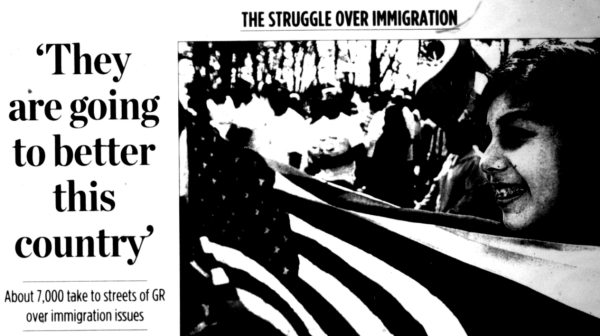
Starting at Garfield Park on the south side of Grand Rapids people from all over West Michigan came together from all walks of life. There were ministers, small business owners, parents, students, but most of the people who gathered today were workers. Several people I talked to said they took the day off from work, because “this issue is more important than a day’s pay.” Economics was one of the 2 main reasons that people mentioned for taking action on this issue.
A farm worker named Vicente said, “people don’t realize how important we are to the economy…..we pick the fruit, we do the work!” Teresa Hendricks from the Michigan Migrant Legal Assistance Project says that “if the current undocumented workforce was arrested the economy locally would shut down. We estimate that migrant workers generate about $10 billion annually in West Michigan.”
The other issue that people kept repeating was the fact that if the proposed legislation went through it would be “a grave injustice.” The possibility that millions of people could be jailed for nothing more than being undocumented, generated lots of angry energy at the march. The legislation in question was introduced in 2005, known as the Border Protection, Antiterrorism, and Illegal Immigration Control Act. This bill would criminalize undocumented immigrants and even punish those who offered them any assistance, including rides, housing, and food support.
During the march, people yelled, chanted, and carried hundreds of Mexican flags. Luis Beteta, head of the Catholic Church’s Hispanic Ministry office said that “this proposed legislation itself was criminal. People should never be considered illegal just because a policy says so.” When asked about people who are not directed at risk with this proposed legislation Beteta said “in Nazi Germany many people said this doesn’t concern me and look what happened. It affects all of us. We are all Immigrants.”
The march ended on Calder Plaza, where an estimated 7 – 8,000 people listened to speakers from a variety of different community organizations. Speakers highlighted the contributions of immigrants to US society, discussed HR 4437, and highlighted the continued need for legislative proposals such as the Kennedy-McCain Immigration Reform Act and the DREAM Act. Similar events were held across the country in cities such as Houston, Phoenix, and Salinas over the weekend with the largest of these rallies drawing between 500,000 and 1,000,000 people in Los Angeles.
Grand Rapids Press Coverage
The Grand Rapids Press coverage wasn’t awful, but it was limiting in what information was shared. First, the coverage does not center the voices and perspectives of the immigrant community that participated in the march. Second, the coverage focused too much on the theme of, “we are not terrorists.” Third, the coverage underestimated the numbers that turned out. The GR Press relied on the GRPD for an estimation and put it at 7,000, while organizers told me they believed it was closer to 10,000. Lastly, the GR Press coverage did not provide any larger analysis of why so many turned out for the march and how the mass turnout was replicated across the country. The lack of context also failed to acknowledge that there had been several organizing meetings in the months leading up to the march, meetings that were public with 200 – 300 each meeting.

 Grand Rapids Institute for Information Democracy
Trackbacks
Comments are closed.