GRIID Class on the Prison Industrial Complex in Kent County – Week #6
 For week #6 in our collective investigation into the Prison Industrial Complex in Kent County, we read two essays that I selected based on the discussion we had during week #5.
I did share an extra resource, which is a toolkit that focuses on community care around mental health.
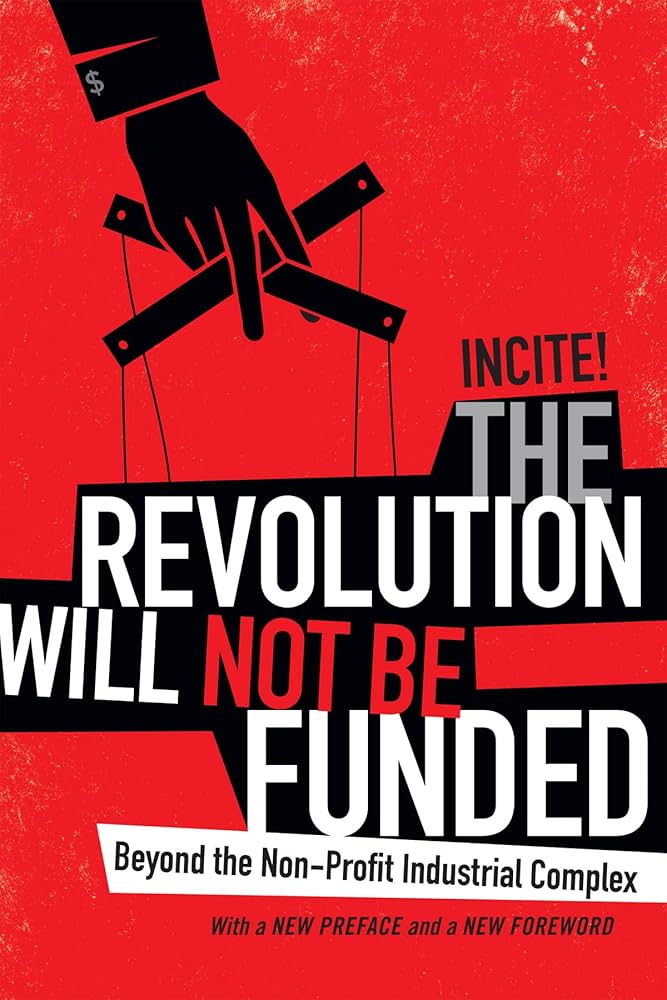
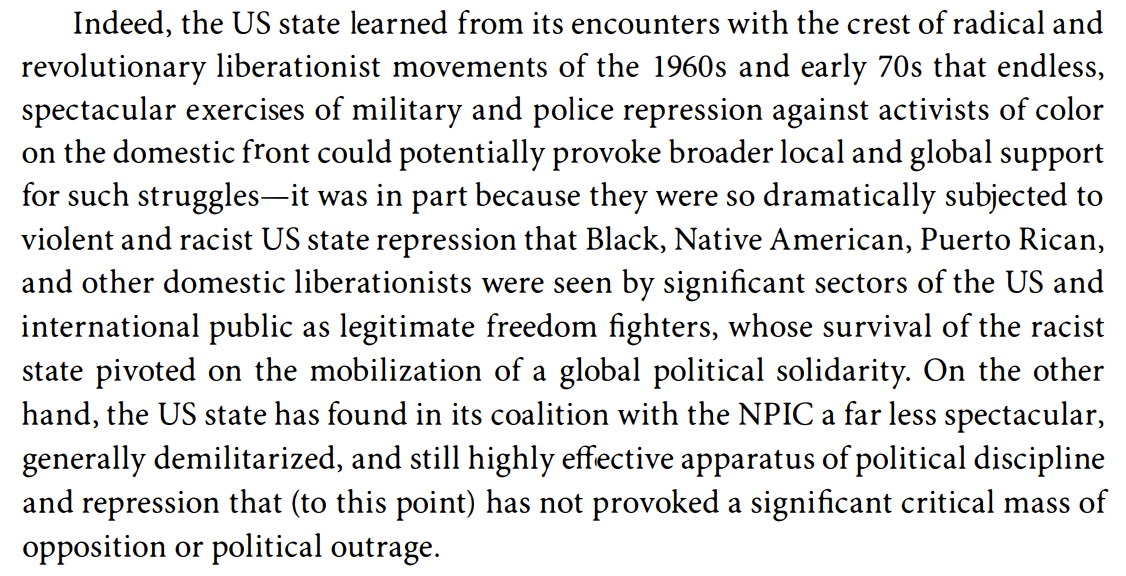
The first essay we discussed was a chapter from the book, The Revolution Will Not Be Funded, beginning on page 44, by Dylan Rodriguez. Rodriguez talks about carceral violence, using the FBI’s COINTELPRO campaign against radical groups in the 1960s and 70s. The essay then talks about what lessons the state learned during those decades and how they began to develop relationships with those in the non-profit sector and how the non-profit industrial complex came to play a larger (less violent) role in diminishing the impact or even the possibilities that people might take more radical actions to challenge systems of power and oppression.
Next, we discussed what environmental strategist Stephen D’Arcy lays out for us in his essay, Environmentalism as if Winning Mattered: A Self-Organization Strategy.
D’Arcy suggests a two-pronged strategic approach, the Resistance Phase and a Transition Phase. Keep in mind that D’Arcy is focusing on environmental outcomes, but he also makes clear that his approach is fundamentally an anti-capitalist strategy.
The Resistance Phase would include some of the following strategic objectives:
- To construct an anti-corporate alliance of Indigenous communities, workers’ organizations, and environmental protest groups, based on a serious, sustained commitment to practical solidarity at the grassroots level.
- To build cost-raising protest movements, directed against all forms of environmental destruction, framing these struggles whenever possible as struggles for environmental justice, including Indigenous self-determination, economic justice and public welfare.
- To promote prefigurative community-based alternatives to capitalist production that model sustainability, solidarity, popular autonomy, and environmental justice.
- To re-establish vital currents of ecologically oriented anti-capitalist radicalism, for instance, eco-socialism, anarcho-Indigenism; social ecology; left eco-feminism; and so on.
The Transition phase would also have four strategic objectives:
- To organize anti-capitalist environmentalists into a common front of radical community organizations (SMOs, CCOs, PAOs), capable of tactical concentration for united action;
- To establish the hegemony of the anti-capitalist common front within the mass environmental movement, so that it exercises a consensual, acknowledged leadership role in pointing the way forward for large sections of the broader movement;
- To gain for the common front and its allies a degree of community-based “social” power, resting on the capacity to deploy general strikes, mass protest, and mass civil disobedience campaigns, on such a scale that the community-based opposition constitutes a community-based counter-power that can effectively challenge the economic power of corporations and the coercive power of the state;
- To secure the transfer of ever more extensive governance functions to community-based self-organization (SMOs, CCOs, PAOs), so that “social” sector institutions ultimately displace — rapidly whenever possible, gradually whenever necessary — both “private” and “state” sector institutions from their role in running the economy, the healthcare and education systems, providing social services, etc.
Darcy emphasizes that we not only need to resist the harm that governments or the economic systems are causing, but to create a counter-power infrastructure that makes us less dependent on existing political structures, structures which primarily benefit those in the Capitalist Class.
 Grand Rapids Institute for Information Democracy
Comments are closed.