Urban Core Collective calls out Consumers Energy for rising utility costs, especially how it impacts BIPOC communities in Michigan
 Earlier today, the Climate Justice Team with the Urban Core Collective (UCC) hosted a Press Conference regarding the increased utility costs that Consumers Energy is imposing on the public. The Press Conference was live streamed and you can watch a video of that live stream here.
Sergio Cira-Reyes, a Climate Justice organizer with UCC, kicked off the Press Conference with these comments:
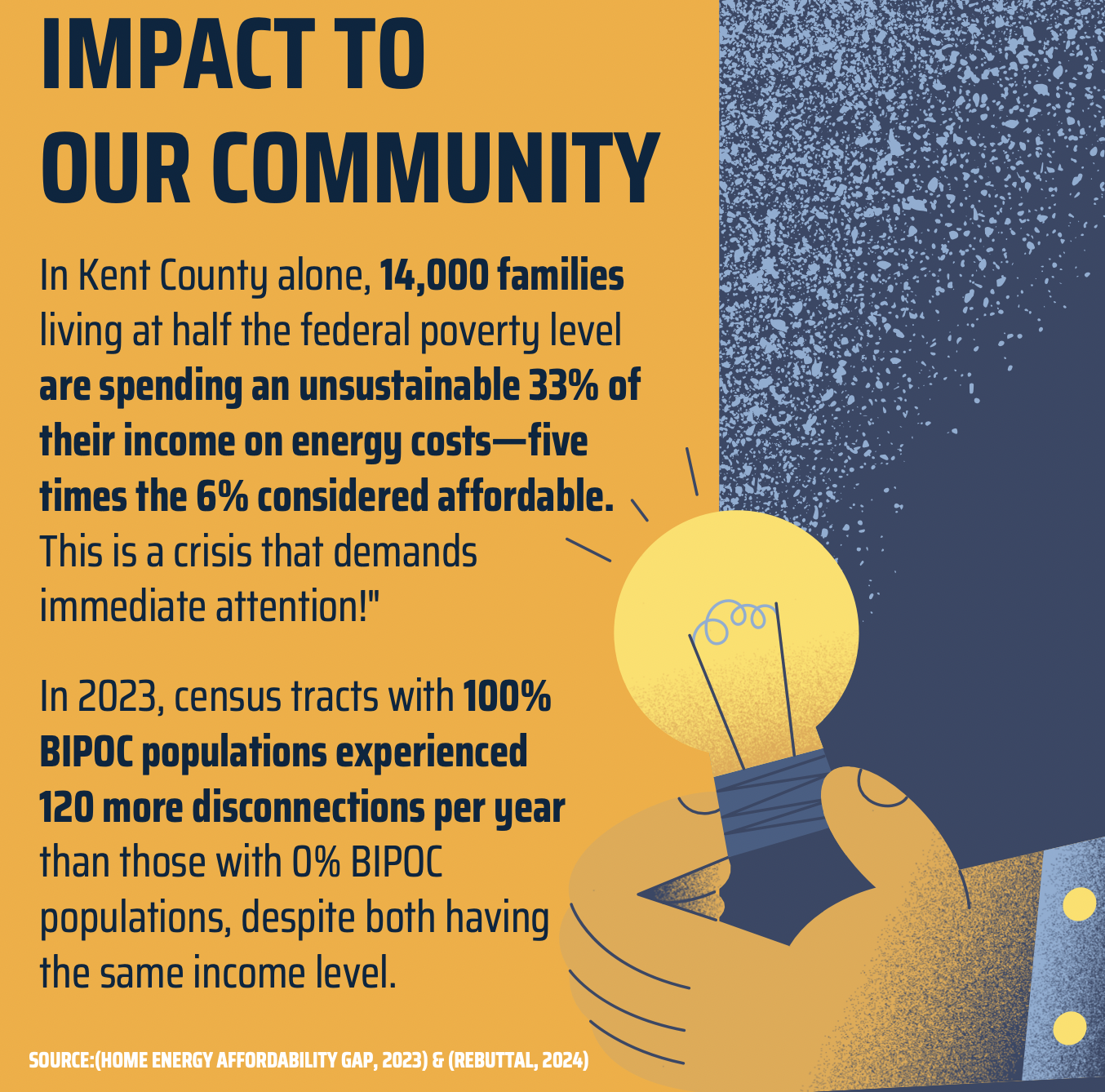
With the progress of climate change, an alarming crisis is growing as the percentage of income that families have to spend on energy surpasses the 6% allocation that is considered affordable. As recently as 2019, close to 14,000 Kent County families living at 50% of the federal poverty level, were spending 33% of their income on energy costs. Spending six percent of household income on energy costs is considered affordable, yet families are spending more than the 30% that they should be spending on housing alone. Since 2019, the Michigan Public Service Commission has approved a total of $274 million in six annual rate hike requests from Consumers Energy.
 A second major points that was raised during the Press Conference, also from Cira-Reyes, was that of all 148 sitting state lawmakers, 102 received campaign funds from DTE Energy or Consumers Energy PACs between 2017 and 2022.” That’s almost 70% of all Michigan lawmakers taking money from the utilities during that time period. The campaign contributions from the utility companies raises serious concerns about whether the policy that the commission leans on to make decisions on our behalf is made by politicians who are in the pockets of the Utilities.
Janet Zahn, who is the Co-Chair of the Grand Rapids Climate Coalition, also spoke during the Press Conference. Zahn addressed how disconcerting it is that Consumer’s Energy was continue to hike utility costs, but was not as committed to increasing the amount of energy it was providing, specifically from renewable sources. Zahn said, “the energy companies should be providing a public service to the communities they operate in, instead of prioritizing profits for their shareholders.”
Another important point that was addressed during the Press Conference had to do with how Consumer’s Energy was disproportionately shutting off electricity to BIPOC consumers. “Besides the less than transparent regulatory process, there are also concerns surrounding reliability and disproportionate disconnection rates tied to race. Consumers Energy ranks among the lowest performers nationwide when it comes to reliability, but most alarming are the systematic disconnections disproportionately targeting BIPOC communities. In his rebuttal testimony to the Michigan Public Service Commission, Boratha Tan on behalf of the Ecology Center, The Environmental Law & Policy Center, The Union of Concerned Scientists and Vote Solar, found a direct correlation between the percentage of people of color living in a census-tract and disconnections by Consumers Energy, even when the area median income was the same. In 2023 “census tracts with a 100% BIPOC population would experience about 120 more residential disconnections compared to a 0% BIPOC population census tract with the same income level.” In other words (using Consumers Energy’s own data), disconnections happen more often in BIPOC communities than in non-BIPOC communities, even when both communities have the same income level.”
 The Urban Core Collective (UCC) has decided to intervene, on behalf of residents in Grand Rapids, in order to stop Consumers Energy from increasing rates. In this and past rate cases, UCC also argued for an increase in bill assistance for customers unable to afford electricity, better community engagement and transparency, and equitable investment in energy infrastructure in low-income and BIPOC communities. In the case where the MPSC gave Consumers Energy the green light to increase rates by $92 million, the utility company had sought a $216 million increase in its original application. UCC, along with other advocacy organizations in the state, intervened in that case as well.
Call to Action
The UCC is urging residents to make public comments describing how Consumers Energy’s rate hikes are impacting them. Residents can give their public comment using any of the following three options:
- Attend the next commission meeting on March 13, 2025 which will be take place at 7109 W. Saginaw Highway, Lansing, MI 49817
- Submit a comment via the Michigan Public Service Commission website
- Send a public comment via email by contacting the Commissioners at
lara-mpsc-commissioners@michigan.gov.
If you are interested in the work of the Urban Core Collective’s Climate Justice Team, you can contact Sergio Cira-Reyes directly at sergio@uccgr.org.
 Grand Rapids Institute for Information Democracy
Trackbacks
Comments are closed.