4 reasons to think critically about the February 28th economic blackout
It’s been all over social media, with people being urged to do things like not spend money, not shop, to consume nothing, and to hit em where it hurts.
Before offering up my 4 reasons to think critically about the February 28th economic blackout, I want to say that in general I fully support boycotts, strikes divestment campaigns and any other economic grounded tools to impact systems of power and oppression.

However, as I wrote back on February 18th, we need to think strategically about what we are doing and to avoid just being reactionary in what we are participating in. Grassroots, community-based social change is not a quick fix, rather it is the result of dismantling systems of power and oppression, along with creating new ways organizing that are based on cooperation, consensus, radical imagination and collective liberation.
I’m not writing this to tell people not to participate in the February 28th economic blackout, but to encourage people to think critically about it, especially if we want to build powerful social movements that are necessary to confront and dismantle systems of power and oppression like Capitalism, white supremacy, Settler Colonialism, heterosexism, patriarchy, ableism and other systems of oppression.
First, when engaging in economic boycotts and economic blackouts, we should always ask ourselves who do we want to negatively impact and who do we want to avoid doing harm against? There are companies that are listed with the February 28th economic blackout like Amazon. It is true that Amazon does evil and awful shit, like providing tech support to the Israeli military to more effectively target Palestinians, assist Immigration and Customs Enforcement (ICE) agents to target immigrants, and the way they exploit those who work in the Amazon distribution centers.
In thinking about boycotting Amazon on February 28th and beyond, will it have unintended consequences that could negatively impact Amazon workers? Amazon workers have been trying to organize a union in recent years, in order to build worker power and win demands from the Jeff Bezos-owned company. Does anyone know if Amazon workers are supporting the economic blackout and if they were asked to be part of the campaign? Social movements need to come from those most impacted and it has to be collectively decided if it is to be effective.
Second, boycotts have been a strategic tool used by social movements for more than a century around the world. However, boycotts are usually initiated by those most impacted by a specific corporation or center of economic power. Several examples that I think are worth looking at are:
Montgomery Bus Boycott – this boycott relied on creating alternative means of transportation for African Americans who were resisting the racist and sexist practices of the bus company in Alabama.
The 1965-1970 Delano Grape Strike and Boycott – this boycott was called by farm workers who were fighting for better wages, better working conditions and the right to organize as farm workers.
Palestinian Boycott, Divestment and Sanctions Campaign – this campaign was organized by Palestinians as a way to fight against Israeli apartheid, Israeli settler colonialism and Israel’s decades of brutal military occupation
The Seattle General Strike of 1919 – this movement was organized by workers, anarchist, socialists and communists in an effort to take control of the city of Seattle and create a radically different kind of economic and social system.
The overall theme with each of these boycott movements was that it was born out of the collective reality of those most impacted by whatever oppression they were facing.
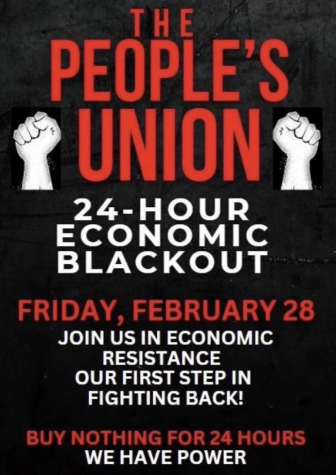 Third, who is behind the February 28th economic blackout? This whole campaign is not coming out of a movement by from one guy, John Schwarz. John Schwarz, aka The One Called Jai, is credited with organizing the boycott. Schwarz is a former business owner and manager, who by his own admission, did not expect his idea to amount to anything.
The People’s Union USA is complete a creation of John Schwarz, a guy who has not prior involvement with labor unions or grassroots organizing. Schwarz is a TikTok influencer and meditation and mindfulness facilitator.
Fourth, what are the goals of this campaign that was proposed by one guy? According to John Schwarz, there are 4 things needed to unionize the people.
- Establish a Legal Foundation
- Organize Membership
- Develop Economic & Legislative Strategies
- Build the Infrastructure for Action
For me, this plan seems to fit the business as usual model, the non-profit industrial complex model, which seeks to operate within the framework of the existing system.
What about the goals or demands of this campaign. According to John Schwarz, these are the demands, which you can read at this link. These demands are primarily centered around making billionaires pay their fair share. However, billionaires can only become billionaires because the economic system of Capitalism allows them to exploit and expand their wealth by use the labor of others and always with exploitation as a central component. This is a false solution and will not address structural or systemic oppression, as I have written about before.
Again, by all means participate in the economic blackout, but I will not participate in an effort that was organized by some white dude who has no experience with grassroots organizing. Instead, I will continue to be involved with movements that are led by immigrants – Movimiento Cosecha, led by tenants – the Grand Rapids Area Tenant Union, ally groups like GR Rapid Response to ICE or the Grand Rapids Pull Over Prevention (GRPOP), both of which seek to do defensive work that reducing the harm to affected communities like immigrants, BIPOC communities and other marginalized groups who are the most impact by the current political and economic system we have in this community and this country.
 Grand Rapids Institute for Information Democracy
Comments are closed.