GRIID Class on the Prison Industrial Complex in Kent County Week #1
I am always grateful for being able to facilitate these kinds of conversations and investigation into systems of power and oppression in this community. I want to share what we will be talking about in the GRIID class over the 8 weeks that it will occur, so here is a summary of week #1.

After everyone introduced themselves and talked about why they wanted to be part of this conversation, everyone then talked about their own lived experience with the PIC. The personal stories were powerful and we talk about the commonalities in each story and the fundamental differences.
After sharing personal stories we began to discuss an article that was written by Angela Davis. Davis was one of the first people to name the Prison Industrial Complex (PIC). The article from Davis was written a few decades ago and I purposely chose this article since it both demonstrates how things haven’t changed that much since the 1980s, but also to get people to think about how important it was for the idea of the PIC to become part of how we think about cops, the courts and jails/prisons.
 The other reading for week #1 was a chapter from the book, Abolition Now!: Ten Years of Strategy and Struggle Against the Prison Industrial Complex. We discussed chapter 12 from longtime activist/author Dylan Rodriguez, entitled, Warfare the terms of Engagement, which you can access here.
Some of the main themes that Rodriguez addresses are the role of the Non-Profit Industrial Complex play in regards to the Prison Industrial Complex, the use of tax money to fund punishment rather than meet the needs of people. Rodriguez also talks about the need for there to be collective resistance to state violence and the PIC. One powerful quote from the chapter is:
Our historical moment suggests the need for a principled political rupturing of existing techniques and strategies that fetishize and fixate on the negotiation, massaging, and management of the worst outcomes of domestic warfare.
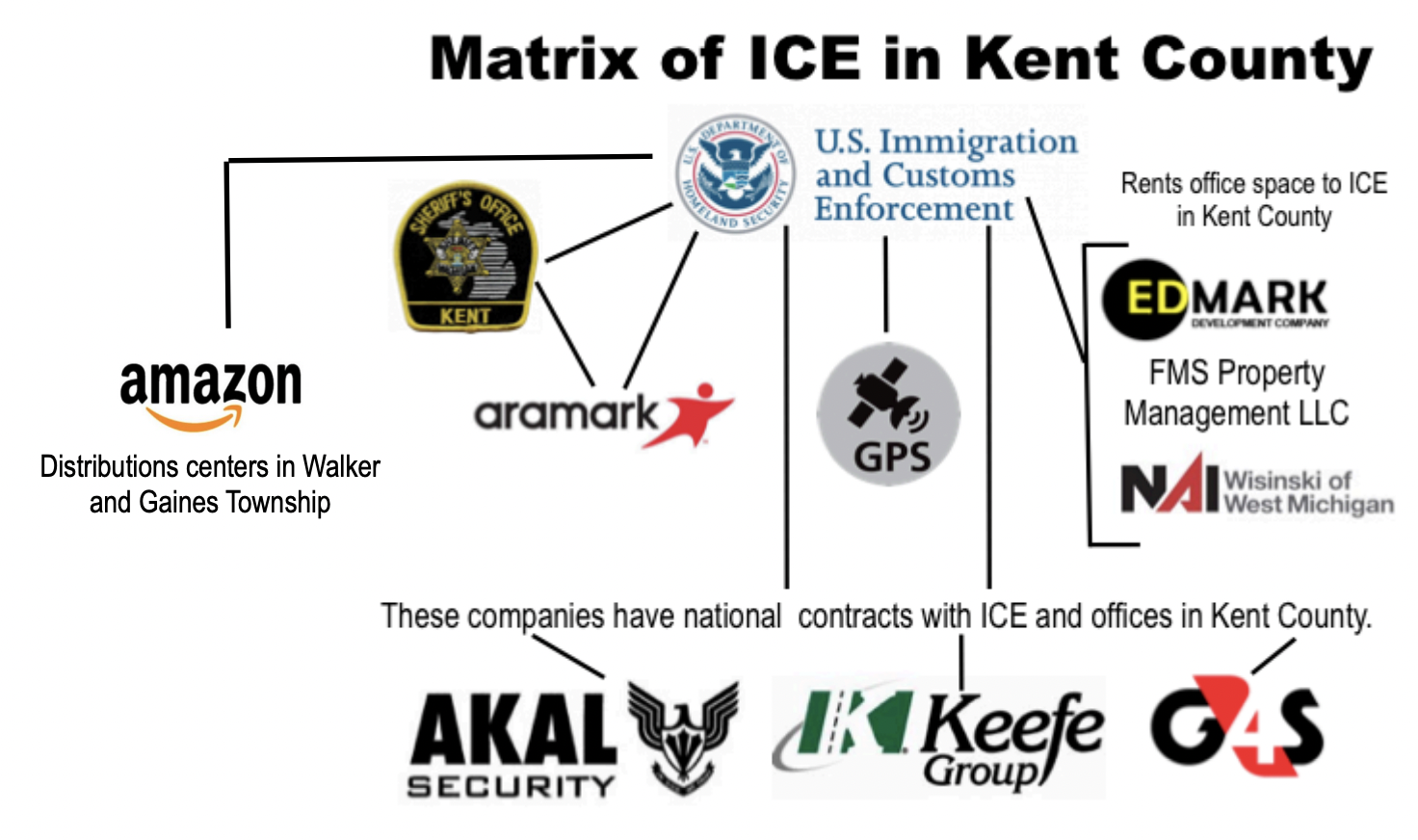
I also shared with the participants the graphics included in this post, which are visuals that can help us understand the Prison Industrial Complex in Kent County. These graphics can be used to help us map out what the PIC looks like in Kent County, since the PIC includes cops, the courts, the jail, and the various private contracts that are profiting off of the PIC when they provide resources and technology that are used by cops, courts and jails.
Over the 8 weeks of this class, we will collectively map out what the PIC looks like in Kent County and possibly create popular education resources that organizers can use to educate and mobilize people to dismantle the PIC in Kent County.
 Grand Rapids Institute for Information Democracy
Comments are closed.