GRIID end of the year in Review: Part III – Monitoring the Grand Rapids Power Structure
In Part I of the GRIID Year in Review, I wrote about the media watchdog work I do and how the local news reported on critical issues in Grand Rapids for 2024. Part II of the GRIID Year in Review focused on monitoring the Far Right in West Michigan. Today, I want to provide an overview of GRIID’s monitoring of the Grand Rapids Power Structure.
I have been writing about the Grand Rapids Power Structure for the past couple of decades. I write about this structure because I believe it is important that we understand what they do and what that means for the rest of us. I also believe that if we are ever to achieve any lasting sense of collective liberation, then the Grand Rapids Power Structure must be dismantled.
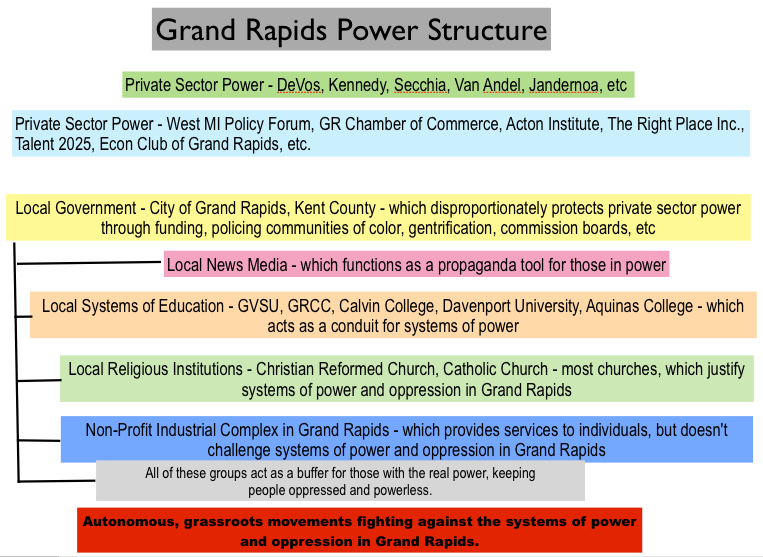
The Grand Rapids Power Structure was extremely active in 2024, which is why I decided to update my 2018 ten part series, since the local power structure is always evolving. You can read the 2024 ten part series by going to this link, which is Part X, but has all of the other 9 parts linked in that article.
The Grand Rapids Power Structure played a significant role in the 2024 Elections, specifically local and state elections. In October, after the quarterly campaign finances were made public, I wrote about whom the Grand Rapids Chamber of Commerce was funding, which candidates took money from the Real Estate industry, the GR Mayoral race, the Grand Rapids City Commission races, how DeVos money dominated Kent County candidates, and how DeVos and other members of the GR Power Structure were buying state races. I also wrote about how members of the Grand Rapids Power Structure spent nearly half a million dollars to pass a ballot initiative to increase the hotel taxes as a way to fund downtown development projects.
Another way that the GR Power Structure leverages their wealth is in development project, where they get the State and local governments to use massive amounts of public money that will ultimately expand the wealth of those in the GR Power Structure. In February, I wrote about how so-called community engagement functions as part of the GR Power Structure’s strategy regarding the soccer stadium. Later in February, I wrote about how the Downtown Development Authority (DDA) was using public taxes to fund the Amphitheater.
In March, I wrote about how the Meijer family expanded their wealth in 2024, from $15 billion to $16.5 billion. Later in March, I wrote about how Grand Action 2.0 was proposing apartment complexes that would be adjacent to the Amphitheater and the soccer stadium, but that the hundreds of millions in public money should be used for such projects.
In April, the City of Grand Rapids decided to prioritize more public money for developers and the GRPD, which I wrote about. In late May, I then wrote about how the Grand Rapids City Commission unanimously voted to give $318 million towards the Grand Action 2.0 apartment complexes for the Amphitheater and the Soccer Stadium.
In August, I wrote about a recently created group called Thrive and Prosper, which is essentially a front group for members of the Grand Rapids Power Structure. As I do every year, I posted numerous articles about the Foundations of several members of the Grand Rapids Power Structure beginning in mid-August, which you can access here.
Beginning in late September, I wrote several posts about a massive development project involving the DeVos and Van Andel families. This massive downtown development project, it was later revealed, had been in the works for several years, but the public only found out about it in September of 2024. This project was also requesting $544 million in tax incentives. In October, the Grand Rapids DDA approved this project and later that month, and the Grand Rapids Brownfield Redevelopment Authority unanimously approved the $544 million subsidy. In November, there was a public hearing on the DeVos/Van Andel development project, where developers and City officials talked down to those who spoke against the project. The City then approved the massive tax incentives for the DeVos/Van Andel project, despite significant public opposition.
A few other noteworthy posts I did on the Grand Rapids Power Structure, were about the DeVos/Van Andel announcement that they would own the professional soccer team that would be playing at the soon to be built stadium, the Kent County Commission decision to approve a 25 year contract with Live Nation for the Amphitheater bookings, and the newly created website that members of the Grand Rapids Power Structure collaborated on to both celebrate and sell the economic benefits to the new downtown development projects.
In Part IV of the GRIID end of the year in Review, I will talk about the social movements and groups that organized against systems of power and oppression in Grand Rapids.
 Grand Rapids Institute for Information Democracy
Trackbacks
Comments are closed.