An alternative to the dominant narrative regarding the legacy of Mayor Bliss
On Friday, MLive posted an article with the headline, Grand Rapids’ first female mayor leaves after 9 years marked by ‘remarkable’ growth.
The article primarily celebrates the outgoing mayor, whom the journalist credits with bringing tremendous growth to Grand Rapids. In addition to celebrating Mayor Bliss, the MLive article only cites three sources, City Manager Mark Washington, Josh Lunger from the Grand Rapids Chamber of Commerce, and Kent County Commissioner Robert Womack. Not surprising, each of these sources praised Bliss, which means there is no critical assessment of what has happened during the two term tenure of the outgoing Mayor.
There was some reflection in the MLive piece, which stated:
Bliss’ tenure as head of the city hasn’t been without its challenges. In 2020, Grand Rapids made national headlines due to social justice riots that destroyed businesses downtown. Police relations hit an all-time low in 2022 after the killing of a Black man by a Grand Rapids cop. Meanwhile, the city continues to struggle with homelessness and housing affordability.
Despite these issues, there is no investigation nor sources that could have challenged the narrative that the City of Grand Rapids has seen “remarkable’ growth.” Don’t get me wrong, I agree that there has been a great deal of growth in Grand Rapids, especially growth that has been beneficial to the business class. What the MLive writer fails to question is……for whom has the City’s growth been remarkable for?
In July, GRIID posted an article talking about the economy and how many people are living paycheck to paycheck. I cited data from ALICE, which stands for Asset Limited, Income Constrained, Employed. According to an ALICE report for 2023, 41% of Michigan households live paycheck to paycheck, but that number goes up to 47% for Grand Rapids households. This means that nearly half of the households in Grand Rapids are living paycheck to paycheck! This doesn’t sound like remarkable growth to me.
Since MLive, and the local news in general, won’t provide the public with a more honest assessment of Mayor’ legacy, I will provide some concrete examples of how Mayor Bliss has failed to embrace justice, has supported repression, and enabled remarkable growth of the wealth gap in Grand Rapids.
- In early February of 2016, some members of the group Healing Children of Conflict met with Mayor Bliss to see if she would endorse a City effort to divest from companies profiting from the Israeli occupation and Israeli Apartheid. The campaign began in October of 2015. Mayor Bliss refused to support such an effort.
- In March of 2016, GVSU students, who were supporting the bus union campaign for a new contract, were being targeted by the GRPD and Mayor Bliss supported this.
- In late March of 2016, the United Farm Workers sent a letter to Mayor Bliss condemning her participation in the annual Cesar Chavez march, but not supporting bus union workers and allowing the cops to harass GVSU students.
- In April of 2017, GRPD officers pulled guns on several Black youth because they “fit a description.”
- On May 1st, 2017, Movimiento Cosecha held a march on May Day, with clear demands from political leaders. Mayor Bliss did not participate but the GRPD showed up to threaten and harass the 2,000 who marched.
- In May of 2017, 100 Black men came to a Grand Rapids City Commission meeting calling for a state of emergency regarding systemic racism in Grand Rapids. No action was taken by the City.
- In October of 2017, Movimiento Cosecha took part in a solidarity action with the bus driver’s union to demand a new and fair contract during a City Commission meeting. They were ignored by Bliss and the City Commissioners.
- In December of 2017, an 11 year old Black girl was handcuffed and detained by the GRPD.
- In May of 2018, Movimiento Cosecha once again had a large march from Roosevelt Park to downtown Grand Rapids. Again, Mayor Bliss did not participate and the GRPD had a massive show of force that again tried to dictate the direction of the march route.
- In late 2018, a GRPD cop who was off duty, saw a story on TV about a man – Jilmar Romos Gomez, who was suffering PTSD and started a fire at Spectrum Health. The GRPD cop called ICE and said that this man was an undocumented immigrant, when he fact he was a former Marine. Under Mayor Bliss’s leadership Captain VanderKooi was never held accountable for this incident over a two year period.
- In February of 2019, immigrant justice activists disrupted the Grand Rapids City Commission meeting, because Mayor Bliss would not allow the same amount of time to community members that the Chief of Police was given to defend Captain VanderKooi.
- In March of 2019, a coalition of groups held a press conference with a list of demands around the GRPD and the lack of accountability regarding their actions against Black and Latinx communities.
- May 2019 march by Cosecha, was once again not attended by Mayor Bliss, plus the GRPD were now threatening people if they marched in the streets.
- GRIID obtained FOIA documents regarding the GRPD’s monitoring, spying, harassment and intimidation leading up to the 2019 May Day march.
- In May of 2020, Grand Rapids also had a George Floyd protest that erupted with thousands of people in the streets and the response from the GRPD was repressive. Mayor Bliss called for a State of Emergency, brought in the Michigan National Guard and instituted a curfew for downtown Grand Rapids. There was an effort to Defund the GRPD in late June/early July, which the Mayor derailed and numerous other repressive tactics used by the GRPD to target activists. You can check out our visual timeline of all this.
- In July of 2020, Defund the GRPD protested in front of the home of Mayor Bliss. (Pictured here below) She was not there, as she primarilY stays with her partner in Caledonia, which was verified by several of her neighbors who came out to talk with those protesting.
- In November of 2020, the community organized a campaign to defeat the GRPD from obtaining Shot Spotter technology. Mayor Bliss voted for it.
- In late December of 2020, Mayor Bliss gave the GRPD the green light to evict unhoused people who set up an encampment at Heartside Park.
- In April of 2021, the City of Grand Rapids sent out a Press Release saying that anyone protesting the outcome of the Derek Chauvin trial would be arrested.
- In May, the group Defund the GRPD was organizing to pressure the City of Grand Rapids to not only reduce funding for the GRPD, but to allow more public input on how public money would be used in the City Budget for 2022. In early May, the City held a one hour virtual town hall meeting on the 2022 Budget, which was an insult to those who have been organizing around how public money would be used. Defund the GRPD had posted their own demands on what they wanted to see happen with the funds, as well as the process for determining the 2022 City Budget. Defund the GRPD also organized people to call in during the City Commission meeting later in May, right before they voted on the 2022 Budget.
- Throughout much of 2021, the group Justice for Black Lives were targeted for demanding Police accountability in Grand Rapids.
- In November, at a protest following a not guilty verdict for Kyle Rittenhouse, several JFBL activists were arrested again, after the protest had finished. Once again, JFBL held a press conference to respond to the arrests and to counter the claims made by the GRPD.
- On April 4, 2022, the GRPD shot and killed Patrick Lyoya in the back of the head, execution style. Mayor Bliss has done nothing to further justice for the family of Patrick Lyoya, but has repeatedly allowed the GRPD to target activists who are demanding justice.
- In late December 2022, the Chamber of Commerce wanted to impose ordinances that would essentially criminalize the unhoused. During the last Grand Rapids City Commission meeting for 2022, Mayo Bliss and the other commissioners refused to denounce the Chamber’s proposal.
- Throughout 2023, Mayor Bliss fully supported the GRPD’s desire to purchase and use drones, plus she fully endorsed the Grand Rapids ordinances that has criminalized the unhoused in this city.
- After the brutal Israeli assault in Gaza, GR residents tried to get the City of Grand Rapids to pass a resolution demanding a ceasefire in Gaza and to call on members of Congress from Michigan to not use federal tax money that does to Israel but to use those funds to benefit our community. Mayor Bliss and the other commissioners said calling for a resolution is not what they do.
- Since last year, the GRPD has targeting more dissident groups and calling un-permitted marches illegal. When the Comrades Collective joined Palestine Solidarity Grand Rapids for a march that began at MLK Park, then went to Rep. Scholten’s home, the GRPD showed up in big numbers and ticketed the safety car driver. Safety cars have been used in recent years during marches as a means of protecting those marching from motorists that want to ram into people who are in the streets, just like what happened in Charlottesville in 2017.
- In April of 2024, during a march for Patrick Lyoya, which took places 2 days after the second anniversary of his murder on April 6th, the GRPD arrested the safety car person and then impounded their car. Patrick Lyoya’s parents were present during the march and were shocked at how people were treated by the GRPD.
- A few weeks after the GRPD shut down a non-violent march on the 2nd anniversary of Patrick Lyoya’s death, two BIPOC activists then received calls from the GRPD to turn themselves in, since one was being charged with a misdemeanor and the other a misdemeanor and a felony.
- During the Primary Election of 2024, Mayor Bliss was part of the group that was pushing for the Hotel Tax increase in Kent County, which would direct more money to projects like the Amphitheater and Soccer Stadium. Bliss helped to raise nearly half a million dollars for the Destination Kent Committee, the group that was behind the Hotel Tax increase ballot initiative.
- Over the past few years, Mayor Bliss has also voted for the use of over $1 billion of public money to finance development projects that will expand the wealth of those who are already filthy rich. Here are four projects Mayor Bliss has signed off on: At least $100 million in public money for the Amphitheater; $318 Million for the 2 apartment buildings that will be next to the Amphitheater and the Soccer Stadium; $100 million for Soccer Stadium; and $565 million in tax incentives/subsidies for the DeVos/Van Andel 3 towers project on Fulton and Market.
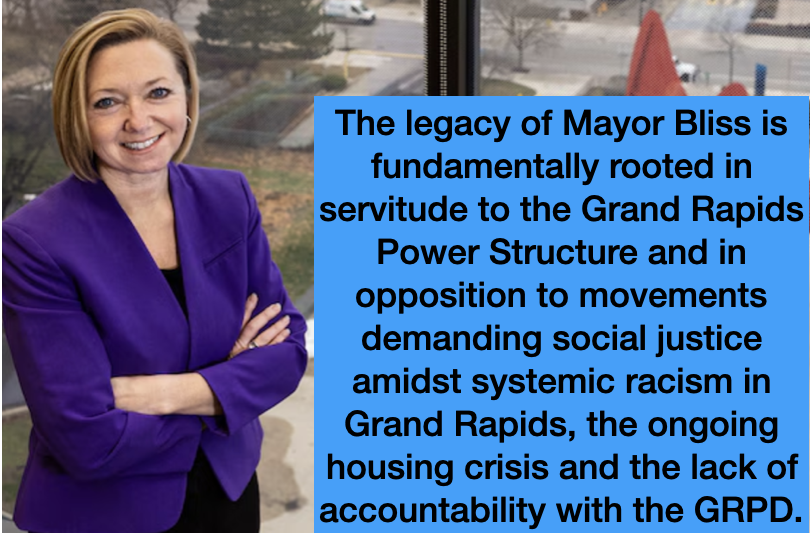
This is just a partial list of the ways in which Mayor Bliss has opposed efforts to promote justice, especially efforts that were led by BIPOC organizers. The legacy of Mayor Bliss is fundamentally rooted in servitude to the Grand Rapids Power Structure and in opposition to movements demanding social justice amidst systemic racism in Grand Rapids, the ongoing housing crisis and the lack of accountability with the GRPD.
 Grand Rapids Institute for Information Democracy
Trackbacks
Comments are closed.