We need faith communities, other institutions and families to commit to being a sanctuary for those are are being threatened by mass deportation in Kent County
No one really knows if the incoming Trump Administration will be able to actually be able to implement a mass deportation campaign in this country.
The logistics and the cost of such an endeavor will be extremely difficult. However, what will be even more difficult for any government effort to engage in mass deportation will be how much resistance there will be. Imagine if there were thousands of faith communities, schools, non-profits and other institutions that publicly declared their opposition to the threat of mass deportation and their willingness to offer Sanctuary.

I know what kind of commitment and risk it takes to declare your community as a sanctuary for those whom the government deems as “illegal.” In 1986, the community I was living in, Koinonia House, declared itself a sanctuary for Central American political refugees that were fleeing the US sponsored counter-insurgency wars.
 One major aspect of becoming a Sanctuary was the need for those seeking to declare themselves a Sanctuary to obtain support from the community, especially in the form of letters. Such letters were a sign that Koinonia House would indeed be trusted with doing the work and it signaled to the federal authorities that those who signed the letters stood with the members of the Grand Rapids Sanctuary. After soliciting letters, Koinonia House received nearly two dozen endorsements from churches, community organizations, university groups, individuals and parents with whom we had developed a relationship with.
The Central American Sanctuary Movement had two main goals. First, was the commitment to offer a safe place for people to live who were fleeing political violence. The second part of the work was to try to influence public opinion and eventually change the national policy around US support for the counter-insurgency wars in Central America.
 We never fully knew how much we were under surveillance, but within the first month of offering Sanctuary to the Guatemalans that had arrived, two FBI agents showed up one day at our door. Not knowing who they were, the Guatemalans let them in. I was upstairs doing some work, when one of the Guatemalans came to get me. The FBI agents introduced themselves and then said, “So, what’s going on here?” I responded by saying, “Since you are FBI, we have to assume that you know exactly what is going on here. However, if you don’t have a warrant, then I’m going to have to ask you to leave.” Right at that moment there were several friends who had stopped by, so we invited them in and told said in a loud voice that the FBI agents were here to harass and intimidate us. Fortunately, the FBI agents left. This was a clear lesson about the importance of being public about the Sanctuary work and how being public and visible could prevent us from being arrested and the Guatemalans from being deported.
During the first Trump Administration, a church in Wyoming, Michigan, Joy Like a River, declared itself a sanctuary in 2018. This was certainly welcomed news, but it was also the only church to declare itself a sanctuary, out of roughly 800 churches that exist in the Grand Rapids area.
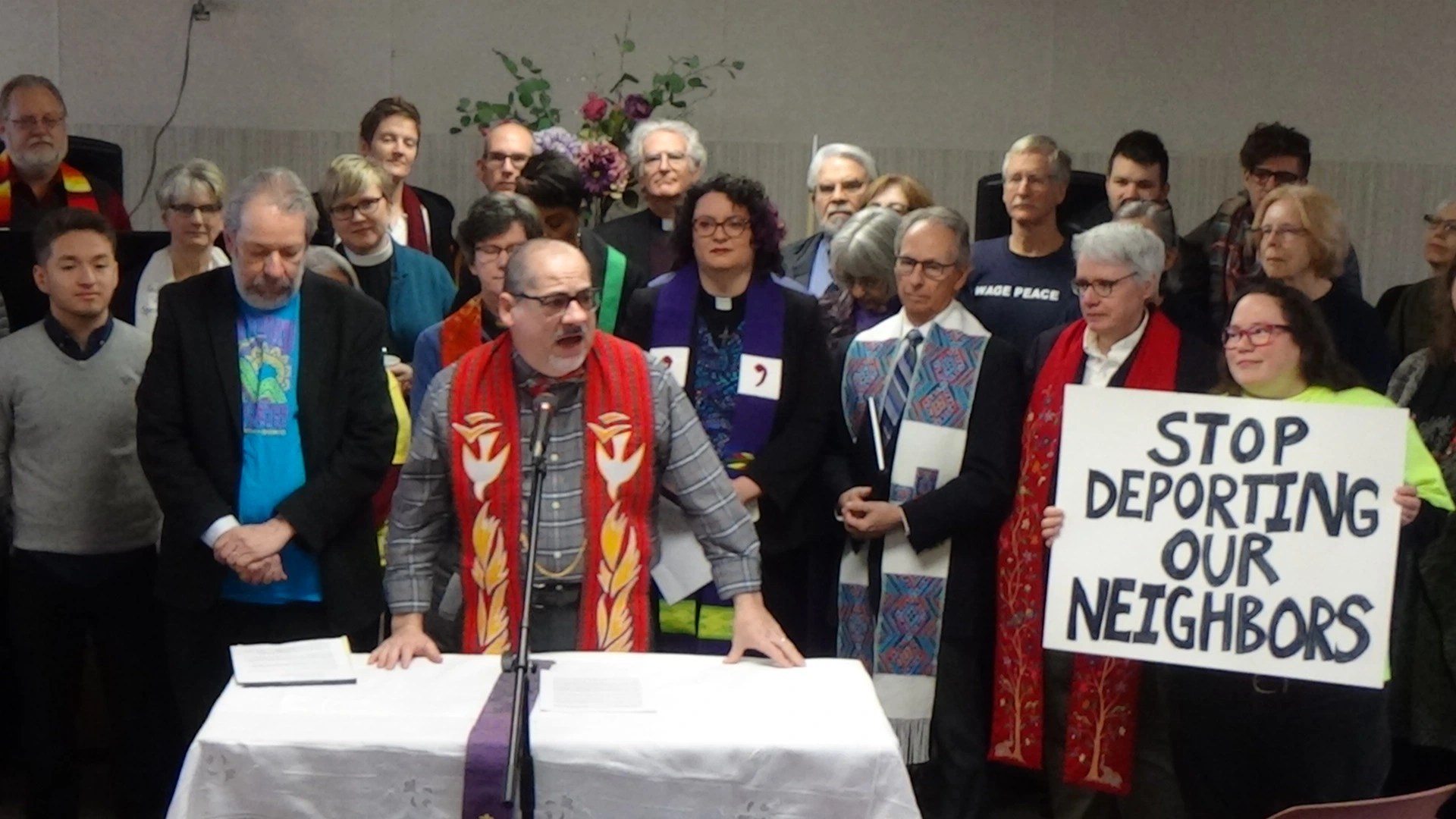
With the incoming Trump Administration’s threat of mass deportation, we will need lots of churches willing to be a sanctuary, whether or not they publicly declare themselves one or not. It certainly sends a message to the immigrant community about how serious congregations and other institutions are when it comes to what they are willing to do and willing to risk to support those most vulnerable to deportation.
When churches declare themselves a sanctuary, they are making a commitment to provide safe haven for undocumented immigrants. This doesn’t mean that undocumented immigrants have to stay in the church, it just means that the church community is taking on that responsibility. Members of the congregation can house people however they are able to, but the congregation is making a commitment to providing safe haven for those seeking sanctuary. Here are some toolkits for churches that are interested in being a Sanctuary Church:
- https://pda.pcusa.org/site_media/media/uploads/pda/pdfs/toolkit_for_churches_accompanying_asylum_seekers_2024%5B56%5D.pdf
- https://www.uua.org/files/documents/starkcharles/0810_road_new_sanctuary.pdf
- https://neumc-email.brtapp.com/files/fileshare/sanctuary+movement+toolkit+(umc).pdf
- https://www.interfaithimmigration.org/resources/toolkits/
In addition to churches, schools can also be sanctuaries, which means that they do not allow ICE on the school premises and will not cooperate with any law enforcement agency that is targeting undocumented immigrants or their children. The GR Rapid Response to Ice group put together this useful Sanctuary toolkit for schools during the first Trump Administration, in English and in Spanish.
Non-profits and even businesses can take a put stance against ICE, by announcing their solidarity with undocumented immigrants and posting some sort of signage in a window or near the entrance to their building that says – We welcome immigrants here, but no ICE agents or cops can enter.
Imagine what kind of message this sends the immigrant community, where churches, schools, non-profits, local businesses and other institutions take a public stance to be safe spaces for immigrants and to publicly declare that they will not cooperate with ICE or any other law enforcement agencies that is seeking to arrest, detain and deport immigrants. This is the kind of solidarity we need. This is one way we can resist the Trump Administration’s threat of mass deportation.
 Grand Rapids Institute for Information Democracy
Comments are closed.