Thinking about those struggling with mental health issues and why the GRPD once again demonstrates that they only keep those with tremendous privilege safe
It has been nearly two weeks since the GRPD repeatedly shot and killed an African American man who had a history of struggling with mental health issues.
We know from multiple sources that the man who was repeatedly shot and killed by the GRPD outside of Trinity Health hospital in Grand Rapids, was at the hospital because he was trying to get medications that he had been on. The hospital refused him, which led to his feeling of distress and frustration.
According to a story from WOODTV8 from November 13th, a former police chief turned-turned-police training consultant stated:
“If you take a few seconds to absorb what is going on, you say, OK this is somebody that’s got psychiatric problems. We can’t tell whether this is a real gun or not. He’s not made any threats. So let’s take time from cover to see if we can make an assessment of what’s going on.”
The police consultant went on to say, “The threat never increased and they never tried to do anything except order him to drop the gun. Why didn’t they try to engage in a conversation? What are you doing this for? Why are you so upset? How can we help you? This isn’t worth it. We’re not going to shoot you.”
Essentially, what the police consultant was saying is that the GRPD response in this situation was completely unnecessary. The GRPD response also should make it clear that the way they act in these kinds of circumstances demonstrates that their first priority is not public safety.
To put the GRPD’s killing of the man who was clearly struggling with mental health in context, we have to come to terms with the fact that this was the 1,152nd person killed by the police in the US so far in 2024, according to https://mappingpoliceviolence.org/. Mapping Violence has 1,151, since the most recent police killing of civilians is logged for November 2, 20024. The police have killed at least 25 people in Michigan so far in 2024.
Mental Health Responses
It is clear to this writer that the GRPD does not keep people safe, especially BIPOC people and other marginalized communities, along with those that are struggling with mental health issues. The GRPD’s first impulse was to protect themselves and to ignore someone that was clearly in distress.
So what do we do and how can we organize in such a way as to provide community care, especially during a crisis? First, we need to do no harm in these situations and stop calling the cops. The group Interrupting Criminalization has a great list of for Health Care providers in a document titled, Beyond Do No Harm. Principle #5 says, Stop calling police on people with unmet mental health or medical needs.
In addition, Interrupting Criminalization has an excellent document called, A Checklist for Assessing Mental Health Response Models. This checklist provides important and robust questions about what we in community need to think about regarding response for those having a mental health crisis and why it is important to not do this work with the GRPD or any other cops.
Additional Resources include:
Painting the Ocean & the Sky – A non-carceral community response
Building a Coordinated Crisis Response Learning Space
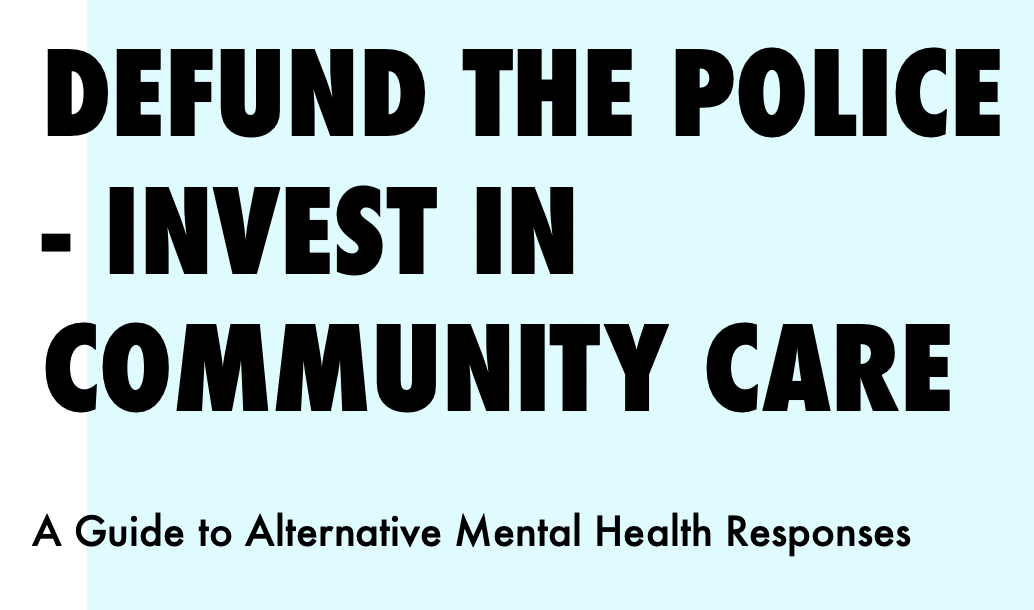
Defund the Police, Invest in Community Care: A Guide to Alternative Mental Health Responses
 Grand Rapids Institute for Information Democracy
Trackbacks
Comments are closed.