Questions about policing in Grand Rapids were primarily avoided at candidate forum last week
Last week Linc Up held a candidate forum with the two 3rd Ward candidates and the two Mayoral candidates.
Members of the Community Owns Safety Coalition asked questions about the GRPD, police funding and alternative community safety initiatives. In each case, the candidates primarily avoided addressing the actual questions that were asked. Two of the questions posed by members of the Community Owns Safety Coalition were asked to the 3rd Ward candidates, Marshall Kilgore and Bing Goei. Just one question was asked to the Mayoral candidates, Senita Lenear and David LaGrand.
Below are the questions asked, along with the answers from the candidates, which were taped. Apologies for the bad lighting in some of the videos, but what is most important is what the candidates had to say. At the end I will provide comments after each their responses.
Question #1 – We know that when the needs of the community are being met that crime is less likely to happen. As City Commissioner would you support an initiative to redirect GRPD funding to meet real community needs?
Candidate Marshall Kilgore begins by talking about a balanced budget, which is not what the question was about. He also talked about getting more funding from the State and Federal governments. The State of Michigan and the US Government also spend too much on funding for cops and the military and not enough for meeting community needs. The question was addressing the fact that for the 2025FY Grand Rapids City budget, $77 million is allocated for the GRPD, when there are thousands of families in this city that are not having the basic needs met – housing, healthy food, health care, transportation, etc. Candidate Kilgore addressed none of this.
Candidate Goei also avoids addressing the question and goes as far as saying that “we do not need to redirect any funding,” which says to me that he will not reduced the GRPD budget in order to directly meet the needs of the community. Candidate Goei also talked about balancing the budget, but more importantly he talked about leaving the decision making up with the City Manager and the City staff the know what is best for the community, even though a significant portion of the community has been asking for a reduction in the GRPD’s budget to meet community needs since 2020, just like the group Defund the GRPD proposed in 2022.
Question #2 – The Hillard-Heintze report from 2019, stated that most calls around public safety were for non-violent offenses. Sending heavily armed cops to deal with non-violent complaints is a waste of taxpayer funds. We demand an alternative to the GRPD, we demand a crisis response team. (See Hillard-Heintze report beginning on page 53 at this link https://griid.org/wp-content/uploads/2019/04/492019-gr-city-committee-of-the-whole.pdf)
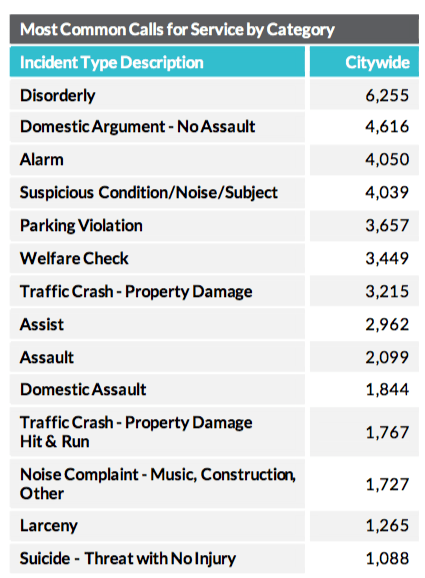 What was interesting about candidate Goei’s response to this question was that he was reading some of the findings and agree’s with the recommendation that more civilian personnel could respond to the majority of calls, which would not require cops, as shown in the chart here on the right. Candidate Goei also says that the city should find ways to support the community groups that are also doing things to reduce crime in the city, yet he never address the call for a non-police response team or other alternatives that would more efficiently utilize public funds and rely less on the GRPD.
Candidate Kilgore does agree that additional funding for a Crisis Response Team is needed, but he also believes that the GRPD often needs to be with them. Candidate Kilgore even acknowledged the fear they had recently after being pulled over by the GRPD, but then re-affirmed the need to have social and mental health workers partner with cops.
According to Alex Vitale (author of the book, The End of Policing) hundreds of people with mental illness are killed by cops on an annual basis. Police do not have the capacity to make a mental health diagnosis and statistically, when police respond to concerns about someone with mental health issues, too often it results in the person being arrested. According to the National Alliance on Mental Illness (NAMI), 2 million people with mental health issues are jailed every year and that the number two cause of death in jails and prisons is suicide. NAMI estimates that 83% of those incarcerated with mental health issues don’t have access to the treatments they need. Vitale believes that what is happening with police responding to these types of calls, is the criminalization of mental illness. Having police present with mental health professionals only escalates potential harm.
Question #3 – Recent FBI statistics for Grand Rapids shows that violent crimes are down, yet the GRPD budget for FY2025 increased. As City Commissioner or as Mayor, would you be willing to reduce funding for the GRPD?
Mayoral candidate LaGrand’s response to this question is instructive for several reasons. First, he completely avoids the questions about violent crime decreasing, plus he never addresses the part of the question that asks if he would support reducing the funding for the GRPD.
Second, LaGrand spend most of his time talking about how more people die from traffic accidents in Grand Rapids than from murder. While this is true and it means that maybe GR needs to invest a a major increase in mass transit, it has nothing to do with violent crime decreasing and the call for a reduction of funding for the GRPD.
Third, LaGrand then changes the question to say, “do we need to do policing better in Grand Rapids?” LaGrand then goes on about changing the culture of policing. This is not what people in this city nor around the country have been calling for for year and most emphatically since 2020. People have been calling for a defunding of the GRPD and to direct the massive police budget dollars to meet real community needs.
Lastly, LaGrand said it will take a great deal of work, accountability and policy change to make policing in Grand Rapids better. Again, it’s not what the question was asking, but it does speak to the fact that people have been organizing around this issue for year, so many of us know this is not any easy fix. However, Grand Rapids City leaders have been unwilling to have those hard conversations and actually listen to what the community has been calling for and working towards. It is also worth noting that while LaGrand was a State Representative, he voted for an increase in the State’s funding for policing in Michigan.
Mayoral candidate Senita Lenear’s response to the question was that they wanted to see what the GRPD budget is being used for currently and then how that can be folded into other programs that do crime prevention. Lenear specifically talked about the SAFE Task Force, which she was involved in while she was a City Commissioner. The problem with such a program is that it only targets youth for violence reduction. Lenear also suggests that there needs to be more social workers to compliment the work of the GRPD, which, as was mentioned previous, is an ineffective model when paired with cops.
Candidate Lenear then ended her comments by talking about the importance of a neighborhood policy model and that she wants to see it grow. Lenear also stated that it is important to have cops know the community and the community to know the cops, but this notion of community policing is not only a bad model, it functions as a form of counter-insurgency, where cops build trust with people for the explicit purpose of intelligence gather that serves their interests, but does not benefit the community.
The community policing model is based on the broken windows theory. Author Alex Vitale says, “Broken windows policing is at root a deeply conservative attempt to shift the burden of responsibility for declining living conditions onto the poor themselves and to argue that the solution to all social ills is increasingly aggressive, invasive, and restrictive forms of policing that involve more arrests, more harassment, and ultimately more violence. As inequality continues to increase, so will homelessness, and public disorder, and as long as people continue to embrace the use of police to manage disorder, we will see a continual increase in the scope of police power and authority at the expense of human and civil rights.”
In the end, all four candidates ended up avoiding and addressing the three questions that were asked by Community Owns Safety Coalition members. Equally important was the fact that not one of them would publicly commit to reduce and redirect current GRPD funding to meet community needs, even though that was central to all three questions.
 Grand Rapids Institute for Information Democracy
Trackbacks
Comments are closed.