Pentagon funding for research and development in Michigan and in Grand Rapids
Outgoing US President Dwight D. Eisenhower warned the American people about the Military Industrial Complex in his farewell address in January of 1961. Eisenhower said:
“We have been compelled to create a permanent armaments industry of vast proportions. . . . This conjunction of an immense military establishment and a large arms industry is new in the American experience. . . .Yet we must not fail to comprehend its grave implications. . . . In the councils of government, we must guard against the acquisition of unwarranted influence, whether sought or unsought, by the military-industrial complex. The potential for the disastrous rise of misplaced power exists and will persist.”
Indeed, the US Military Industrial Complex has only grown since Eisenhower warned us. The US weapons cartel/industry is one of the most powerful lobbies in DC, providing millions annually to both the Republicans and the Democrats, according to data from the Center for Responsible Politics.
Another way that the military industrial complex has impacted the US, is through the massive Pentagon spending that goes to universities and other institutions for research purposes. William Hartung, who has been writing about and researching Pentagon spending in recent decades, just published an article entitled, The Pentagon Goes to School: The Battle for the Soul of American Science. In that article, Hartung states:
The divestment campaigns launched last spring by students protesting Israel’s mass slaughter in Gaza brought the issue of the militarization of American higher education back into the spotlight.
And now, Pentagon-funded research is once again on the rise, driven by the DOD’s recent focus on developing new technologies like weapons driven by artificial intelligence (AI). Combine that with an intensifying drive to recruit engineering graduates and the forging of partnerships between professors and weapons firms and you have a situation in which many talented technical types could spend their entire careers serving the needs of the warfare state. The only way to head off such a Brave New World would be greater public pushback against the military conquest (so to speak) of America’s research and security agendas, in part through resistance by scientists and engineers whose skills are so essential to building the next generation of high-tech weaponry.
In this important article, Hartung provides a link to DoD contracts with universities and other research facilities, 469 to be exact, that have received funding from the Pentagon.
Pentagon funding for Michigan Schools and one research facility in Grand Rapids
It was no surprise to see that schools like U of M and MSU are on the list of schools to receive massive funding from the pentagon, as both major Michigan universities have a long history of providing research and training for the US military.
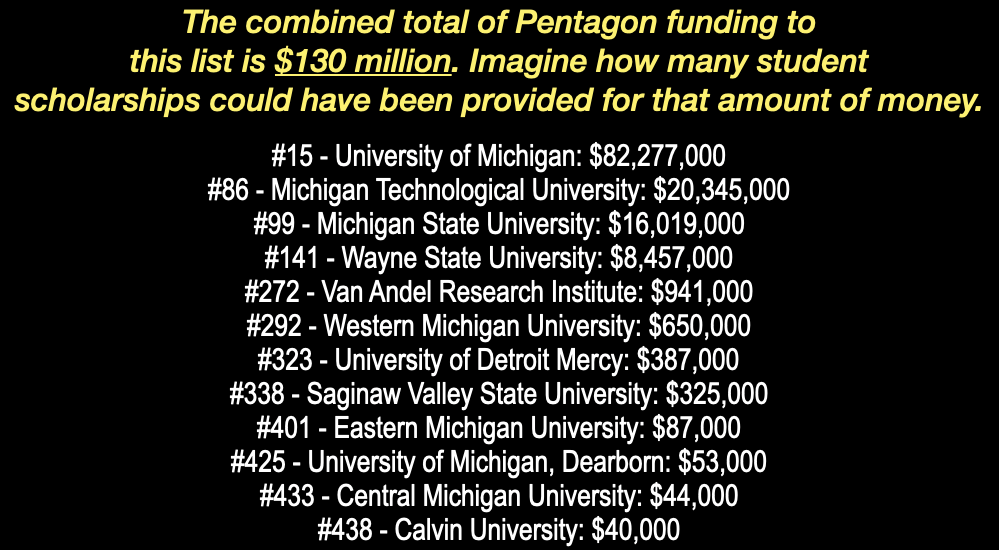
What follows is a list of places that the Pentagon has provided funding to in Michigan, with the first number being the ranking in the 469 recipients, along with the amount of money they received in 2022:
- #15 – University of Michigan: $82,277,000
- #86 – Michigan Technological University: $20,345,000
- #99 – Michigan State University: $16,019,000
- #141 – Wayne State University: $8,457,000
- #272 – Van Andel Research Institute: $941,000
- #292 – Western Michigan University: $650,000
- #323 – University of Detroit Mercy: $387,000
- #338 – Saginaw Valley State University: $325,000
- #401 – Eastern Michigan University: $87,000
- #425 – University of Michigan, Dearborn: $53,000
- #433 – Central Michigan University: $44,000
- #438 – Calvin University: $40,000
I sent Emails to both the Van Andel Research Institute and Calvin University to ask them what kind of research they were doing with the money they received from the Pentagon contract. If I get any answers I will publish their responses.
The fact that so many universities and other research institutions have received large sums of money from the Pentagon should be cause for concern, even outrage. On top of the fact that in Michigan alone, the combined contracts come to roughly $130 Million. Now, just imagine how many student scholarships could have been provided for $130 Million.
 Grand Rapids Institute for Information Democracy
Comments are closed.