Violent crime is dropping and GRPD funding increases: Who controls the narrative controls public spending
Last week, WOODTV8 ran a story entitled, Data: Has violent crime dropped in West Michigan?
The story was based on FBI data, which states that violent crime decreased between 2022 and 2023, by 3%. West Michigan followed this trend and Grand Rapids nearly quadrupled the decrease, with nearly an 11% decrease.
In addition, if you look at the most recent FBI crime data, you can see that violent crimes continues to decrease in Grand Rapids.
Unfortunately, the decrease in violent crime nationally and locally is often not reflected in news coverage or in the political rhetoric of both Republicans and Democrats. The decrease in violent crimes is also not reflected in the bi-partisan commitment to increase funding for the cops.
This push to provide more funding for police is also the mantra that the Grand Rapids Police Department has been using, particularly Chief Winstrom. The calls to increase funding for police, especially after the national movement to defund the police in 2020, has been constant, and Grand Rapids elected officials have embraced this message. The City Manager and the Grand Rapids City Commission approved an increase in the GRPD’s budget from last year, a $3 million increase to be exact.
So what are we to make of the fact that violent crime is down, yet the GRPD, other police departments and and elected officials are not only embracing the “we need more funding for cops” mantra, they are actually pushing the fear narrative. Of course, part of the reason for the fear narrative is that we are in the midst of an election cycle and no politician or candidate wants to be seen as “soft on crime”, but despite the upcoming election politicians and candidates embrace the increase police funding narrative.
Embracing the increase funding narrative for cops is not only problematic, it does actual harm. Here are a few ways in which the increase funding for cops narrative is harmful:
According to https://mappingpoliceviolence.org/ police around the country have already killed 997 people this year, with a disproportionate number of those people being from BIPOC communities. In addition, as Alex Vitale, the author ofThe End of Policing points out, police departments also disproportionately spend the majority of their time policing poor and BIPOC neighborhoods, since this is what local power structures demand of them.
Second, the excellent report from Interrupting Criminalization entitled, Cops Don’t Stop Violence, deconstructs the whole notion of crime, how crime data is misused to serve policing interests and how police consistently engage in their own crimes against people they stop, detain and arrest. This report concludes with the following statement: It’s time to recognize that decades of pouring more money, resources, and legitimacy into policing in an effort to increase safety have failed — because policing is functioning as it is intended to: to contain, control, and criminalize Black and Brown communities rather than to prevent and reduce violence. It’s time to invest in meeting community needs and building non-police community safety strategies. It’s time to invest in just recovery.
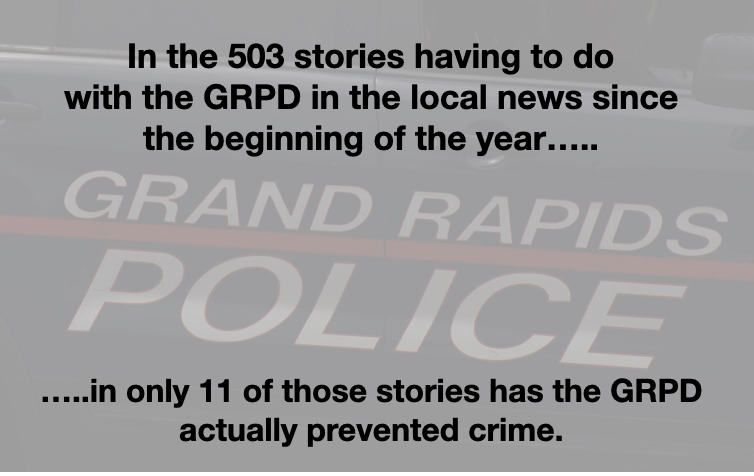
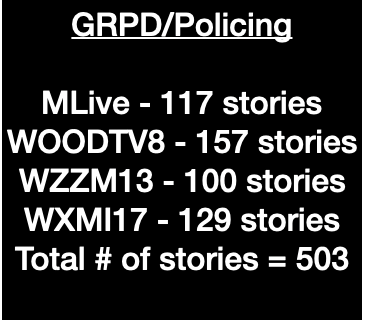 Third, the news media feeds into the fear narrative, which justifies large police departments. Since January 1st, I have been monitoring MLive, WOODTV8, WZZM 13 and WXMI 17 on a variety of issues. The number one new theme is crime, as you can see in the image here on the right. Comparatively, during the same time period, there have only been 72 stories about local elections. However, what is even more instructive is the fact that of the 503 news stories from the four news agencies, stories that center on public safety, there have only been 11 stories where the GRPD actually prevented a crime. If the GRPD is not actually preventing crime, then what the hell do they actually do?
Lastly, maintaining narratives around fear and the need to increase police funding results in massive police department budgets, which ultimately means that other critical issues like housing, food, health care, education, climate justice, etc. will not be a priority.
The last talking point is critical, since it was central to the Movement for Black Lives creating the Defund the Police Toolkit. The Movement for Black Lives understood that policing is designed to control and repress communities that are demanding justice, and that police departments are a drain on how public tax dollars are spent. We need to flip the script on this narrative and demand better in our communities.
 Grand Rapids Institute for Information Democracy
Comments are closed.