Day Three – Socialism Conference: Immigration Abolition, Border Imperialism, Indigenous resistance and anti-carceral movement work
 Silky Shah (Unbuild Walls: Why Immigrant Justice Needs Abolition) began the conversation by talking about how far the Democrats have moved to the right on immigration and carceral responses to immigration. This ultimately means that Republicans just continue to move even further to the right of whatever the Democrats are proposing, leaving immigrants to suffer under both parties.
Shah then talked about how Republican Governors have been busing immigrants to the North, which may not have been a huge problem decades ago, but now that social services have been radically defunded, cities line New York no longer have capacity to deal with an influx of immigrants. This has led the Democrats to focus even more on draconian border policies. Thus, moving to the right is the logic for winning the 2024 election for the Democrats.
She then says, “the Biden/Harris policy for those who have been here for 10 years or more and are married to a US citizen is just window dressing and crumbs. Neither of these things promote immigration justice.”
Harsha Walia (Border and Rule: Global Migration, Capitalism, and the Rise of Racist Nationalism) began by talking about how Far Right border policies have been a bipartisan approach in the US, but is also happening around the globe. Walia refers to this trend as both a fascist border policy and nationalist xenophobia. “What we are seeing is that politicians and the commercial media are talking about border insecurity, when they fail to talk about the actual violence being done to immigrants at the border.”
Another important point that Walia talked about was the fact that we don’t talk about immigration outside of the US/Mexican border. In fact, Mexico is currently deporting more Central Americans than the US, but they are doing so at the behest of the US. This dynamic is conveniently left out of the political and media narrative.
Then there is the issue of border outsourcing, when states, like Australia, are paying the private sector to create and run detention centers, often off the mainland, as a way of hiding it and distancing the state from the harm. Another aspect of global border imperialism is that we don’t talk about the colonial history or the current imperialist dynamic, which are the very roots of why so many people are fleeing their countries of origins. We cannot “fix” the immigration issue if we don’t come to terms with how US foreign policy is displacing people and has created the “immigration crisis.” Walia says that the real crisis is imperial policies.
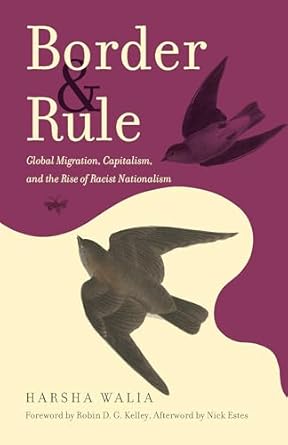 Walia end her opening comments by saying, “To undo and dismantle border imperialism, is to dismantle racial capitalism.”
Silky then talked more about the evolution of US immigration policy, especially from the Obama years, which were very draconian. She discussed how the immigrant (led) justice movement pushed back against the Democratic immigration and border policies. The immigrant justice movement has been able to, especially during the Trump years, reduce deportations, create more sanctuary spaces and reduce some of the harm. Unfortunately, in this moment, the Harris campaign has now become hawkish on immigration, but if she is elected Silky fears that too many people will abandon the immigration justice movement, just like they have under Biden.
Harsha then talked about how the immigrant justice movement, particularly in so-called Canada, has been an anti-colonial/anti-imperialist movement, which not only believes that No One is Illegal, but that Nations States are the entities that are truly illegal. She says that this framing and narrative has provided space for the movement in Canada to become more abolitionist over time.
Walia also said, “The years and decades of austerity policies have forced our movements to to become too single issue. This is a consequence of having bipartisan Neo-Liberal economic policies.” For example, every 2 seconds someone is displaced because of climate change, but too often we don’t talk about how climate change causes displacement. Harsha says, “in fact, every major struggle – anti-imperialist, climate justice, labor justice, etc., are intertwined with immigrant justice.”
She ended her thread on this issue, by stating, “You can’t be anti-fascist today if you are not anti-border! In the same way that defund is the floor for abolition, status for all immigrants is the floor for anti-border imperialism.”
How Can the Left Respond to this Moment?
Later in the day I sat in on a live taping of the Laura Flanders Show, with guests Harsha Walia, Rachel Herzing, and Nick Estes.
The theme for the show/discussion was, how do we respond to this moment? We are led to believe that the most important thing we can do is to vote in November, despite the fact that there is no evidence that this actually creates the kind of change we want.
Harsha began by saying, “In this moment I think we need to think about Global Fascism and recognize it, along with the tendencies towards Fascism, as we recently saw at the DNC, with Harris saying that she wants to be more to the right on US border/immigration policies, law enforcement policies and of course the unconditional US support for the Israeli genocide.”
Nick responded by saying,”We need to learn from the history of Indigenous resistance. We also need to avoid falling into the electoral politics framework. There is no real choice.” Estes was also critical of the uncommitted movement, since they thought they could change the Democratic Party, plus he isn’t convinced that many of them will still vote for Harris.
A second question posed by Flanders was, “Are there any new possibilities and new forces outside of political party forces?”
Rachel stated that, “we need to have an intersectional analysis of the current crises, to see how they are inter-connected. The student encampments have been amazing and encouraging. Then there is the current crisis of Capitalism, where you see moments like the 2020 uprising, specifically to state violence, where protests shut down commerce and disrupted business as usual in lots of ways.”
Nick responded to the question by saying, “I think about the mobilization against Standing Rock and how so many people started to think about Indigenous struggles, just like how so many people have been mobilized to resist the US support for the Israeli genocide, and that so many people are not ignoring this issue. Plus, the bipartisan support for Israel should tell us something about the ruling class in this country.”
Harsha stated that, “the system and the structures in the US requires us to silo our struggles, which is especially played out in the the Non-Profit Industrial Complex.”
Flanders then came back to Estes, asking what he meant by his comments about Capitalism must die. Nick’s response was clear. “Capitalism must die, because even in the so-called green economy there is a reliance on extractivist practices, which always impacts Indigenous people the most. Line 3 and the ongoing carbon emissions from these projects are the direct outcome of Capitalism.” Estes also pointed out that Minnesota Governor Walz provided the financing and state support for the Line 3 project, which means that tar sands oil will flow through this pipeline for years to come, with untold amounts of carbon emission. Nick then commented, “But we are told by the DNC that Walz is an environmentalist.”
Rachel Herzing responded to the question by saying, “You can’t have the Prison Industrial Complex without Capitalism. It’s not about safety, it’s about generating profits from a system of carceral violence.”
Harsha Walia chimed in by saying, “We need to think about bordering as displacement, which happens around the world, but also happens within our own communities such as what happens with gentrification. Taking an abolitionist approach to borders, imperialism and Capitalism will be necessary if we want our movements to succeed.”
Bring the conversation back around to the upcoming election, Flanders wanted the panelists to talk about whether or not movement politics is at all compatiple with electoral politics? Nick Estes referred to an article he wrote in 2018, headlined, You can’t vote any harder. He then said that, “Deb Haaland has provided us with reports on the genocidal policies of Boarding Schools, but she has also presided over an increase in oil and gas drilling permits in the US.”
 Rachel Herzing had her own question/comment, stating, “Will Black people be bamboozled by voting for a Black person, like we saw with Obama, and now with Harris? I do think it is worth think about down ballot voting, like local judges and school board members.” Rachel also shared that while in Atlanta recently, she saw a Black family with Law & Order logo T-shirt, with Harris 2024 underneath. She was puzzled and couldn’t tell if this was serious or if the family was making fun of the Harris/Walz ticket.
Harsha’s comments regarding movements and electoral politics was right to the point. “I am always blow away by the fact that if we don’t get involved in voting that shit will hit the fan, when in fact these are often the same people that don’t do much of anything beyond voting to reduce the harm or to create structures built on collective liberation.”
Nick Estes then shared an interesting observation about how systems of power when trying to do good are still engaging in harmful policies. “We learned that NGOs that worked on ending pipeline policies would talk about how the Keystone XL campaign was really connected to the US imperialism against Venezuela, since the Keystone XL project was a way of undermining Venezuela’s oil. Interestingly enough, the Venezuelans actually provided us Indigenous people with oil in the Dakotas, where we have some of the highest oil costs and some of the harshest winters. The 350 people did not want to talk about this connection, since it wouldn’t sell amongst their funders, which is a big problem for movement work.”
Laura Flanders ended with one last question for the panelists. She asked, “what gets you out of bed in the morning to keep doing what you do?” Rachel Herzing stated, “the abolition of imprisonment is happening right now. It is not some futurist vision, but a project/movement right now. What Black and Pink is doing on a daily basis is amazing, just like the work of Critical Resistance. I want to continue to be part of that. We have to organize and organize, especially in collective fashion, which is always absolutely necessary if we are to have a future.”
Nick Estes shared what he learned from the late Elizabeth Cook-Lynn, who said, “we don’t even own our own life, we are here to make things better for the future. This is how how we can be good ancestors.”
Harsha came back to a theme that has been repeated over and over again at this conference….. “How can we be in good relationships with each other. Ho do we find unity through struggle. How we are and how we are with each other is what really matters.”
 Grand Rapids Institute for Information Democracy
Comments are closed.