Day Two – Socialism Conference: How to Abolish Rent and reflections on Capital and Abolition
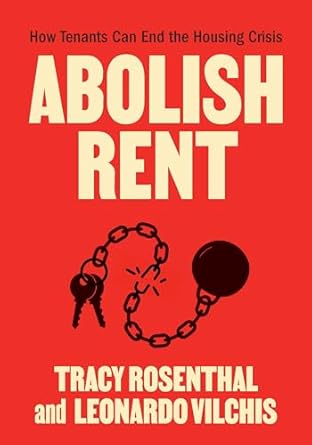 The Abolish Rent session was a presentation/discussion by the co-authors of the new book, Abolish Rent: How Tenants Can End the Housing Crisis. Tracey Rosenthal and Leonardo Vichis, both long-time movement organizers, providing participants with great examples, cogent analysis and inspiring organizing tactics and strategies from tenants, mostly in Los Angeles where they reside.
The moderator for the session made a point early on in the discussion, that this book is a fabulous resource that can help us all re-frame the issue around the current housing crisis. In fact, one of the primary points they made is that we need to see rent as the crisis, not housing.
Other powerful re-framing statements the co-authors made were:
- Rent is a fine for a human need.
- Rent is the gap between tenants’ needs and landlords’ demands.
- Tenants live inside the landlord’s profit-maximization vise.
- Rent is a monthly tribute to those with generational wealth.
- Rent is an engine of inequity.
- Rent is our money, which landlords invest for their gain.
- Rent prevents us from caring for ourselves and each other.
- Behind each rent check is a threat of eviction.
- Behind each rent check is the threat of state violence.
The co-authors had many more re-framing comments and analysis that was critical to why abolishing rent is a central goal of any tenant movement.
Many of the stories they share centered the relationships that tenants built with each other and the power of the common lived experiences. According to the co-authors this often led to tenants taking collective action to demonstrate to each other the value of pushing the envelope and taking larger risks. In many ways what they were saying was what the great educator Paolo Freire always talked about, which was the take action, reflect on it, plan something else, and then engage in another action. This is how we learn, the co-authors said, by practicing risk and resistance, then seeing how systems of power react.
Tracy Rosenthal said that there are no blue prints to organizing. Sure, we can learn from past movements, but we can’t just repeat what they did, since system of power and oppression are always learning and evolving as well. Abolish Rent: How Tenants Can End the Housing Crisis is both a powerful and inspiring book, and should be widely read by anyone who wants to practice housing justice.
Capital and Abolition
 When studying Capitalism and the Prison Industrial Complex, what does it mean to follow the money? This was the initial question asked by the moderator to both Lydia Pelot-Hobbs (The Jail is Everywhere: Fighting the New Geography of Mass Incarceration) and Ruth Wilson Gilmore (Abolition Geography: Essays Towards Liberation). Focusing on the Angola Prison in Louisiana, Pelot-Hobbs said, “Be ready to be wrong or inaccurate.” Angola prison was financed by the petro-oil industry as a result of the profits made during the early 70s OPEC oil boycott. These are all “mundane realities,” said Gilmore, talking about the research and following the money. “But we need to focus on the mundane so we can actually follow the money. We need to follow the minutia of capital expansion.”
The discussion then shifted to the difference between the anti-State State vs the Pro-State State. Both presenters talked about the need to not be completely dismissive of the important of the public good that governments can do, since they have an infrastructure that can benefit people. Wilson talked about the need to find a political and ideological space between anarchism and communism, which would not completely abandon the possibilities of influencing public dollars for public good.
Pelot-Hobbs talked about the organized abandonment of New Orleans after Katrina, where Neo-Liberal forces stepped in immediately and sought to dismantle public housing, public education and aspects of the abandonment of funding for infrastructure, which ultimately led to the levee breaks and the mass flooding of New Orleans. There was a tremendous amount of autonomous, grassroots Mutual Aid and organizing work being done after Katrina, which also needed some public institutions. There were important lessons learned from this for future organizing.
 Ruth Wilson Gilmore then said, “Abolition is a way to find a space between communism and anarchism, communism with s small c.” She also talked about the idea of communist philanthropy, where we are creating and funding the world we want to make.
During the Q & A there were numerous comments and questions that led to some good discussion. However, there was one question/comment that stood out to me. The work of abolition and anti-imperialism, were both manifested by the 2020 uprisings and more recently the Palestine Solidarity Movement.
Ruth Wilson Gilmore said, “You can’t have abolition without anti-imperialism/anti-colonialism and you can’t have anti-imperialism/anti-colonialism with abolition.” For me, this was an important reminder and framing for the movement work we do in community. This led to another important statement, which was, “How are we fortifying our organizational links.” How are we connecting and collaborating, so as not to operate in silos, but also to strengthen each other’s movements and create better collective accountability.
 Grand Rapids Institute for Information Democracy
Trackbacks
Comments are closed.