The economy sucks for most people, so why are we not talking about it more?
For anyone who spends time with working class people you know that there are countless people who are struggling to get by.
Despite the claims made by economists and Democratic Party apologists, a huge sector of the population is struggling with housing costs, food costs, gas costs, utility costs and many other basic necessities.
 The cost of living continues to rise, yet most people’s annual income or their wages has not risen at all or not nearly close enough to the cost of living. There are lots of people with more than one job and there are also lots of people that I know who have a side hustle, primary because the wages they make are not enough to cover the weekly or monthly expenses.
What is instructive is that fact that in the midst of the 2024 election cycle, wages, income and poverty are not significant talking points. Sure, there are candidates and politicians who will talk about the middle class or equity, but they do not talk about economic justice, the wealth gap or the fact that the wealth of the billionaire class continues to grow at astronomical rates. According to a March 2024 report from inequality.org, “the country now has 737 billionaires with a combined wealth of $5.529 trillion, an 87.6 percent increase of $2.58 trillion, according to Institute for Policy Studies calculations of Forbes Real Time Billionaire Data.”
A popular meme right now on social media has been to remind people of the fact that the fight for a $15 an hour wage has been around so long that such a wage would be grossly inadequate for people to survive. Many people are saying that the new minimum wage should be $25 an hour and that a Living Wage should be at least $35 an hour.
Data on Poverty
According to a recent study done by Wallet Hub, where they looked at which states are seeing high levels of distress around income, Michigan is #1 in states with the highest percentage of a states population in financial distress.
On Sunday, MLive posted an article entitled, 41% of Michigan households live paycheck to paycheck. You can see the breakdown by town on an interactive map in the article.. The source that MLive is citing is a recent ALICE report. ALICE stands for Asset Limited, Income Constrained, Employed.
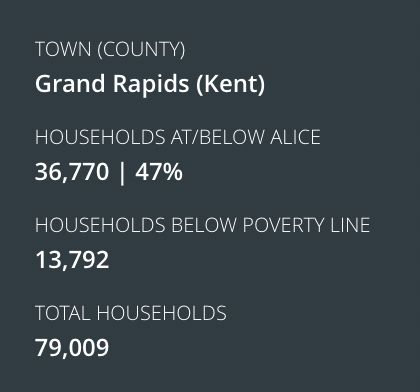
The MLive article provides a searchable map, so that anyone can look to see what percentage of people are economically struggling across the state. I looked at the data for Grand Rapids, shown above on the right. As the MLive headline said, 41% of Michigan households live paycheck to paycheck, but that number goes up to 47% for Grand Rapids households. This means that nearly half of the households in Grand Rapids are living paycheck to paycheck! You wouldn’t know this, since the local news doesn’t really talk about it much, nor do the politicians, hell even faith leaders to make economic justice a priority when they preach.
Now, for anyone who reads the GRIID blog, you know that Grand Rapids has lots of major development projects that, especially in the downtown area, where hundreds of millions of public taxpayer money is being used to fund projects that will primarily benefit the already disgustingly rich people who have been proposing these projects. And yet, there is no organized movement of people making demands that public money should be prioritized around meeting the needs of thousands of households in this city.
One last piece of data that should piss everyone off, is based on a recent article on TruthOut, with a headline that reads, 27 States Let Utilities Shut Off Electricity for Nonpayment During Heat Waves.
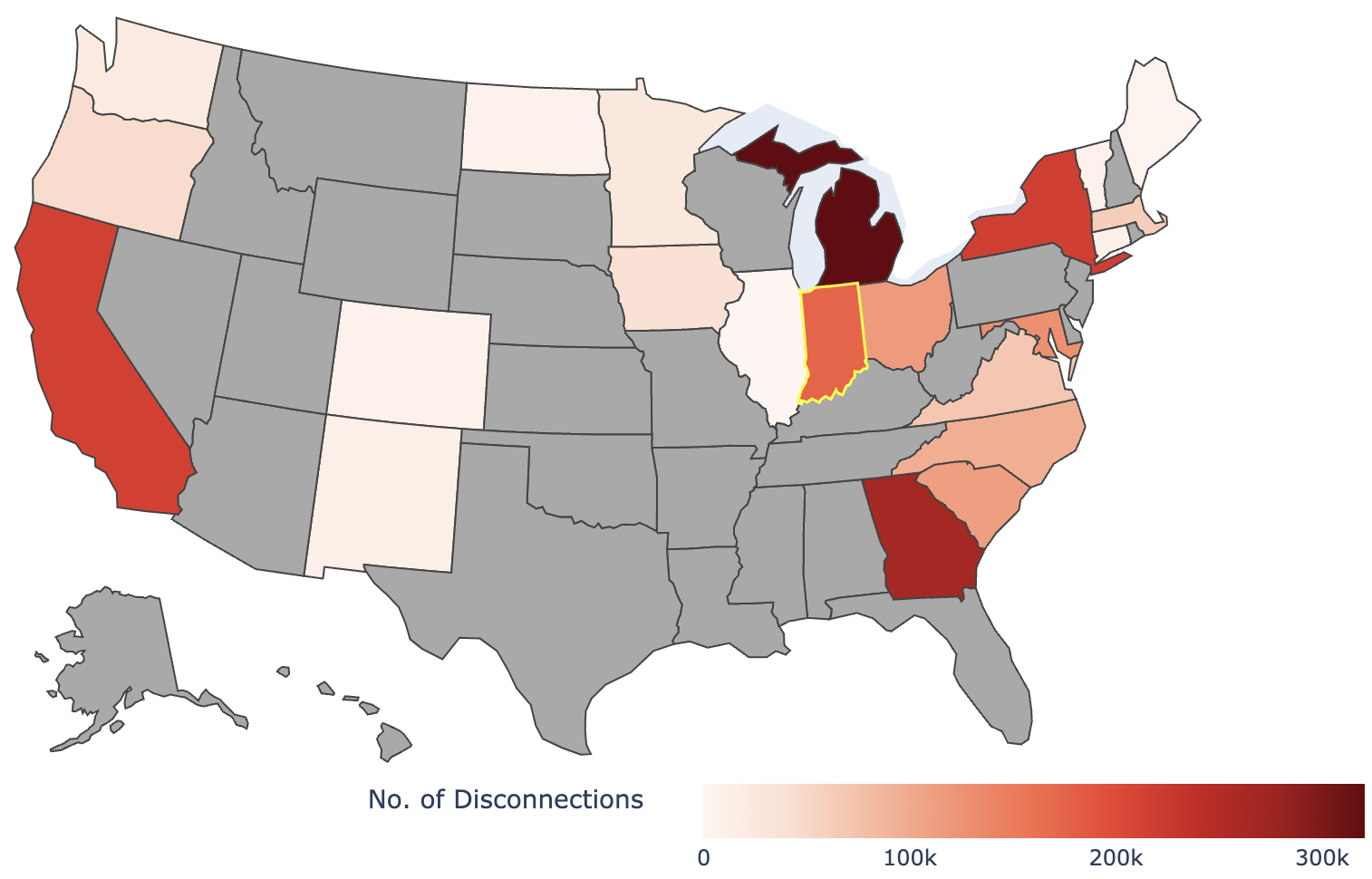
The TruthOut article cites data from Utility Disconnections, which tracks where utilities are being shut off throughout the year, regardless of how hot or how cold it is. According to Utilities Disconnections, between January 2018 and December 2023, Michigan had the highest number of utility shutoffs in the country – 320,706.
What can we do?
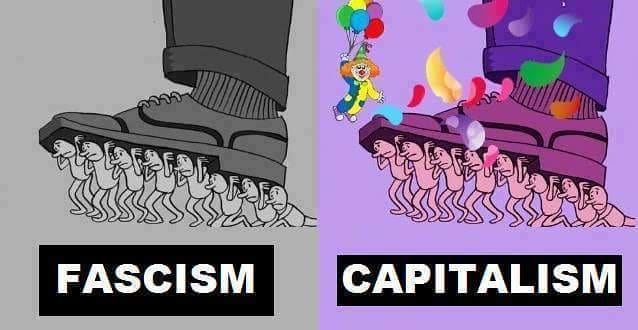
There are no easy answer or quick fixes. One thing for sure is that whatever we do has to be a collective response. As an abolitionist, I am committed to not only dismantling the economic system of Capitalism, I want to practice collective liberation and cooperation. One way to think about this is from an excellent article by Stephen Dacy, Environmentalism as if Winning Mattered: A Self-Organization Strategy. Darcy suggests we need a two-pronged strategy of Resistance and Transition. Darcy argues that while we resist oppressive structures and systems, we need to simultaneously work to create autonomous systems and practices that reflect the kind of world we want to live in.
However, in the mean time, here are a few things that we can do collectively to promote and practice economic justice and foster cooperative practices that can lead to collective liberation.
- Most of us have jobs and are not bosses, therefore you can be organizing for workplace democracy and fight for better wages and benefits. You can join a union or you can start an independent one, like an autonomous IWW chapter.
- Create worker-run cooperatives, where bosses are not needed and where those who do the work decide how funds are spent and how they are shared between those involved. See the book, For All the People: Uncovering the Hidden History of Cooperation, Cooperative Movements, and Communalism in America.
- Create or join a community garden. Growing food collectively will not only help us not rely as much on agribusiness and fake foods, but it helps to foster solid relationships and practice skill building. The same could be said for food cooperative, housing cooperative, childcare cooperatives, etc. For a great model, look at the example of Brazil’s Landless Workers Movement, Movimento dos Trabalhadores Rurais Sem Terra, where those who have been displaced and dispossessed, occupied land that was appropriated by the rich. The MST then creates their own autonomous communities. It is the largest organized social movement in the world.
- Make demands at the local, state and federal level to prioritize budgets – which are exclusively made up of the tax we collectively pay – that larger portions of public money be spent on uplifting people, creating more equity and moving away from funding things like policing, the prison industrial complex, the military industrial complex, etc. If government systems to not respond to our demands, then we can collectively engage in tax resistance. As Secretary of State George Shultz once said, “people can march all they want, as long as they pay their taxes.”
- Practice Mutual Aid. One of the fundamental principles of Mutual Aid is the idea that “we take care of each other.” Mutual Aid can be in the form of money, food, transportation, housing, caring for children, pretty much anything we can do that demonstrates ways of taking care of each other. I would highly encourage what Dean Spade has written on the topic of Mutual Aid.
- Engage in collective boycotts and economic sabotage. Systems of power and oppression rely on us to spend money on things that cause oppression. If we engage in collective boycotts and economic sabotage, we can wound the system of Capitalism, Militarism and White Supremacy, especially in our own communities.
- Practice skill sharing. We all know things, knowledge or skills that we can share. The more we share those skills, the more than we don’t have to collectively relying on someone else doing something for us. Again, skill sharing is most effective when we practice it collectively.
These are just some of the more important tactics and strategies we can implement and practice if we are going to create another kind of world to live in. None of it will be easy, much of it will mean that we need to take risks, but then again if we look at significant shifts in history, especially the kind where collective liberation was at the center, taking risks has always been necessary.
 Grand Rapids Institute for Information Democracy
Trackbacks
Comments are closed.