After six months of Grand Rapids news monitoring the commercial media is failing us when it comes to serving the public interest
One aspect of the work that I have been doing with the Urban Core Collective (UCC) is monitoring the local commercial news media. The areas of focus for the news monitoring has been to look at the coverage around the issues areas that UCC is working on – the Grand Rapids Public Schools, Public Safety, Climate Justice and their new Democracy Initiative.
Here is the data for the four news agencies I have been monitoring since January 1st through July 6th:
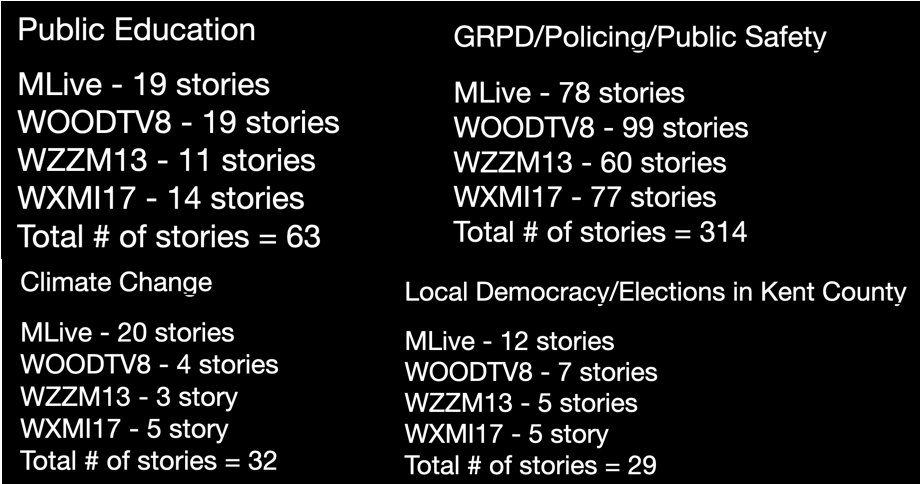
As you can see from the data, policing/public safety dominates local news coverage over areas of public education, climate justice and local democracy. There are several reasons why crime coverage is far more likely than the other three areas.
- It is easier to produce crime coverage, since it is already a packaged story, driven by images and narrative. Flashing police lights and police tape make make for stories that are easy to fill in the blanks.
- The local news media relies almost exclusively on the GRPD or the local judicial system as sources of information on crime and public safety.
- The local news media rarely asks probing questions or investigates the claims from the police or the courts, especially since they have internalized the belief that the police and the courts actually serve the public interest.
- It is also worth pointing out that in all of the 313 policing/public safety stories over the past 6 months, there have only been 8 stories about community-based groups doing crime prevention work. Lastly, of all these 313 stories that center mostly crime, there were only 10 stories about the GRPD actually preventing crime, which means in most of the stories the GRPD showed up after a crime had been committed. This should tell us something about the real function of the GRPD.
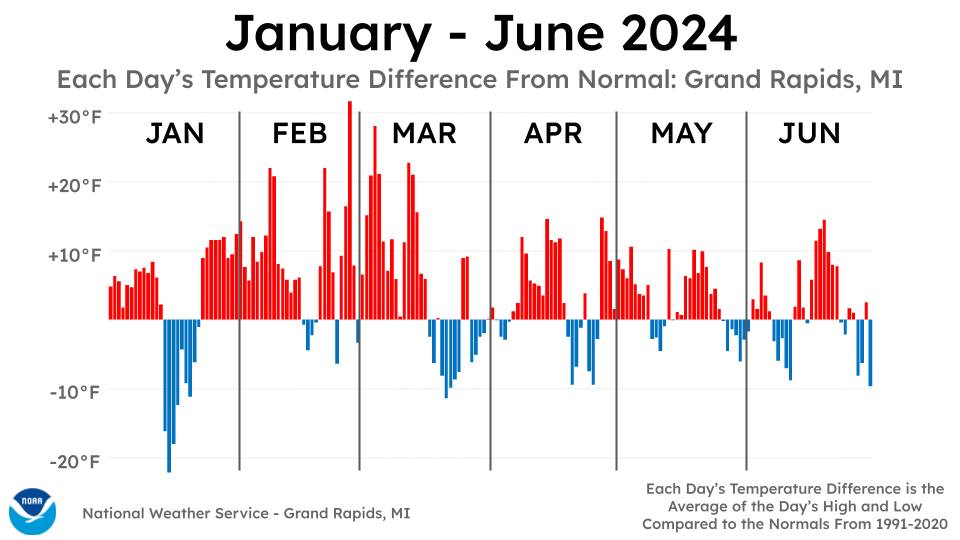
Beyond the data it is also important to look at the kinds of stories done and the narratives they are using in the local commercial news media. In the coverage of Climate Justice (32 stories total) in only one of those stories was phrase climate change used. There was one story where the phrase “climate related phenomenon” was used and the term “global warming” was used only once. This means in the bulk of the climate coverage – which centered mostly on the mild winter and the increased heat in May and June – there was rarely any direct correlation between the weather and climate change.
On the matter of local elections and local democracy, the coverage was even less than on Climate Change. For as much as the public talks about the importance of participating in local elections, the news media doesn’t seem to embrace this reality. For the upcoming August 6th Primary Ballot there are numerous political races that should be getting attention, such as the Mayoral race in Grand Rapids and the 1st and 3rd Ward races in Grand Rapids. There have only been a few stories about the Grand Rapids Mayoral race, such as a few stories about campaign financing and a few about candidates speaking with some sectors of the community. What we have not seen in the local news is any coverage about the platforms of the Grand Rapids Mayoral candidates, which is ultimately the most relevant information.
There have been no stories about candidates running for the 1st and 3rd Wards in Grand Rapids so far, which is deeply problematic, especially since in both races there will be two new city commissioners, since the standing commissioners are term limited.
Lastly, the only other local election coverage has been about ballot initiatives and most of those stories have been about the hotel tax proposal. Unfortunately, with the increased hotel tax stories the public has only heard from those who support the proposal. Not surprising, many of the people endorsing the increased hotel tax proposal, which will be used to fund the Amphitheater, the Soccer Stadium and the Aquarium, are also the same people who will be the primary economic beneficiaries of these development projects.
On the matter of local news reporting on the Grand Rapids Public Schools, while there are more stories on this topic than on Climate or local elections, much of the coverage is still not useful for the public’s understanding of GRPS policy decisions.
The GRPS coverage was a mix of stories about school snow days, school closings and stories that were about a specific program or project that involved in the GRPS. There were very few stories about GRPS policy decisions and even less about community organizing efforts to improve the Grand Rapids Public School system.
The decision of local news agencies to focus more on feel good stories as opposed to centering GRPS policy and budget decisions doesn’t promote community engagement. If we want people to be informed and involved in the Grand Rapids Public Schools the local commercial news media needs to spend more time on investigating and reporting on how school policies impact outcomes for students.
Since the late 1980’s I have been involved in monitoring and documenting how the local news media has been reporting on issues that are critical to the community. After 35 years I can attest to the fact that the local news media mostly fails the public in reporting on matters that are of vital importance to this community. If we want to see more people engaged in community issues, then we also need to demand that the local news media needs to report on critical community issues and actually serve the public interest instead of merely entertaining us.
 Grand Rapids Institute for Information Democracy
Trackbacks
Comments are closed.