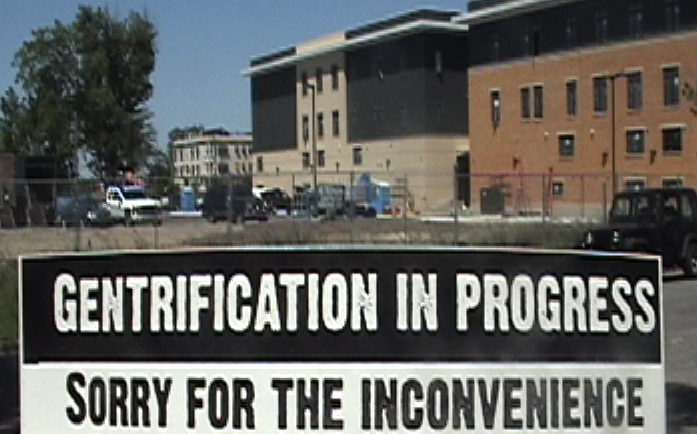
The Gentrification of a neighborhood is now nearly complete, but MLive doesn’t bother to acknowledge that fact
 “Interest in market-rate housing on the southern edge of Downtown is driven by the location.” Mike Coyne CEO of Cella Building Company
On Sunday, MLive posted an article with the headline, “First units in new 58-unit ‘all electric’ apartment building to open in late August.”
The article celebrates the addition of 58 new market-rate apartments on the corner of Wealthy and Division, just south of Downtown Grand Rapids. More importantly, the article centers the perspective of the CEO of the development company, Mike Coyne, who is the only source used in this story. The MLive article is problematic in several areas, besides only citing the developer the journalist fails to discuss the significance of market-rate housing vs more affordable housing, the amount of public money used in this project without public input, and the fact that there is no historical context to house this project came about in that neighborhood.
Historical Context
(For transparency purposes, I lived in the neighborhood on LaGrave from 1984 – 2012. This allowed me a first hand experience of how the neighborhood had changed.)
The history of the neighborhood where the new 58 market-rate units constructed by the Cella Building Company is conveniently omitted. The neighborhood that the new development sits in used to be called the Forgotten Corner Neighborhood.
A century ago that neighborhood was occupied by Europeans immigrants. However, after WWII, many of those residents began to move out of the area and into the suburbs. Many of the new residents were African American, many of whom had migrated from the South to Michigan in search of a better life. However, some of the European immigrants still owned many of the homes, which were now disproportionately rental units.
In the summer of 1967, this neighborhood became the epicenter of the 1967 riot in Grand Rapids. The 1967 riot included the destruction of a few businesses, but mostly rental units which became targets since white absentee landlords were the owners. Several houses were either burned or left in disrepair for decades, right up to the time when I moved there in 1984.
By the early 80s, most of the residents in the Forgotten Corner Neighborhood were Black and Latinx. Beginning in the late 1980s, downtown Grand Rapids began to see a major injection of money and development projects, which included the expansion of what was then St. Mary’s Hospital. As with all commercial development projects, parking becomes a central issue. St. Mary’s and Mary Free Bed Hospitals began purchasing land south of Wealthy into the Forgotten Corner Neighborhood, primarily for the construction of surface parking lots.
Seeing the writing on the wall, residents in the Forgotten Corner Neighborhood decided to organize to prevent further encroachment, along with the increased possibility of gentrification, which had already begun in the 1990s in the Wealthy St. corridor. ICCF had also moved into that neighborhood and once they found out that residents were organizing they decided to get involved and eventually undermined the desires of residents, some of whom had lived in the neighborhood since the late 1950s.
Between 2003 and 2010 there was no movement on the part of ICCF, or so those of us who lived in the neighborhood had thought so. Out of nowhere, there appeared a front page story in the Grand Rapids Press, with the CEO of ICCF talking about what they were calling the Tapestry Square. ICCF had bought up all the vacant land in the 400 & 500 blocks of LaGrave, Sheldon and Division and then began approaching landlords and homeowners in the area. By the end of 2010, the remaining houses on the 400 block of Sheldon had been bought by ICCF, with apartment dwellers having to vacate and home owners selling their property.
This behind the scenes land grab was not what residents were told at the last large neighborhood meeting with ICCF. In the 2002 Wealthy – Jefferson Development Initiative, it stated, “All current home owners will be able to continue to enjoy their homes, including some form of protection against tax increases that could threaten their ownership in the future.” The residents, who participated in the 2000 and 2002 planning sessions, were also assured that they would not have to leave and that new development would be built around existing property. Clearly, ICCF had other plans.
Before I moved out of the neighborhood in 2012, MLive continued to ignore this history and only focus on the new development projects.I wrote about the MLive omissions twice on December 2nd and December 4th of 2012.
Unaffordable Housing that used public subsidies
The most recent MLive article about the 58 market-rate housing units does state that the cost will range from $1,299 to $2,099, with 38 one-bedroom units, six studios and 14 two-bedrooms. The studio apartments will no doubt be the $1,299 price and the two-bedroom at the $2,099 price. MLive does not tell us what the 38 one-bedroom units will cost, but they will likely be between $1500 and $1800 a month. These costs are prohibitive for many people, especially for those who are part of the working class poor, which makes up thousands of people in Grand Rapids. According to the National Low Income Housing Coalition, for people to afford the average rent in Grand Rapids, they would need to earn $25.50 an hour. And since minimum wages in Michigan is $10.33, there will be lots of people who will not be able to afford the cost of rent at the new Cella Building Company apartments on Wealthy & Division.
Lastly, the MLive article does note that the Michigan Strategic Fund approved a $3 million Michigan Community Revitalization Program loan for the project, along with the city of Grand Rapids also approving a $1.3 million reimbursement over 14 years from its brownfield program to help offset the cost of developing contaminated, functionally obsolete properties.
In the end, developers used public money to create rental units that are unaffordable to large sectors of the population in Grand Rapids, even though millions of public dollars were used to subsidize the Cella Building Company apartments.
This could be the last of the gentrification process that has been happening in the Forgotten Corners Neighborhood, where most of the residents were displaced over time, were unaware of the development plans by ICCF for roughly a decade and and then removed from history by the ongoing reporting of MLive and the other commercial media sources. Hopefully, this post will make it more difficult to relegate the decades-long gentrification process to the dustbin of history.
This print below was created by Christi Wiltenburg.
 Grand Rapids Institute for Information Democracy
Comments are closed.