Women’s History in Grand Rapids: Why resisting the patriarchy matters – Part III
 It’s Women’s History month and one good way to celebrate it is to look back at the incredible work that women’s movements have done in Grand Rapids. This is a three part series, focusing on the women’s suffrage movement, the movement for reproductive justice, and the fight against sexual assault and objectification of women. This 3 part series is taken from my book, A People’s History of Grand Rapids.
Womyn’s Action Network
In recent years there has been a rallying cry to fight “The War on Women,” in reference to national and state efforts to diminish legal protection for women around reproductive rights and rape. The organizing has mostly been inside the electoral framework of fighting legislation and supporting or opposing political candidates. While electoral politics is one strategic approach to fighting for the rights of women and non-men, it is certainly not the only one.
In the early 1990’s, four Grand Rapids women – Karen Henry, Sister Jackie Hudson, Marge Kuipers and Sue Ablao – created the Womyn’s Action Network (WAN). (Note: the spelling of “womyn” with a “y,” was one common in feminist circles at the time, to avoid the sexism in the standard spelling, which contains the word “man.” Though the founders of WAN were trans-inclusive, as time has progressed, that spelling of “womyn” is now often used by anti-trans and often white feminists who deny that trans women are women and/or who feel that including trans women invalidates the fight against patriarchy.)
From the organizational brochure: “The Womyn’s Action Network works to eliminate violence against women and oppression of women through self-empowerment and the resurrection of womyn’s voices.” WAN came together in 1992 and began their feminist work with an event that satirized media representation of women.
The First Annual Media Bash was an awards ceremony featuring both misogynistic and empowering images of women in print and broadcast, all in order to grant the Dick and Jane Awards, based on the patriarchal 1950s schoolbooks for early readers.
- The Dick awards were given out to the ads that were “the most degrading, demeaning and disgusting,”
- The Jane awards were given to “those ads that portray us in the most positive and affirming ways.”
Marge Kuipers had this to say about the Media Bash:
Especially memorable was WAN’s “Dick & Jane Awards” which took place at the temporary UICA building on Monroe Avenue. The room was packed with an enthusiastic assembly of women (along with a few men) who hooted, hollered, and hissed at the images that were projected on the screen of the advertising industry’s exploitation of women. The ‘Dick Award’ was presented to the ad the audience considered to be the worst of the worst.
Karen Henry, one of the group’s founders and an Arab-American woman, understood the importance of critically looking at representation in the media. The Media Bash was a creative way to reframe gender representation, which often normalized the sexualized objectification of women and girls.
 In addition to the Media Bash, WAN organized or participated in Take Back the Night marches, challenged sexist local radio billboards (some from 94.5 WKLQ Radio), spoke on campuses, facilitated forums, and created a Women Now Forever Scholarship. The scholarship was for women attending or wanting to attend college and gave preference to women of color as well as lesbian and bisexual women.
WAN was deeply committed to confronting sexual assault. In the early 1990’s, they co-sponsored a talk by the feminist author Kay Leigh Hagan, who had just published a book entitled, Fugitive Information: Essays from a Feminist Hothead. During Hagan’s talk, she addressed how the Take Back the Night Movement was originally created in the 1970s by those who had experienced sexual assault and rape. In the early years of the Take Back the Night marches, they were designed to be public and to raise a ruckus. Often these early marches would go through parts of the community where sexual assault was committed, or in the neighborhoods of known perpetrators. Hagan made the point that as the event became national and international, these marches had become less radical, turning into candlelight vigils rather than a public denunciation of violence against women.17 (In many cities, Take Back the Night now includes all survivors of sexual assault, including trans individuals and men.)
In addition to the Take Back the Night actions, WAN sponsored the Clothesline Project locally. The Clothesline Project was both an art installation and a mechanism for sexual assault survivors to tell their story by painting on a t-shirt, with images or words. These shirts would be displayed on a clothesline to provide an opportunity to inform the public and to allow friends, family and community members the chance to honored the lived-experience of those who have been sexually assaulted. The Clothesline Project was displayed at art spaces, like 10 Weston, run by Nancy Lautenbach.
The Womyn’s Action Network was based on an inclusive and cross-issue framework. WAN members participated in:
- the annual Pride event in Grand Rapids,
- World AIDS Day,
- anti-war activities,
- community-wide anti-violence campaigns.
The organization was committed to looking at issues through a holistic race/class/gender lens, which included, according to their literature:
- challenging corporate-defined beauty,
- fighting femicide, rape, battering and harassment,
- addressing health issues like breast cancer, menopause, and menstruation.
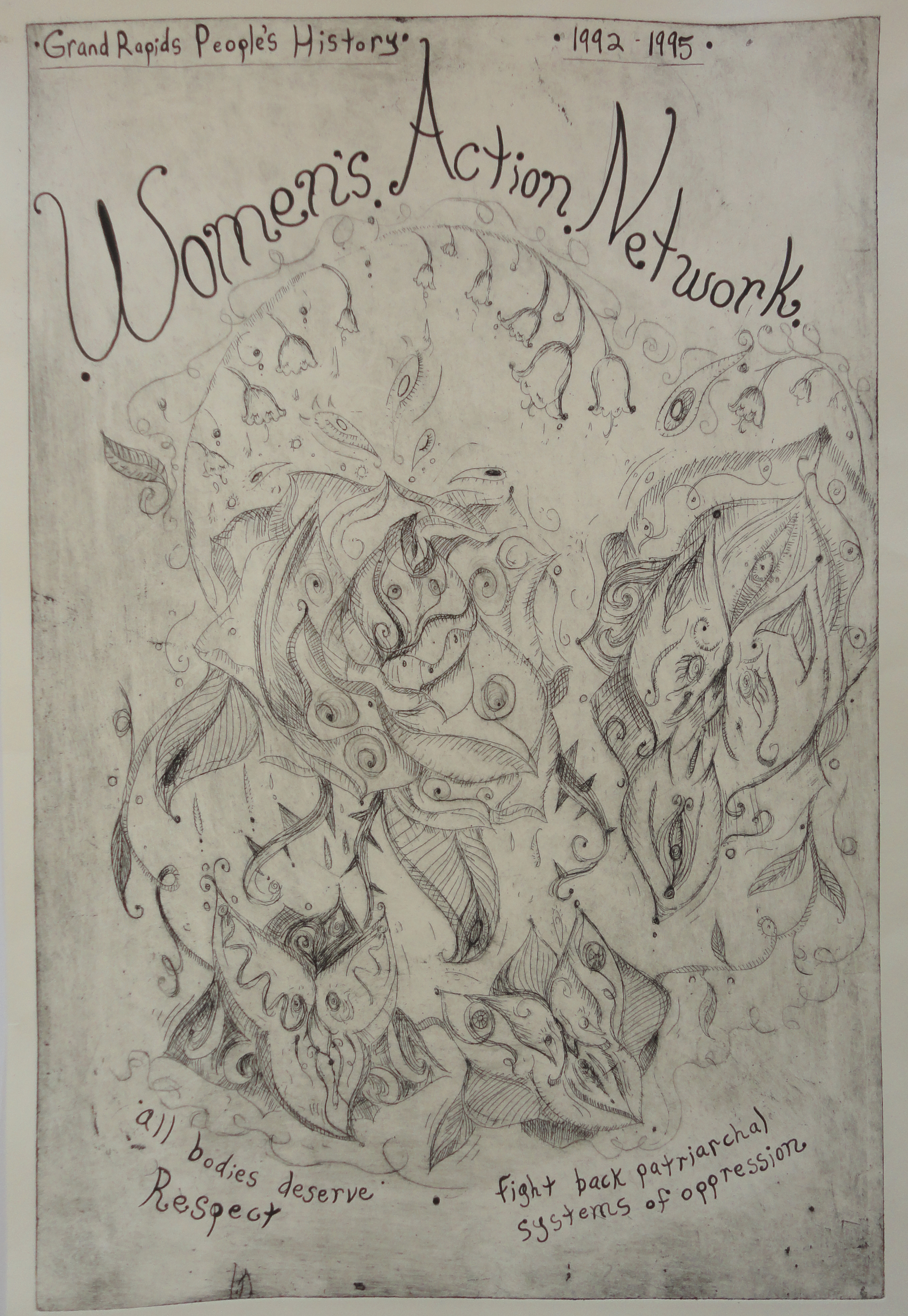
Though WAN survived for only three years, from 1992 – 1995, they accomplished an amazing amount of work in that brief time and inspired many in Grand Rapids to find and define their voices to fight back against patriarchal systems of oppression.
 Grand Rapids Institute for Information Democracy
Comments are closed.