Women’s History in Grand Rapids: Why resisting the patriarchy matters – Part II
It’s Women’s History month and one good way to celebrate it is to look back at the incredible work that women’s movements have done in Grand Rapids. This is a three part series, focusing on the women’s suffrage movement, the movement for reproductive justice, and the fight against sexual assault and objectification of women. This 3 part series is taken from my book, A People’s History of Grand Rapids.
The Reproductive Justice Movement
In the history of the United States, women and gender non-conforming people have rarely had bodily autonomy. Not until the early 1980’s did every US state finally overturn the laws that made married wives the property of their husbands.
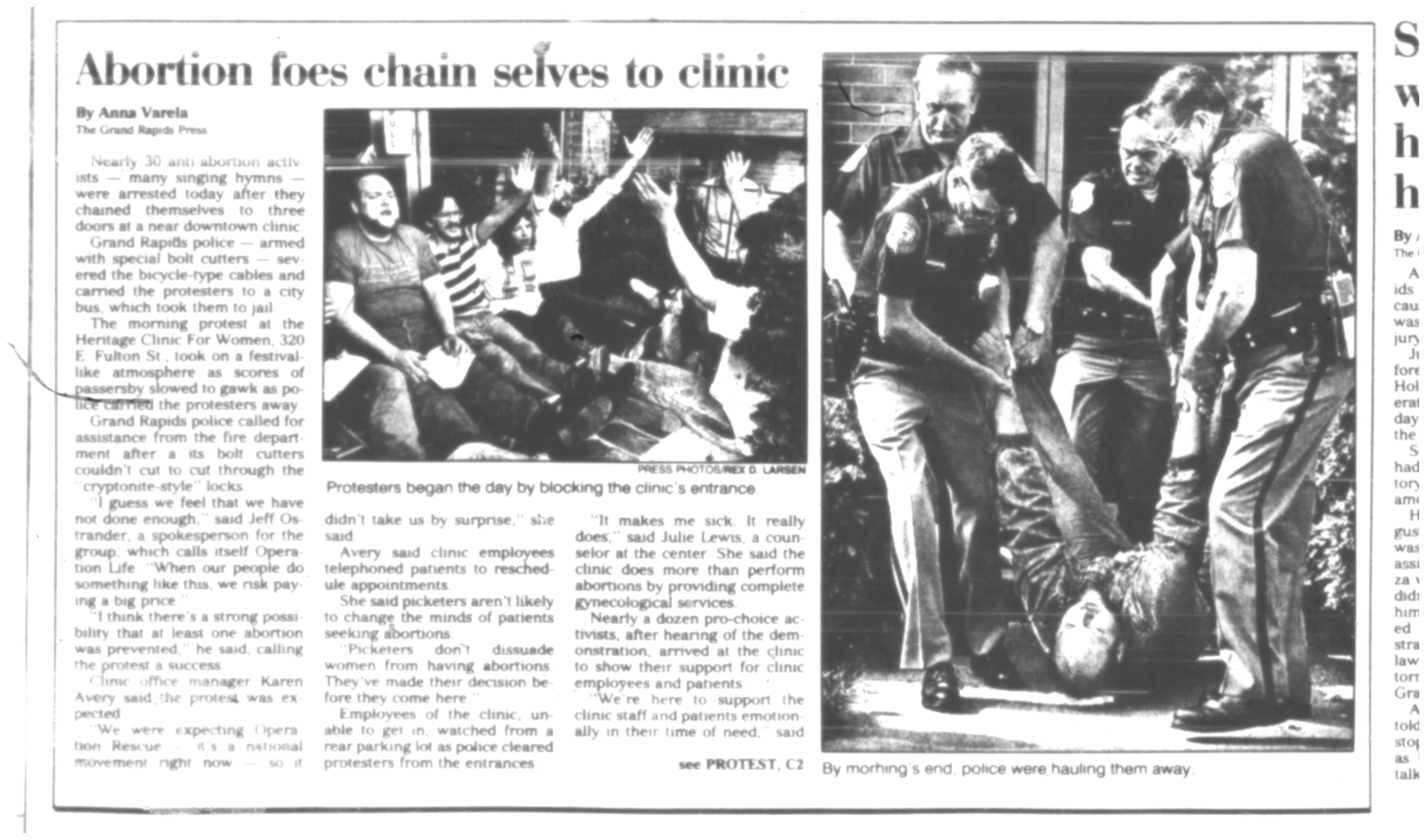
There is one area of bodily autonomy which remains an active struggle: reproductive justice and the right to an abortion. Abortion was legal until 1873, when the federal government outlawed it. Contraceptives were outlawed at the same time, after a contingent of male doctors lobbied intensively for these changes. Like the rest of the US, in Grand Rapids, people did not have the legal right to have an abortion until the 1973 US Supreme Court decision known as Roe V. Wade made it legal.
This doesn’t mean that people were not defying the law and choosing what to do with their own bodies. For decades prior to Roe V. Wade, birthing-age people were seeking out and creating their own networks and resources to practice reproductive justice.
In Grand Rapids, many people are familiar with the Choice Fund at Fountain Street Church (FSC), which provides funds for people seeking abortions and reproductive medical care to help cover costs, transportation, and more. What is less known is that the Choice Fund had begun in the mid-1960s in a very clandestine fashion, long before Roe V. Wade made medical abortion legal.
In a 2021 interview, Dani Vilella, a long-time reproductive justice activist, shared that people working with FSC were going out of state to have abortions. This eventually prompted those who were connected to FSC to create the Choice Fund. In fact, the Choice Fund remained clandestine until the early 1990’s, primarily to avoid the wrath of the anti-abortion movement. The danger was harassment, especially from the religious branch of the anti-abortion movement that dominated West Michigan, which violently targeted clinics that were performing abortions. The money raised by the Choice Fund would go directly to the Heritage Clinic for Women, covering the costs for those who wanted to have an abortion.
Beginning in the late 1980’s, the anti-abortion attacks escalated in Grand Rapids. Operation Rescue, the anti-abortion group led by Randall Terry, came to Grand Rapids on several occasions. Protests and efforts to stop people from choosing to have an abortion were intense and often confrontational.
In response, John Nuerenberg co-founded the group Pro-Choice Advocates of Greater Grand Rapids (PCA), in part because of groups like Operation Rescue protesting at clinics in Grand Rapids. “One of our main purposes was to act as patient protectors against the Operation Rescue folks at the area women’s health clinics.”
Even if Operation Rescue had never come to Grand Rapids, literally hundreds of churches in West Michigan embrace an anti-abortion stance, some evangelical, some Christian Reformed. The Catholic Church is also heavily invested against abortion rights. Many of these churches would include information in their church bulletins about protests and other so-called “pro-life” actions happening in Grand Rapids, Lansing, or in Washington, DC, even sharing a call to action from the pulpit to target reproductive clinics and their patients.
 Additionally, there are thousands of religious people in West Michigan that make regular contributions to Michigan Right to Life. Several members of the West Michigan elite have collectively contributed millions of dollars to anti-abortion groups and other “family values” organization that want to keep cisgender men in a dominant role in society, which means they do not want women and other genders to have bodily autonomy. In Russ Bellant’s book, The Religious Right in Michigan Politics, he cites the DeVos family, Peter Cook, the Prince family, the Van Andel family, and the DeWitt family all as major funders of the anti-abortion movement. Many of these same families continue to make significant financial contributions to anti-abortions groups like Right to Life.
40 Days of Choice and More
The financial and ideological support for an anti-abortion stance contributed to more serious acts of hate and violence against reproductive health patients, clinics, and health educators. Besides physically blockading the entrance of clinics, anti-abortion protestors use graffiti or douse the entrance with butyric acid, which smells like vomit and is difficult to get rid of once it is used.
Many members of the Religious Right in West Michigan have also participated in a campaign they refer to as 40 Days of Life, which started around 2008 and has continued to this day. During the Lent season, religious extremists come to a reproductive health clinic for 40 days in a row to pray, to protest, and to shame patients as they enter and exit.
As a counter, abortion defenders created 40 Days of Choice campaigns and actions over the years, primarily as a means of countering the anti-abortion forces. Defenders would show up to provide support to the patients coming to clinics, as well as acting as volunteer security to intervene if any of the anti-abortion folks attempted to harass, shame, or do bodily harm to those entering the clinic. In a 2012 interview, a 40 Days of Choice participant said that she would often witness anti-abortion protesters spitting on the women who came to the clinic. In addition, the people who owned the building right next door to the clinic were staunchly anti-abortion, so the clinic staff would have to constantly remind people to not park on their property, since they were known to be both verbally and physically abusive towards those who came to show support for the patients who came to the clinic.
With the election of Donald Trump, the overtly bigoted and misogynistic Republican presidential candidate, in 2016, those committed to defending the right to an abortion mobilized to go to Washington, DC to protest the inauguration in early 2017. The blatantly anti-feminist and anti-abortion rhetoric coming from the Trump administration reinvigorated the Reproductive Justice Movement to provide security and accompaniment at local clinics in Grand Rapids. A new wave of young people began showing up and working with the clinic to provide support to their patients, keeping anti-abortion protestors at a distance.
In May of 2020, two anti-abortion protesters were arrested at the Heritage Clinic in Grand Rapids. In an anonymous interview at the time, a clinic employee shared that some involved with the protest were the group Red Rose Rescue.
On the day of their protest, they showed up in a large group, gathering outside of the clinic. When patients exited their vehicles, they would either shout loudly at the patients or would directly approach them. They were verbally aggressive and their voices were elevated (we could hear them screaming from inside the clinic). One particular protestor, a woman named Caroline Davis, was seen and heard screaming to patients, “Repent your sins”, “You’re going to regret this every day”, and more. Many members of the group entered the building in the stairwell in an attempt to gain access to inside the clinic, but due to the safety and privacy measures we always have in place, in addition to the diligence of precautionary measures our staff took, they were not successful with entering. Patients came into the clinic visibly shook up and unhappy. Patients disclosed to us that protestors had approached their cars and physically banged on their car windows. One protestor held open the door to the clinic for a patient and told her to “have a nice day” (in a way that felt insincere and manipulative to the patient). Another patient came to her appointment in a vehicle with a business logo on the side, and a protestor called that business to inform them of where they were, violating their privacy.
Towards the end of the interview, the clinic employee shared some of the most important aspects of reproductive rights:
Many times, people hear ‘reproductive justice’ and think that it is solely a pro-choice vs. anti-choice issue. It is so much more than that, though. It is ensuring that people who want to have and raise children have the adequate means to do so, and should be able to build a family on their own terms.They should be financially prepared with a living wage, paid family leave, and unbiased employers. We need social structures that allow for anyone regardless of background to receive proper pregnancy and childbirth care. There should be easy access to free or affordable contraceptives, STD/STI/HIV testing, and safe sexual health measures, such as condoms or other birth control, PrEP medication, etc. Equal access to abortion care, regardless of reason. Comprehensive sex education in public and private schools. Freedom from sexual and domestic violence. Supporting LGBTQ parents, teen parents, birth parents, and adoptive parents. Other issues that are often overlooked or not considered to be – but are 100% interrelated with reproductive justice – include food security and access to clean water; unwavering support of gender and sexual identity/presentation; immigration justice; environmental justice; disability justice; indigenous rights; and more. We must build and sustain safe communities for EVERYONE.
 Grand Rapids Institute for Information Democracy
Comments are closed.