Women’s History in Grand Rapids: Why resisting the patriarchy matters – Part I
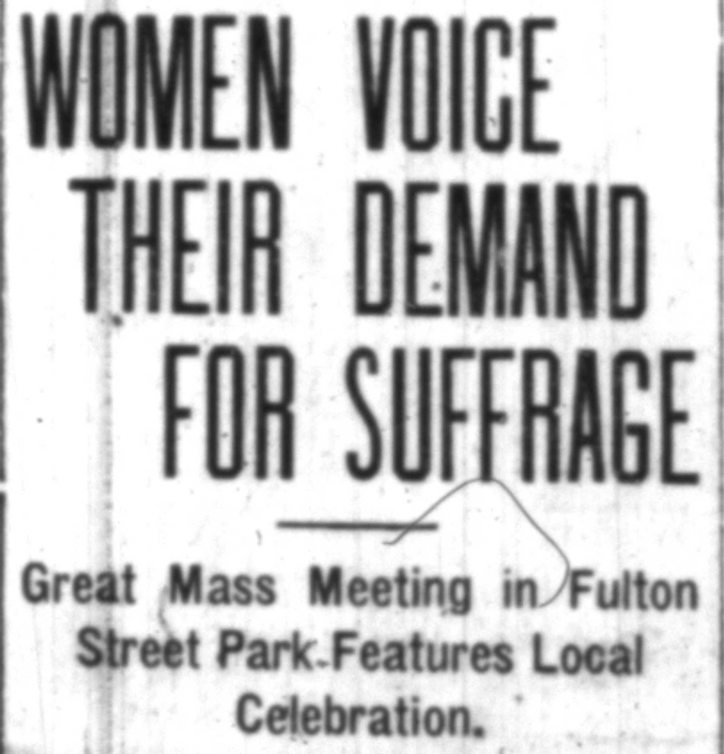 It’s Women’s History month and one good way to celebrate it is to look back at the incredible work that women’s movements have done in Grand Rapids. This is a three part series, focusing on the women’s suffrage movement, the movement for reproductive justice, and the fight against sexual assault and objectification of women. This 3 part series is taken from my book, A People’s History of Grand Rapids.
Just two years before Grand Rapids officially became a city, a large gathering of women held in Seneca Falls, New York. Some historians identify this, the 1848 Women’s Convention, as the beginning of the Women’s Suffrage Movement in the US, though it largely excluded Black women. But 19th century abolitionist and feminist Lucretia Mott suggested that the first women’s conference was actually 11 years before, the Anti-Slavery Convention of American Women of 1837 in New York City.
The National Scene: Fighting Patriarchy while Upholding White Supremacy
21st century feminist historian and author Helen LaKelly Hunt agrees with Mott that the 1837 Anti-Slavery Convention was the real origin of the modern Women’s Rights Movement, since the early suffragists who attended were as equally committed to the end of chattel slavery, which would liberate Black women and families, as they were to white women’s liberation.
However, by 1866, in a meeting where Black freedom fighter Frederick Douglass and white feminist Susan B. Anthony argued about whether to prioritize suffrage for Black men or suffrage for white women, Anthony said, “I will cut off this right arm of mine before I will ever work or demand the ballot for the Negro and not the woman.”
Sojourner Truth gave her famous speech in 1866 in Akron, Ohio, where it’s reported she said, “I feel I have the right to have just as much as a man.” (The speech that became widely known during the Civil War by the title “Ain’t I a Woman?” was in fact a variation of the original speech. It was re-written by a white woman that portrayed Truth speaking in a stereotypical Southern dialect, though Sojourner Truth was from New York and grew up speaking Dutch as her first language.) Through the late 19th century, Black feminists Frances Harper and Anna Julia Cooper continued to fight for Black women to be included in the women’s movement. And in the 1913 suffrage parade in Washington DC, Black organizer Ida B. Wells-Barnett defied the racial segregation imposed by white feminists. Instead of walking at the back of the procession as instructed, Wells-Barnett declined to participate at all, only to jump from the crowd during the march to join her state’s white delegation, taking and holding her place between two white women.
While the national suffragist movement struggled with white supremacy, the fight in Grand Rapids, just as white in nature if not more so, had its additional challenges.
The Women’s Suffrage Movement in Grand Rapids
In 1874, there was a campaign by the Michigan State Woman Suffrage Association (MSWSA) to adopt a referendum in the Michigan legislature to allow women the right to vote. The Grand Rapids Women’s Suffrage Association (GRWSA) was founded the same year. Although some women played a role on the leadership team, the president of GRWSA was Judge Solomon L. Whitney, a white man.
A few months after their founding, the Grand Rapids Women’s Suffrage Association invited writer and women’s rights activist Elizabeth Cady Stanton, who spoke to an audience of 1,000 people at the Pearl Street Universalist Church.
To build the movement to win women’s voting rights in Michigan, local communities and suffrage associations needed to increase their numbers. In 1880, Grand Rapids held its first Suffrage Convention, with delegates attending from across the state. Efforts like these paid off, for the state legislature granted some women the right to vote in local school board elections the very next year. Yet these rights did not yet extend to communities with larger school districts, like Grand Rapids. There, women could not vote in school elections until 1885, a big year in that more women won the right to, not only vote for school boards, but to run as candidates themselves.
The heralded 20th century arrived, yet women had still not won the right to vote in all elections. However, through persistent and continued organization, the fight against the male-dominated political landscape raged on. In 1908, at the state constitutional convention, women won the right to vote on bond measures and local taxation proposals.
In 1909, there was a major push to put women’s suffrage on the national stage, with Michigan Suffrage organizers vowing to collect 100,000 signatures from state residents. Though they did not get the 100,000 signatures they had hoped, the Michigan suffragists did secure 30,000 such designations and sent delegates to Washington, DC to participate in a parade. The march ended with a half a million signatures being presented to the US Congress.
Solidarity Tactics
 In January of 1911, another attempt to win the right for women to vote was defeated in Michigan. A few months later, the Grand Rapids Furniture Strike began, with thousands of workers, mostly male, demanding better wages, better working conditions, and the right to organize.
Amid the furniture strike, perhaps in a spirit of solidarity, the Grand Rapids suffragists invited a women’s rights activist from England, Sylvia Pankhurst, who was in the US on a speaking tour. In her time in the US, Pankhurst visited with incarcerated strikers in Chicago as well as laborers in factories and workhouses, and she also witnessed the criminalization of African Americans in the South.
Pankhurst and many English suffragists did not limit themselves to so-called acceptable channels to make change. As the Grand Rapids news coverage of Pankhurst’s lecture reported, she spoke about how she and her fellow activists used direct action to force the British Parliament to face the issue of women’s suffrage. Tactics such as smashing windows at the British Parliament, fasting and hunger strikes, hounding liberals in Parliament to take a stance on suffrage, marches in the streets, and targeted arson: all were used by English suffragists to force the issue. The British suffrage movement won the right to vote in 1918, two years prior to their US counterparts. (Diane Atkinson vividly documents the tactics and strategies used by the British suffrage movement in her powerful book, Rise Up Women!)
Though the Grand Rapids-based Suffrage Movement didn’t seem to embrace the more direct-action approach, they did decide to build allies in the fight. The 1911 Grand Rapids Labor Day parade, on the heels of the furniture workers strike, involved 10,000 participants, with thousands more as spectators. Grand Rapids suffragists took notice and decided to participate in the 1912 Labor Day march.
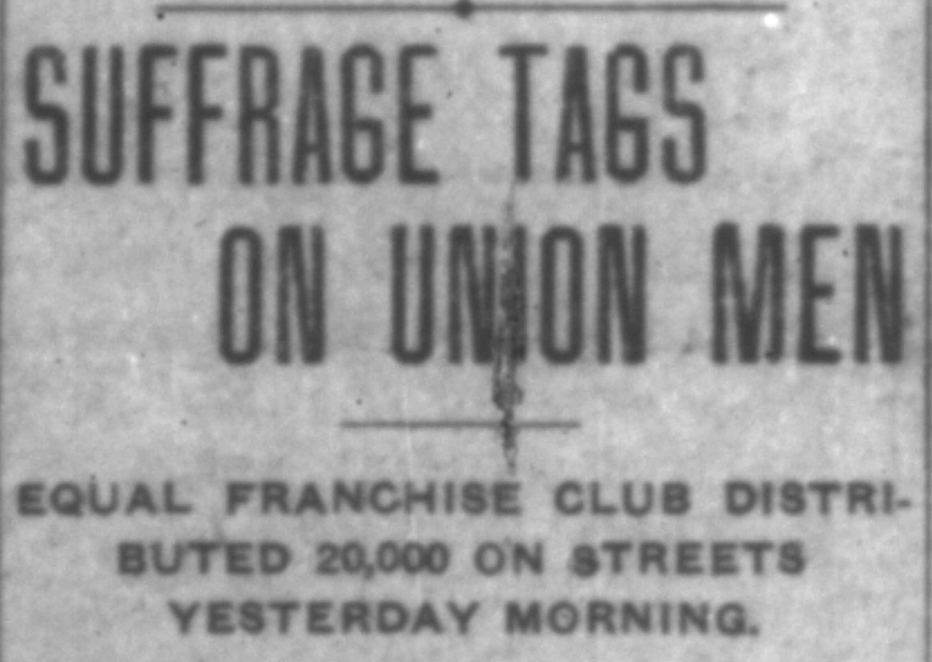
The Equal Franchise Club had a fully decorated float in the 1912 Labor Day parade, sporting a side banner that advocated fair wages for workers: “A Square Deal.” In addition, about 40 suffragists handed out 20,000 tags to those in attendance: “Votes for Women” on one side while the banner message for fair wages occupied the second side. The Grand Rapids Herald reported, “The suffragists met with a most encouraging reception from the men.”
As the Grand Rapids suffrage movement grew in numbers, not everyone welcomed the idea that women should vote. The City Attorney and other Grand Rapids officials publicly opposed women’s suffrage, as did large sectors of men in the Grand Rapids Christian Reformed Church. In November of 1912, there was a local ballot initiative to allow women to vote in city elections, but influenced by these conservative factors, more men voted against than for.
In 1913, the active and growing suffrage movement felt a blow at the state level: the Michigan Equal Suffrage Amendment lost by less than a thousand votes. Suffragists were outraged that the vote was “stolen” from them during the referendum, according to an article in the Jackson Citizen Patriot on December 19, 1912. Following the election was a major push for vote verification, which resulted in numerous counties, including Kent County, marking a further reduction of votes for women’s suffrage.
When the US entered World War I in 1917, many women’s suffrage groups, including those in West Michigan, decided to support the war effort and take an active part, particularly to encourage people to buy war bonds. The Equal Franchise Club even sent a telegram to President Wilson asking him to grant women’s suffrage as a war measure. “To a large number of thinking women in America the granting of the franchise to women by federal amendment would be a pledge of sincerity and integrity in our great war for democracy.”
Yet some women’s suffrage groups that did not jump to aid in the US entry to WWI. The National Women’s Party came out against the war, which was met by a strong denunciation from the Grand Rapids Equal Franchise Club. The Club wrote in response to the NWP’s anti-war stance, “It is unfortunate that so much publicity is given to the tactics of the woman’s party, comprising only 5 percent of the suffragists of this country, while 95 percent of the suffragists are active in war work.”
As WWI was winding down, the fight for women’s suffrage again took center stage, with a new vote in Grand Rapids in November of 1918. This time, voters for women’s suffrage won the majority vote for city elections. At the national level, the 19th Amendment was finally ratified in 1920.
Yet the ratification of the 19th Amendment did not mean all women could vote: only white women. Along the way, the national women’s suffrage movement lost their original 1837 commitment to racial equality, replaced by an allegiance to white supremacy. The movement lost the ability to say that their work benefitted all women. This has always been a major criticism of the women’s suffrage movement in the US, which created long-standing tensions between white women and women of color who did not trust that white women would have their back in all gender justice fights.
 Grand Rapids Institute for Information Democracy
Comments are closed.