7 developments projects in downtown GR totaling $223 Million will primarily benefit the professional class and businesses that profit from tourism
Once again we see Grand Rapids continuing this path of development in the downtown area, projects that will attract tourists and talent, all at the expense of the thousands in this city that are struggling to survive.
In the March Downtown Development Authority (DDA) agenda packet, on page 28, there is a list of 7 projects, with the expected costs and a map of their location, shown here.
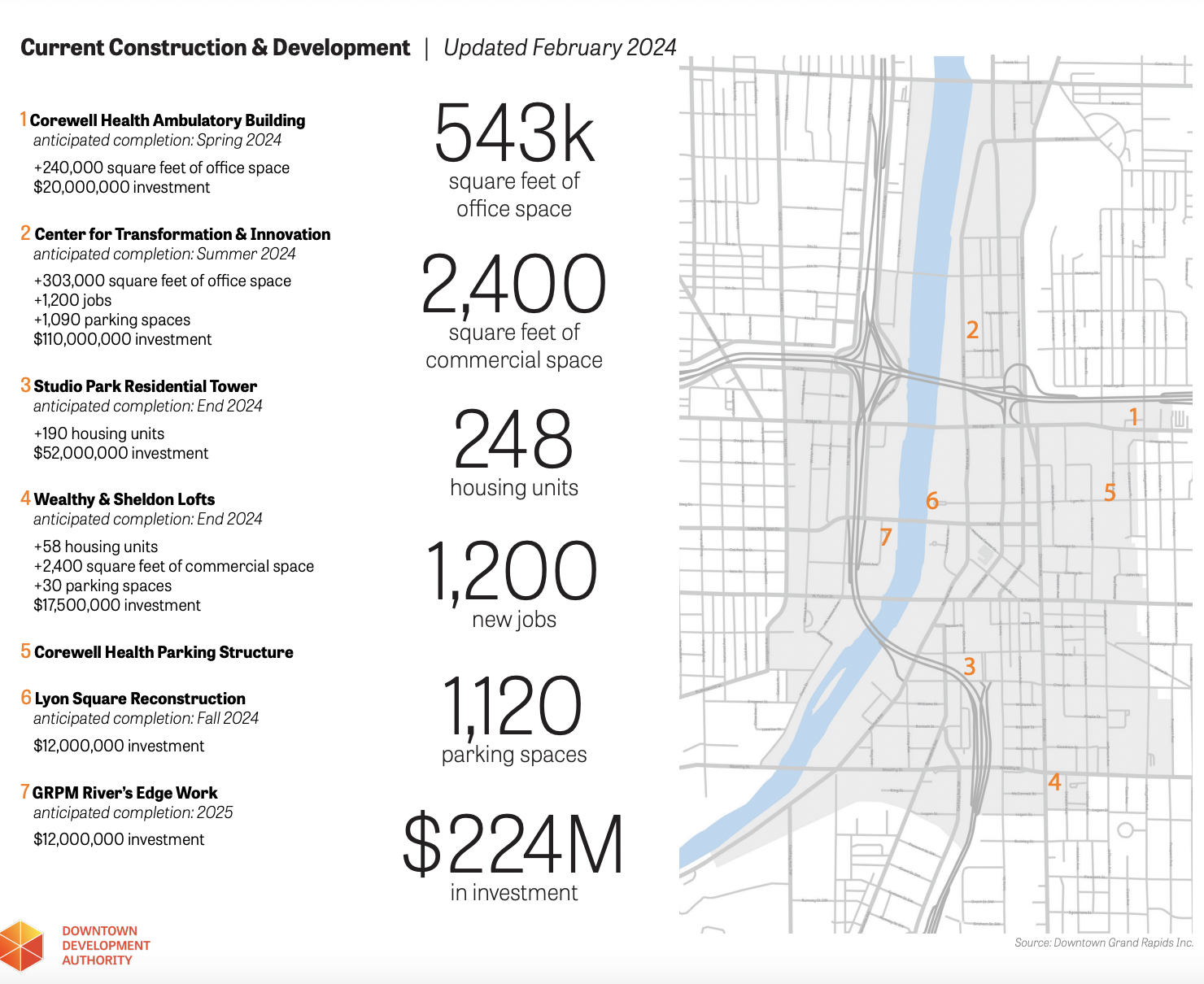
The cost for each of the projects are:
- Corewell Health Ambulatory Building – $20,000,000 investment
- Center for Transformation & Innovation – $110,000,000 investment
- Studio Park Residential Tower – $52,000,000 investment
- Wealthy & Sheldon Lofts – $17,500,000 investment
- Corewell Health Parking Structure
- Lyon Square Reconstruction – $12,000,000 investment
- GRPM River’s Edge Work – $12,000,000 investment
Total investment – $223,500,000
The Corewell Health Parking Structure is on hold – as best I can tell – which is why there is no estimated cost next to that project.
The Corewell Health Ambulatory Building is a project that will put lots of money in the coffers of Rockford Construction, which GRIID has been monitoring for the past decade, particularly their involvement in the DeVos/AmplifyGR project.
The Center for Transformation & Innovation is another Corewell project that continues to perpetuate the Medical Industrial Complex.
According to an article on MLive, the Studio Park Residential Tower will likely have, “44 studio apartments, 99 one-bedroom units and 22 two-bedroom units. Previous estimates provided to the city of Grand Rapids indicated a studio would go for $1,594, while a one-bedroom would go for $2,028. A two-bedroom unit would cost $2,870. The 24 condos in this project would start at $595,000 and up for each.
The Wealthy & Sheldon Lofts, which are on the corner of Wealthy and Division, will have 58 apartments, with retail space on the ground floor. The studio apartments would go for $1,175 a month, the one-bedroom for $1,531, and the two-bedroom for $2,817, according to another MLive article.
GRIID has previously written about the Lyon Square Reconstruction project, which is also being managed by Rockford Construction, a project that will create a pocket park along the Grand River between the Amway Grand Plaza and DeVos Place.
Lastly, the Grand Rapids Public Museum’s River’s Edge Work project will upgrade the riverfront portion of the Public Museum, along with improvements to the trails that connect the downtown GVSU campus, the Gerald R. Ford Museum, and Ah-Nab-Awen Park.
The $23,500,000 price tag for these project will see more than 50% of the funding come from the pubic sector, specifically through the State and City use of tax dollars, even though the public has had no real say in such projects, despite the claims of community engagement.
In addition, all of these projects will fulfill the goals of Grand Rapids City officials and the Grand Rapids Power Structure, which are to attract more professional talent to the area, along with making the downtown more attractive to tourists when they attend an event at the Convention Center, the arena, for ArtPrize, or the soon to be developed outdoor Amphitheater and the Soccer Stadium.
It’s never a question of money, but priorities
One thing that GRIID has been pointing out over the last decade has been the inherent contradiction with the City’s willingness to support and subsidize development projects at the expense of neighborhoods, particularly low income neighborhoods where a disproportionate number of BIPOC people live. On top of that GRIID has also been shouting out the fact that the City and the Business Class can always find and use public money for these sorts of projects, while claiming there just isn’t enough funding for truly affordable housing, mass transit, combating food insecurity or for people to make a living wage (which is $25 p/h at the low end).
As always it is important to talk about what $223,500,000 could be used for, particularly to benefit the thousands of families that are struggling to survive in this city. For example, if we could imagine providing families with say a home that was valued at $150,000, which is not a lot these days, but could provide some housing security, how many homes at $150,000 could be bought and paid for from $223,500,000. The answer would be 1,490 family homes. Given the current housing crisis in Grand Rapids, wouldn’t providing paid for homes to nearly 1500 families be preferable? Besides, the Capitalists in this city can certainly afford to pay out of pocket for all these projects without using one cent of public money.
 Grand Rapids Institute for Information Democracy
Comments are closed.