Demanding an immediate ceasefire and an end to US funding of Israeli genocide is the short term goal, organizing with the BDS campaign should be the long term goal
It is quite understandable that the immediate work we can do in Grand Rapids is to demand a permanent ceasefire in the Israeli assault on Palestine, plus a push to end US military aid to Israel.
However, we should not and cannot be content with making those two outcomes the end goal. In 2005, the Palestinians began their Boycott, Divestment and Sanctions (BDS) campaign, as a means of ending Israeli Apartheid and the Israeli occupation of Palestinian land.
For the entire month of March, the international BDS campaign has designated this month as Israeli Apartheid Week. Yes, I know it’s a month, but they historically have organized doing education and actions for one week to draw attention to Israeli Apartheid. Considering that more than 30,000 Palestinians have been killed since early October, which it the largest amount of Palestinians that Israel has killed in such a short period of time, they BDS campaign expanded Israeli Apartheid week to a month. They also recognize that the level of international solidarity has been incredible. Here is part of what the BDS campaign wrote for Israeli Apartheid Week:
While Palestinians remain steadfast in the face of this genocide and persist with our liberation struggle, we take hope and strength from global solidarity expressed in mass demonstrations from Jakarta to Washington, Cape Town to London, and Rabat to Baghdad; trade union actions to stop arms shipments to Israel in Belgium, Italy, Greece, Turkey and elsewhere; hundreds of creative civil disobedience actions (sit-ins, peaceful occupations, walk-outs, strikes, etc.) worldwide; fast-growing grassroots BDS campaigns and calls for military embargo; strong declarations of solidarity by racial, Indigenous, climate, gender and social justice movements; high-profile statements by prominent artists, writers, academics, international experts in genocide, as well as by progressive Jewish groups, human rights and civil rights organizations; and a million local, grassroots solidarity actions and creative initiatives worldwide.
Now, the BDS campaign consists of three areas that we can all take part in – the Academic Boycott, the Cultural Boycott and the Economic Boycott and Divestment. Divestment is a tactic that Calvin University faculty and staff are using, which we wrote about earlier this week.
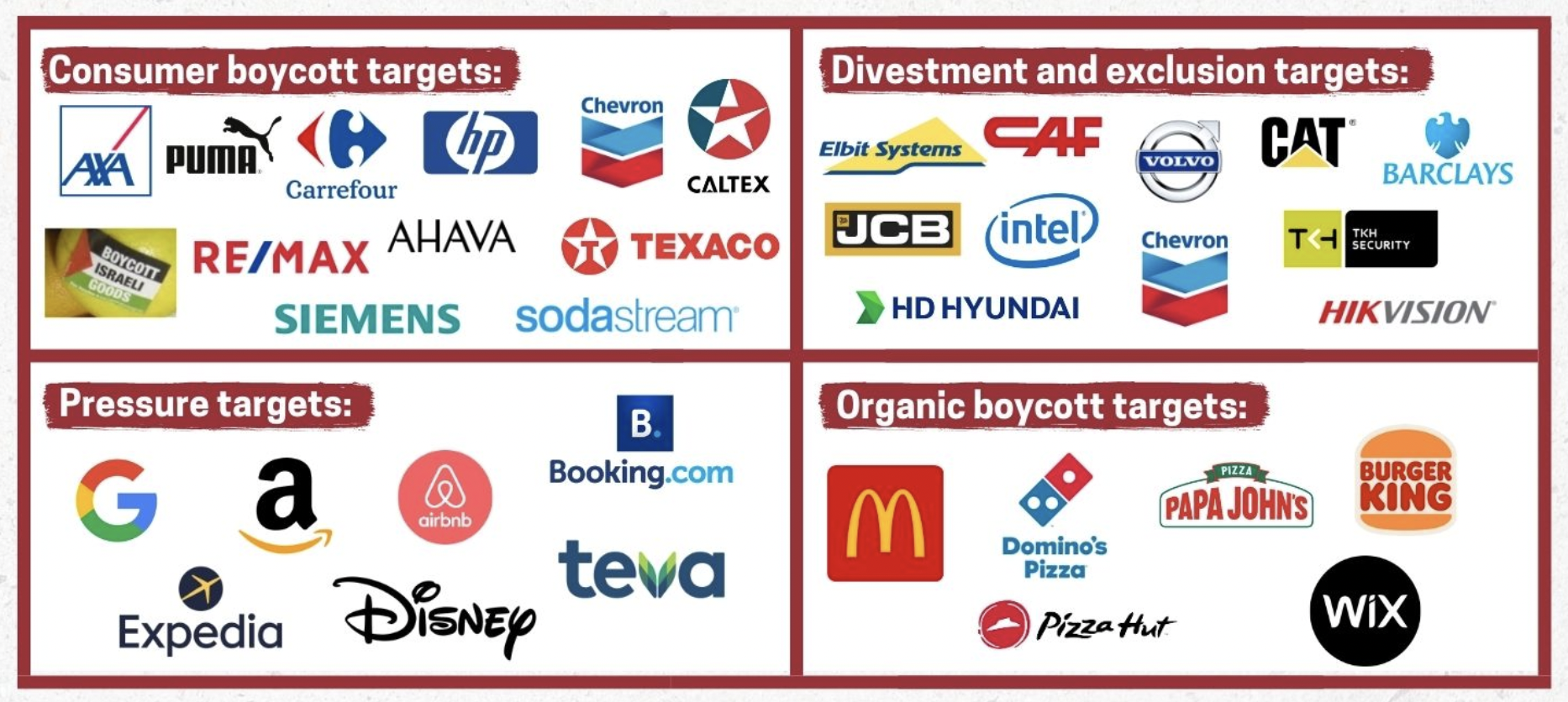
The BDS campaign also focuses on targeted boycotts instead of un-targeted. Un-targeted boycotts are usually longer list of companies to boycott, as opposed to choosing few targets that can often have a larger impact. The targets that the BDS campaign has focused on are companies like Caterpillar, Hewlett Packard (HP), Chevron, RE/MAX, ect. In the graphic above you can see some of the targeted boycott campaigns, some of which are for institutions to divest from. If you are part of a faith community, a university, a corporation or even a labor union, you could chose to divest from companies that are profiting off of the Israeli occupation and Israeli Apartheid. However, there are other boycotts, such as consumer boycotts or pressure targets that people can organize campaigns against directly, both by not purchasing products, but also by doing larger public awareness campaigns or direct actions against companies complicit in the Israeli occupation and Israeli genocide.
The possibilities are endless and the BDS campaign website has an amazing amount of resources;
- An Intro into BDS.
- Israel’s new far-right government – an analysis.
- Israeli Settler Colonialism and Apartheid
- Regular posts and updates about success stories.
- Creating Apartheid Free Zones
- The importance of a Military Embargo.
It is imperative that we support the BDS campaign because it is a Palestinian movement, but also because this work addresses the long term and root causes of Israel’s occupation and Apartheid system of government. STOP GENOCIDE, DISMANTLE APARTHEID!
 Grand Rapids Institute for Information Democracy
Comments are closed.