City of Grand Rapids justifies the trauma inflicted in Honestie Hodges case, while news media fail to provided any analysis of the GRPD’s Youth Interactions policy
Since Sunday, there have been at least three of the four major daily commercial news outlets in Grand Rapids that have reported on the City of Rapids’ attempt to get the lawsuit from the family of Honestie Hodges against the City dismissed.
In 2017, Honestie Hodges was an 11 year old African American whom the GRPD detained and handcuffed at gunpoint, while the police were looking for a crime suspect. Honestie died several years later after she had contracted the COVID virus.

In November of 2023, the family of Honestie Hodges fired a lawyer who filed a lawsuit seeking to sue the Grand Rapids Police Department for the trauma Honestie experienced in 2017. The lawyer who filed the lawsuit was quoted in a November 2023 MLive article as saying:
“After that confrontation by officers, Honestie’s life was marred by extreme emotional and psychological distress significantly diminishing her quality of life and her ability to cope both physically and mentally.”
WXMI 17, WZZM 13 and MLive, all ran stories about the City’s response to the lawsuit over the past few days. The channel 13 story is the shortest (45 seconds), and only provides an overview of what happened in 2017 and the claims made by the lawyer hired by the Hodges family. There were no comments from the City of Grand Rapids included.
The WXMI 17 story was more substantive (2 minutes and 43 seconds), which provided an overview of the case, a summary of the lawsuit against the City of Grand Rapids, along with a response from Grand Rapids City attorneys. Here is what the City attorneys had to say:
“No one doubts that Honestie Hodges was frightened by the situation she suddenly found herself in, or that her mother Whitney Hodges was frightened for her daughter and confused by what was happening,” attorneys representing the city of Grand Rapids say. “Nonetheless, under the the totality of the circumstances as pled in the complaint, and as shown by the relevant body-worn camera footage, these defendants are entitled to dismissal as a matter of law.”
The MLive story was also fairly lengthy, with a more detailed account of what happened in 2017, along with comments from the lawyer who filed the lawsuit against the City, and comments from Grand Rapids City attorneys. Both the MLive and the WXMI 17 stories made mention of the GRPD’s Youth Interactions policy, which was developed after the GRPD detained, handcuffed and held Honestie Hodges at gunpoint. However, neither MLive, nor WXMI 17 provide a link to the GRPD’s Youth Interactions policy, plus neither of local news outlets question the legitimacy of the policy.
In 2018, GRIID reported on the so-called Youth Interactions policy of the GRPD, which included a link to the actual policy document. Here is part of what GRIID wrote about the GRPD’s Youth Interactions policy:
The Youth Interactions Policy is rather vague. It also frames the issue primarily around youth who are suspects. This notion that youth are suspects is exactly what people were so upset by in the community, both in the case of the 5 black youth held at gunpoint a year ago and the 11 year old Black girl held at gunpoint and handcuffed last December. In both of these cases, the youth were not suspects, they just happened to either fit the profile of other suspects or they were in the wrong place at the wrong time.
However, most of the 2-page document deals with youth suspects. Under the section General Procedures, there are 5 points made. Only the 5th point talks about what to do if the youth in question is not a suspect and what to do with them. At this point the document includes 3 ways in which Grand Rapids Police Officers are supposed to deal with youth that are no longer determined to be suspects.
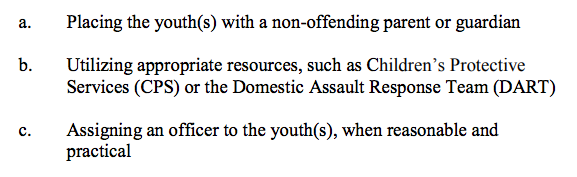
Even these operational procedures, which are to be applied if the youth in question is no longer a suspect, uses language that still views the youth and or the parents as problematic. How many families from communities of color have had difficult and unpleasant experiences with Child Protective Services? If the youth are not suspects, why should an officer be assigned to them?
According to a story on WXMI 17, the cost of the updated training curriculum that is specific to youth interaction, is costing the City of Grand Rapids $9,995.
The Youth Interaction Document doesn’t seem like it will prevent the GRPD from holding youth in Grand Rapids at gunpoint. In fact, the document provides little evidence that the GRPD will be making much of an effort to NOT further traumatize youth, particularly youth of color.
This document was crafted with input from a Task Force, made up of members of the GRPD and community members, listed here at this link from the City. However, despite some public input, the Youth Interaction Policy provides no real guarantees that the police will attempt to minimize any future harm directed at Grand Rapids youth, and more importantly, it does not address more root causes or systemic issues related to why youth would be considered suspects to begin with.
It would seem to me that the news media that apart from reporting on the lawsuit and the City’s desire to have it dismissed, that they should also be reporting on how the Youth Interaction’s policy has been used since 2018, with some analysis. Of course, this would require news agencies and reporters to commit to a more substantial investigation, rather than relying on Media Releases.
 Grand Rapids Institute for Information Democracy
Trackbacks
Comments are closed.