Virtually every politician you know will misrepresent and bastardize the legacy of Dr. King today
Today we honor the legacy of the great civil rights leader, Dr. Martin Luther King Jr. Well, some of us will try to honor this legacy. However, the reality is that most people who have economic and political power will not authentically honor Dr. King. In fact, most of them will misrepresent his legacy to fit their own political agenda or worse, they will bastardize his legacy in the most banal ways.
For example, on Friday, January 12th, Michigan Senator Gary Peters released a video statement ahead of the federally recognized holiday Dr. King, which is today, January 15th. Here is what Sen. Peters says in this video statement:
“As we celebrate the life and legacy of Dr. Martin Luther King, Jr., it’s an important time to honor and reflect on the causes he dedicated his life to. Through his words and in his actions, Dr. King led a movement across America, inspiring us to stand up to injustice and live a life of service to others. Despite every obstacle, he held an enduring love for his country, and he believed in a better future for America. Dr. King’s lessons continue to be just as relevant today. As we live through another period in which basic rights and freedoms are under attack, we must always remember to lead by his example. On this MLK Day, let’s recommit ourselves to his cause by doing what’s right: taking action, serving our communities, and standing up for the rights of all people.”
Like virtually all politicians, Peters uses words like justice, rights, freedoms and service to others. These are warm and fuzzy words, but they are meaningless unless they are attached to actions and context, which Senator Peters fails to address. In fact, the only thing that Senator Peters provides a definitive statement about regarding Dr. King is this, “Despite every obstacle, he held an enduring love for his country, and he believed in a better future for America.”
This is a perfect example of what I mean by the bastardization of Dr. King’s message. Peters makes it seem as if after everything the civil rights leader endured – the persecution, the beatings, the arrests, the constant death threats, government surveillance, jailing and his eventual assassination, that Dr. King was committed to loving the USA. Therefore, what I would like to do is a simple comparison to what Dr. King was all about in words and in actions, then compare that to what Senator Peters is all about in words and actions, by looking at major themes that both men were committed to.
Militarism
Dr. King was fundamentally opposed to militarism and violence. In his famous 1967 speech at Riverside Church, he came out against the US war in Vietnam, stating: “As I have walked among the desperate, rejected, and angry young men, I have told them that Molotov cocktails and rifles would not solve their problems… But they asked, and rightly so, ‘what about Vietnam?’ They asked if our own nation wasn’t using massive doses of violence to solve its problems, to bring about the changes it wanted. Their questions hit home, and I knew that I could never again raise my voice against the violence of the oppressed in the ghettos without having first spoken clearly to the greatest purveyor of violence in the world today: my own government.”
Senator Peters is deeply committed to militarism. He sits on the Senate Armed Forces Committee, has voted for every Department of Defense Budget since he became a Senator, has unconditionally supported the US sending billions to Ukraine since the Russia invasion, and has unconditionally supported the US role in perpetuating the Israeli occupation of Palestine, along with the current genocidal campaign against Gaza and the West Bank. These are just two examples of US militarism that Senator Peters supports, although the list is much longer.
Capitalism
Dr. King’s view of Capitalism evolved during his lifetime, especially after he shifted his emphasis from the South to the North, moving to Chicago. While working on a housing campaign in Chicago, Dr. King stated:
“You can’t talk about solving the economic problem of the Negro without talking about billions of dollars. You can’t talk about ending the slums without first saying profit must be taken out of slums. You’re really tampering and getting on dangerous ground because you are messing with folk then. You are messing with captains of industry. Now this means that we are treading in difficult water, because it really means that we are saying that something is wrong with capitalism.”
In addition, it is important to note that Dr. King always discussed economic priorities and structural poverty. In his Beyond Vietnam Speech, Dr. King stated the following two points:
“A nation that continues year after year to spend more money on military defense than on programs of social uplift is approaching spiritual death.”
“On the one hand we are called to play the good Samaritan on life’s roadside; but that will be only an initial act. One day we must come to see that the whole Jericho road must be transformed so that men and women will not be constantly beaten and robbed as they make their journey on life’s highway. True compassion is more than flinging a coin to a beggar; it is not haphazard and superficial. It comes to see that an edifice which produces beggars needs restructuring.”
Senator Peters is fundamentally committed to defending the system of Capitalism, by supporting the massive tax breaks for the billionaire class, by supporting corporate welfare/subsidies, and by not fighting to pass a livable wage law in the US. Sure, Senator Peters has provided moderate support to some of the more mainstream unions, but that support has been primarily rhetorical and he has no problem accepting campaign contributions from rich people and private corporations that exploit the working class.
Policing in the US
Dr. King was often the subject of arrests, based on the number of marches, sit-ins and other protests he engaged in over the years, from the Montgomery Bus boycotts of the late the 1950s through his support of the Memphis Sanitation workers strike. Dr. King was arrested dozens of time for deliberately violating laws that protected and propped up systems of oppression. During his 1963 March on Washington Speech, King said, “We can never be satisfied as long as the Negro is the victim of the unspeakable horrors of police brutality.” While sitting in a jail in Alabama, Dr. King also made an astute observation about the function of policing, stating, “ It is true that the police have exercised a degree of discipline in handling the demonstrators. In this sense they have conducted themselves rather “nonviolently” in public. But for what purpose? To preserve the evil system of segregation.”
Senator Peters has always been a defender of policing in the US, even after the massive national uprising against policing in the summer of 2020, culminating in the riots after the police murder of George Floyd. In 2021 and 2022, Senator Peters pushed for legislation that would provide more funding to police departments across the country, along with incentives for police recruiting. Senator Peters had the full support of the National Fraternal Order of Police, one of the largest and most notorious police unions in the country.
How to work for change?
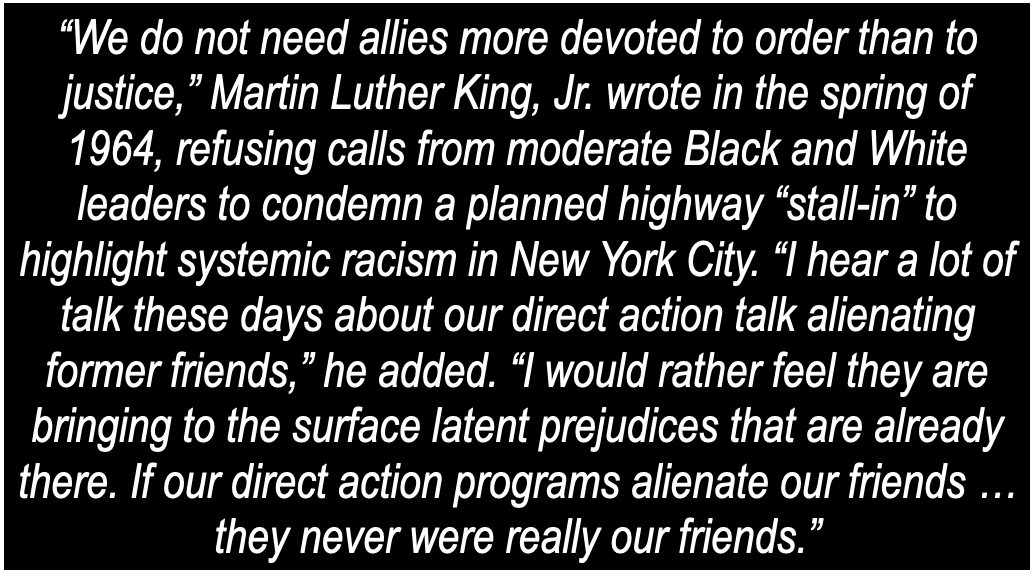
From the Montgomery bus boycotts right up to his assassination, Dr. King put most of his emphasis on how to make change by active participation in social movements. Dr. King historically centered his work within what is often called the Civil Rights Movement or the Black Freedom Struggle, but he also was part of the economic justice and the anti-war movements as well. Dr. King engaged in marches, sit-ins, boycotts, worker strikes, civil disobedience and numerous ways of disrupting business as usual, even shutting down highways.
For Senator Peters, as a politician, primarily has focused on encouraging people to vote and to make campaign contributions.
As you can see, just from the examples I have provided here, there are virtually no similarities between Senator Peters and Dr. Martin Luther King Jr. We should put all politicians to the test and make comparisons to what they say and do, with what Dr. King did and said, especially beyond the I have a Dream rhetoric.
 Grand Rapids Institute for Information Democracy
Trackbacks
Comments are closed.