New Energy bills signed into law by Gov. Whitmer receives criticism from Environmental Justice Group
 “This package of bills is a vital step toward building a clean energy future here in Michigan that creates jobs and grows our economy,” said Chair of the Michigan Democratic Party Lavora Barnes. “While Republicans sit back and do nothing to address the climate crisis, Democrats are proving they will not leave Michiganders behind. We are thankful to our Democratic leaders who continue to make Michigan an example for the rest of the country when it comes to innovation and industry.”
This celebratory statement has been consistent with much of the coverage on the recent set on energy bills that Michigan State Legislators voted on, and Gov. Whitmer signed into law last week. The Detroit Free Press reported:
“By 2040, 100% of Michigan’s energy is set to come from clean sources under a new law approved by Gov. Gretchen Whitmer on Tuesday. The state now has one of the most ambitious clean energy goals in the U.S., after Whitmer approved heavily debated bills that passed both chambers of the Legislature along party lines.”
However, not everyone was so quick to celebrate the new energy legislation in Michigan. No, I’m not talking about the Republicans, who still think that Climate Change is a hoax. I’m talking about groups like the Union of Concerned Scientists and the Michigan Environmental Justice Coalition.
In a post from last week, the Union of Concerned Scientists (UCS) made it clear that there were several things not included in the energy bills that were just signed into law by Gov. Whitmer:
Specifically, it weakened or completely eliminated environmental justice communities’ key priorities regarding affordability, reliability, and equity. Going forward, Michigan policymakers must incorporate these policies, which will mean standing up to utilities and other corporate interests.
The UCS critique also stated:
Additionally, SB 271 requires utilities to achieve a “clean energy” portfolio of at least 80 percent in 2035 and 100 percent in 2040. However, the bill’s definition of what constitutes clean energy includes nuclear power (which doesn’t emit carbon but isn’t “clean”) and fossil gas power plants that capture and store at least 90 percent of their carbon emissions. The Michigan Public Service Commission (MPSC) will ultimately determine whether such gas plant projects—if proposed—are technically and economically justifiable. Even so, it is concerning that legislators included fossil gas in the definition of clean energy given the risk of continuing our reliance on fossil fuels and the impact of emissions from gas production, transportation, and combustion. Giving the MPSC the final decision on what counts as clean energy may force environmental justice advocates to take up the fight once again to protect their communities.
Notably, SB 271 encourages the growth of energy storage in Michigan by setting a statewide target of 2,500 megawatts of capacity. It also encourages distributed generation, such as rooftop solar, by raising the cap when utilities can deny customers the ability to connect their systems to the grid from 1 to 10 percent of the utility’s average annual load. This is a welcome improvement, but it was a result of compromise and negotiation with utilities—and it does not go far enough. There should be no limit on customers who want to install solar, and they should be better compensated for the value locally owned solar provides to the grid. Regrettably, community solar was left out of SB 271 entirely.
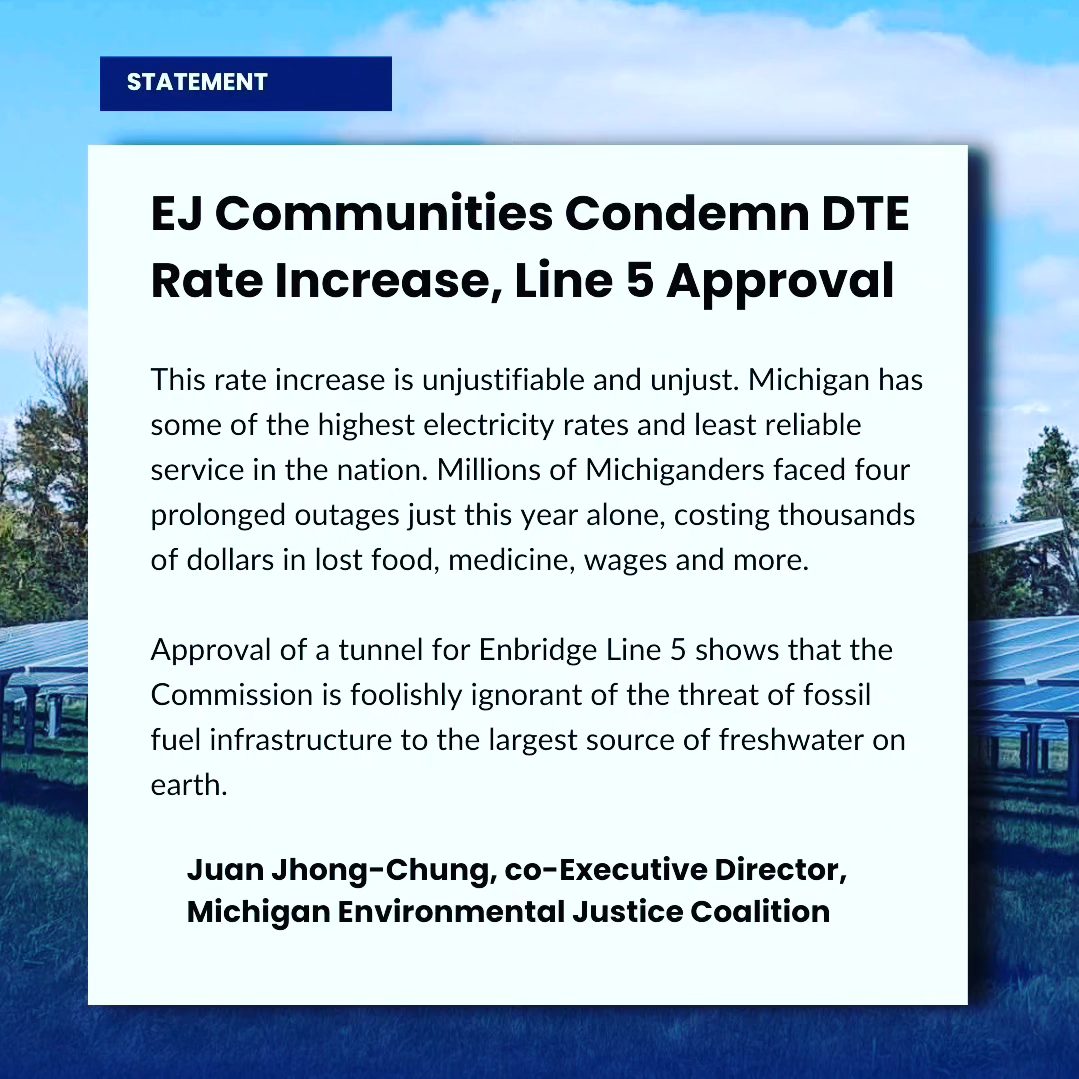
The Michigan Environmental Justice Coalition was equally as critical of the new energy bills signed into law by Gov. Whitmer last week. The coalition released a statement with the heading, EJ Communities Condemn DTE Rate Increase, Line 5 Approval. Their statement reads:
This rate increase is unjustifiable and unjust. Michigan has some of the highest electricity rates and least reliable service in the nation. Millions of Michiganders faced four prolonged outages just this year alone, costing thousands of dollars in lost food, medicine, wages and more.
Approval of a tunnel for Enbridge Line 5 shows that the Commission is foolishly ignorant of the threat of fossil fuel infrastructure to the largest source of freshwater on earth.
The DTE rate increase is particularly infuriating, so much so that the Michigan Environmental Justice Coalition created an Action Alert specifically to condemn DTE, stating in part:
DTE Energy is leaving us in the dark, when we need energy the most. They rely on dirty energy sources that harm our environment, polluting the communities they think can’t fight back while leaving everyone with unreliable and expensive service when we need to heat our homes, cook, and gather with friends.
And, they spend millions of dollars to keep it this way. on political influence to maximize their profit, hiking our rates and leaving us with no other options, paying off some politicians through campaign contributions, secretive “dark money” groups, and an army of lobbyists. All while rigging the rules to influence elections and various laws or regulations, and funding the phony think tanks that fudge data that supports their bottom line.
To sign onto the Coalition’s Action Alert targeting DTE, go to this link.
 Grand Rapids Institute for Information Democracy
Comments are closed.